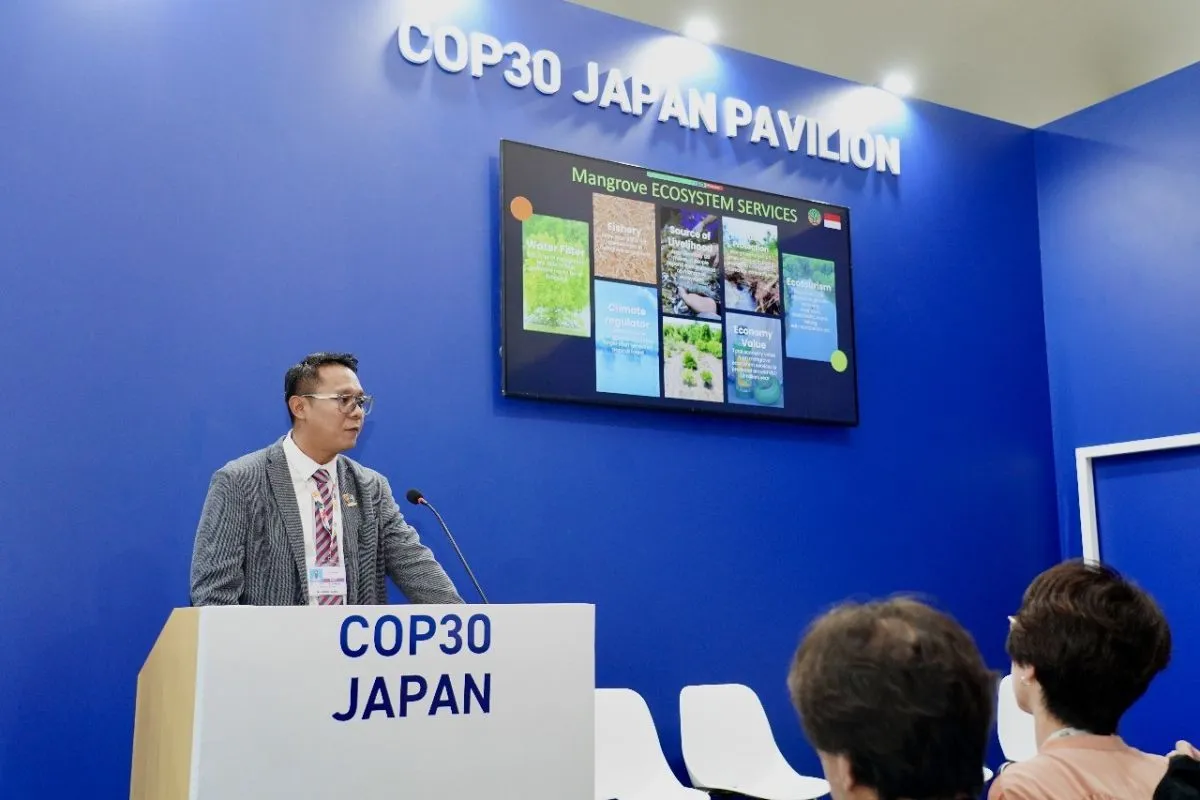
Director of Mangrove Rehabilitation at the ministry, Ristianto Pribadi, in a statement here on Sunday, described the program as a leading example of Nature-Based Solutions that prioritize long-term investment in mangrove ecosystems.
With 3.44 million hectares of mangrove forests, representing 23 percent of the world’s total, Indonesia carries both ecological responsibility and potential to position mangrove restoration at the forefront of climate mitigation and adaptation.
“Mangrove forests have proven to be strategic assets with significant ecological and economic advantages,” he said during a session at the Japan Pavilion at the 30th UN Climate Change Conference (COP30) in Belém, Brazil.
Ecologically, he elaborated, two to five hectares of mangroves can filter pollutants generated by one hectare of fish ponds, while their carbon storage capacity is three to five times higher than that of terrestrial tropical forests.
Mangroves also provide coastal protection at costs lower than hard infrastructure. In addition, they support more than 3,000 fish species, sustaining livelihoods for millions of coastal residents.
“Indonesia’s experience shows that conventional financing systems need refinement to respond to the complexities of large-scale mangrove ecosystem restoration,” he said.
He called for collaboration and innovation, supported by blended funds, climate finance mechanisms, and philanthropic partnerships.
Such mechanisms must allow rapid funding, flexibility, performance-based schemes, and direct community access.
He stated that long-term adaptive funding, efficient multi-stakeholder governance, community economic integration, science-based management, secure land rights, and knowledge-sharing networks form the foundation for program sustainability.
These efforts require synergy among government leadership, international partners, local communities, research institutions, and organizations.
Related news: Indonesia reaffirms peat and mangrove commitment in UNEP talks
Related news: Indonesia, Japan boost cooperation on sustainable mangrove projects
Related news: Police probe illegal clearing of 344 hectares of mangrove in Aceh
Translator: Subagyo, Kenzu
Editor: Azis Kurmala
Copyright © ANTARA 2025


