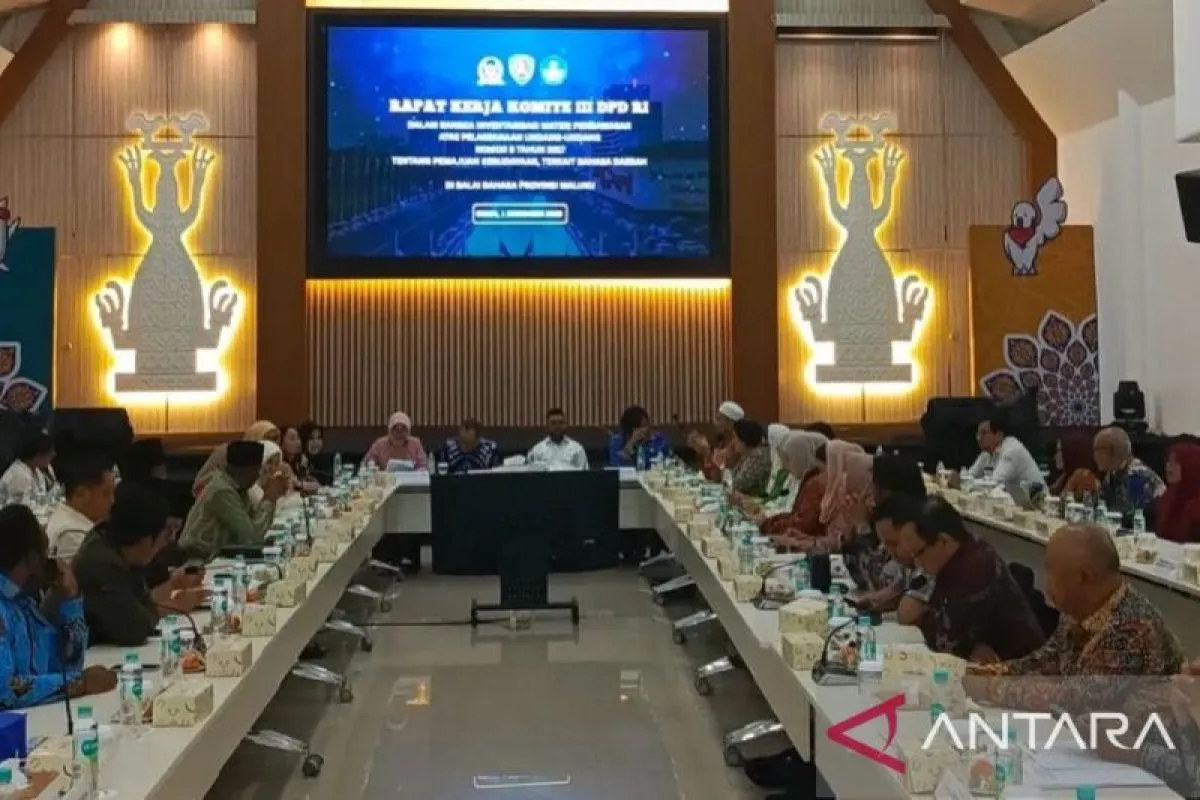
"The step was taken following BBPM's findings that three local languages in Maluku have become extinct and most others are categorized as endangered or critical," said BBPM Head, Kity Karenisa, in Ambon on Monday.
She made the statement during the legislative working meeting regarding the inventory of the implementation of Law Number 5 of 2017 concerning Cultural Advancement.
Through the movement, BBPM strives to develop a generation that is not only fluent in Indonesian and foreign languages, but also deeply rooted in their local languages.
The effort is implemented through various revitalization programs, starting from documenting endangered languages, training teachers and indigenous communities, to developing teaching materials that make it easier for children to relearn the local languages.
In schools, the movement encourages learning that provides space for local languages to reinforce basic literacy, while in families and communities, people are encouraged to return to speaking their local languages as a cultural identity.
Public outreach, workshops, language festivals, and language preservation campaigns are conducted continuously to build collective pride in local languages.
She said that, based on 2024 BBPM data, three of the 71 local languages in Maluku are now extinct: Hoti, Kalely (Kayeli), and Piru.
"If serious action is not taken, Maluku may lose even more local languages," she said.
Although a comprehensive study of language vitality has not been conducted, she said, field indications show that the majority of local languages are endangered or in critical condition.
She explained that a language spoken only by people in their 20s is considered endangered, while one used solely by speakers aged 40 and above is classified as critically endangered, emphasizing that this indicates Maluku's linguistic vitality requires serious attention.
Karenisa also highlighted the phenomenon of language shift occurring in various indigenous communities. While Ambonese Malay is relatively safe, having developed as a lingua franca for centuries of trade, many indigenous languages are weakening to the point of extinction.
Therefore, she said, the initiative aims to develop a generation that is globally capable yet firmly rooted in cultural identity, ensuring that local languages are not only preserved but genuinely brought back into daily use.
Related news: Preserving Papua’s heritage through local language education
Related news: Gov't supports nomination of local scripts as UNESCO's heritage
Related news: School in Papua becomes a stronghold for mother tongue preservation
Translator: Ode Dedy Lion Abdul Azis, Cindy Frishanti Octavia
Editor: Azis Kurmala
Copyright © ANTARA 2025


