Despite the sharply rising casualty count and widespread destruction, President Prabowo Subianto had not declared the disaster a national emergency as of Wednesday.
A national disaster designation would shift responsibility to the central government, unlocking substantial State Budget allocations and allowing expedited coordination across agencies as communities struggle with worsening conditions, ongoing evacuations, and severe shortages of essential supplies.
Scientists and environmental advocates warn the floods were intensified by long-standing ecological damage, including massive land conversion, poorly regulated development, and persistent illegal logging that destabilized watersheds and made low-lying communities vulnerable to extreme rainfall.
Dr. Hatma Suryatmojo, a forest hydrology expert at Gadjah Mada University, describes the flooding as the predictable outcome of accumulated “ecological sins” in crucial upstream regions where decades of mismanagement have eroded natural protections against disaster.
He notes that Aceh alone lost more than 700,000 hectares of forest between 1990 and 2020, a dramatic decline that weakened its watershed systems and increased flood intensity as shrinking canopy cover accelerated runoff during prolonged and concentrated rainfall events.
North Sumatra faces even greater vulnerability, with forest cover dropping to about 29 percent of its 2.1 million hectares by 2020, leaving the province severely exposed to erosion, landslides, and flash floods driven by degraded ecological buffers.
One of North Sumatra’s last major forest refuges, the Batang Toru ecosystem, is now increasingly fragmented by commercial activity, including industrial agriculture, illegal logging, and mining that disrupt ecological continuity and undermine critical watershed functions.
Years of expanding concessions and loosely controlled corporate operations have chipped away at Batang Toru’s integrity, diminishing its capacity to regulate water flow, stabilize soils, and limit downstream flood impacts during severe storms.
West Sumatra retains roughly 54 percent of its 2.3 million hectares as forest, yet its rapid deforestation—reaching 32,000 hectares in 2024—shows how steep mountain terrain loses resilience when tree cover disappears, heightening landslide and flood hazards.
Public alarm
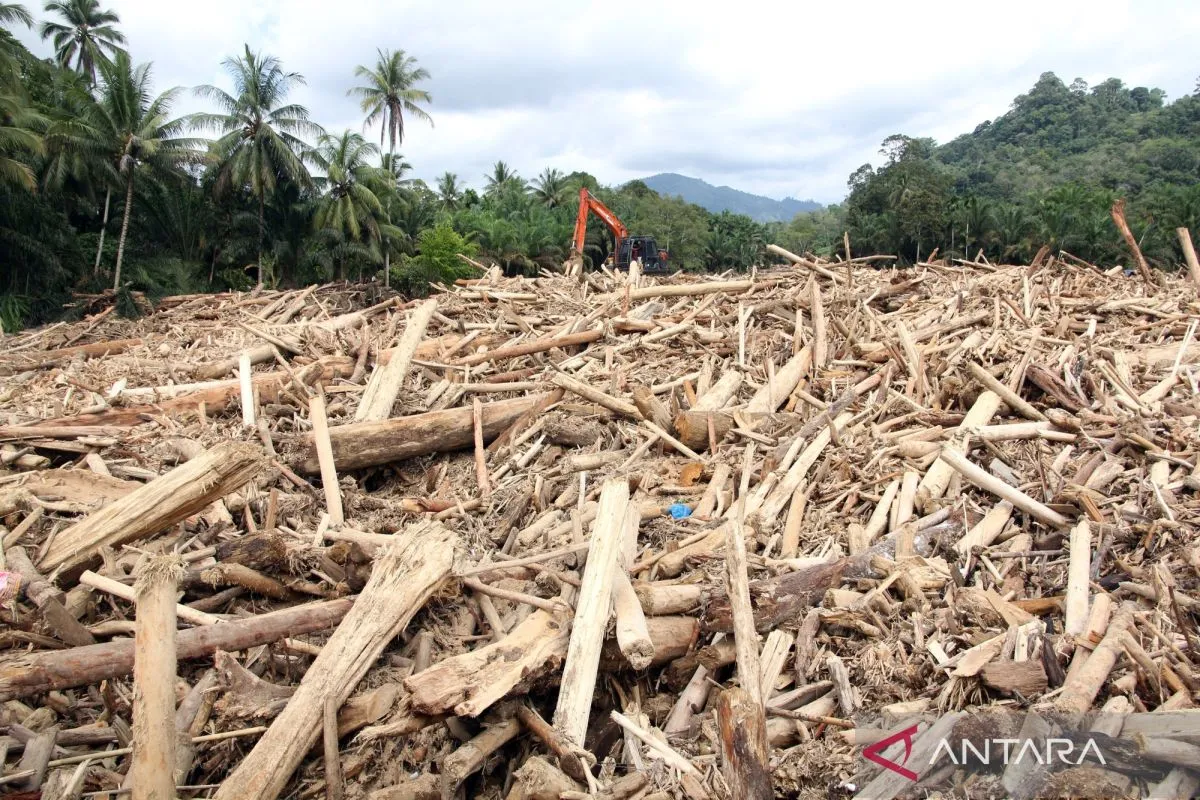
Public alarm intensified after images and videos circulated showing large logs carried by surging floodwaters, fueling suspicions that illegal logging remains widespread and contributed directly to several of the most destructive inundation events across Sumatra.
Environment Minister Hanif Faisol Nurofiq told legislators Wednesday that the government will investigate all possible drivers of the flooding, emphasizing that enforcement of land-use regulations will form a central element of the national response.
He said ministry teams had reviewed environmental documents in the Batang Toru watershed and summoned eight companies operating there, including plantation and mining firms, to examine compliance issues and assess possible roles in landscape degradation.
Nurofiq stressed that the scale of human loss demands strict legal accountability, insisting that no entity will receive exemptions as investigators trace environmental violations that may have intensified the impacts of this year’s deadly floods.
Recommended measures include adjusting regional spatial planning to watershed capacity, tightening permit issuance in sensitive areas, restoring damaged ecosystems, and strengthening climate mitigation and adaptation by integrating them into mandatory regional planning frameworks.
Director General of Law Enforcement Dwi Januanto Nugroho said authorities are tracing every possible source of the timber seen in floodwaters, analyzing evidence to uncover forest crimes that might be hidden behind complex documentation and laundering schemes.
He explained that flood-borne wood can originate from decayed trees, riverbank erosion, legal harvest zones, or illegal logging disguised using falsified or borrowed land-rights permits, noting investigators must distinguish between each potential source.
Several timber-laundering operations surfaced this year, including the June seizure of 86.6 cubic meters of illegal wood in Central Aceh and the August confiscation of 152 logs plus heavy equipment in Solok, West Sumatra.
In October, joint enforcement teams uncovered more than 4,600 cubic meters of problematic timber in the Mentawai Islands and Gresik, while another case in Sipirok, South Tapanuli, involved four trucks carrying logs under frozen permits.
Nugroho said forest crimes now operate through intricate supply chains involving falsified documents and concealed financial flows, prompting investigators to follow not only field activity but also transactional networks that enable illicit timber circulation.
Overhaul forest governance
To curb misuse of land-rights permits, the ministry temporarily suspended the SIPuHH timber documentation system for non-forest areas, closing a loophole often exploited to legitimize wood harvested illegally from protected upstream zones.
Forestry Minister Raja Juli Antoni said recent disasters must become a turning point for Indonesia, emphasizing the need to overhaul forest governance, restore degraded landscapes, and balance economic ambitions with long-term ecological resilience.
He expressed condolences to affected families, urging policymakers to analyze systemic failures that allowed environmental degradation to escalate into widespread human suffering across multiple provinces during prolonged extreme rainfall.
The Indonesian Forum for the Environment, WALHI, argues the floods reveal how natural systems can no longer absorb cumulative damage from mining, plantations, and other extractive industries that reshape watersheds without adequate safeguards.
WALHI Aceh Director Ahmad Shalihin calls the catastrophe an ecological disaster stemming from permissive policies, warning that decades of erosion, mining, and forest clearing have diminished natural defenses and left communities increasingly exposed.
He notes that illegal mining has intensified in upstream areas, where riverbanks are excavated and hillsides cut, muddying rivers and destabilizing soil structure until landslides and severe flooding become inevitable outcomes rather than rare events.
Shalihin said spatial analysis shows about 99 percent of illegal mining sites lie within watersheds, indicating how destructive activities in sensitive upstream zones undermine downstream communities and overwhelm local disaster-mitigation systems.
WALHI urges the government to launch ecological restoration across Aceh and Sumatra, conduct a comprehensive audit of permits linked to upstream degradation, and guarantee meaningful community participation in rebuilding sustainable environmental governance.
Related news: Govt forms task force to trace flood-swept timber origin in Sumatra
Related news: Sumatra floods: Ministry to evaluate forest management, river basins
Editor: Rahmad Nasution
Copyright © ANTARA 2025


