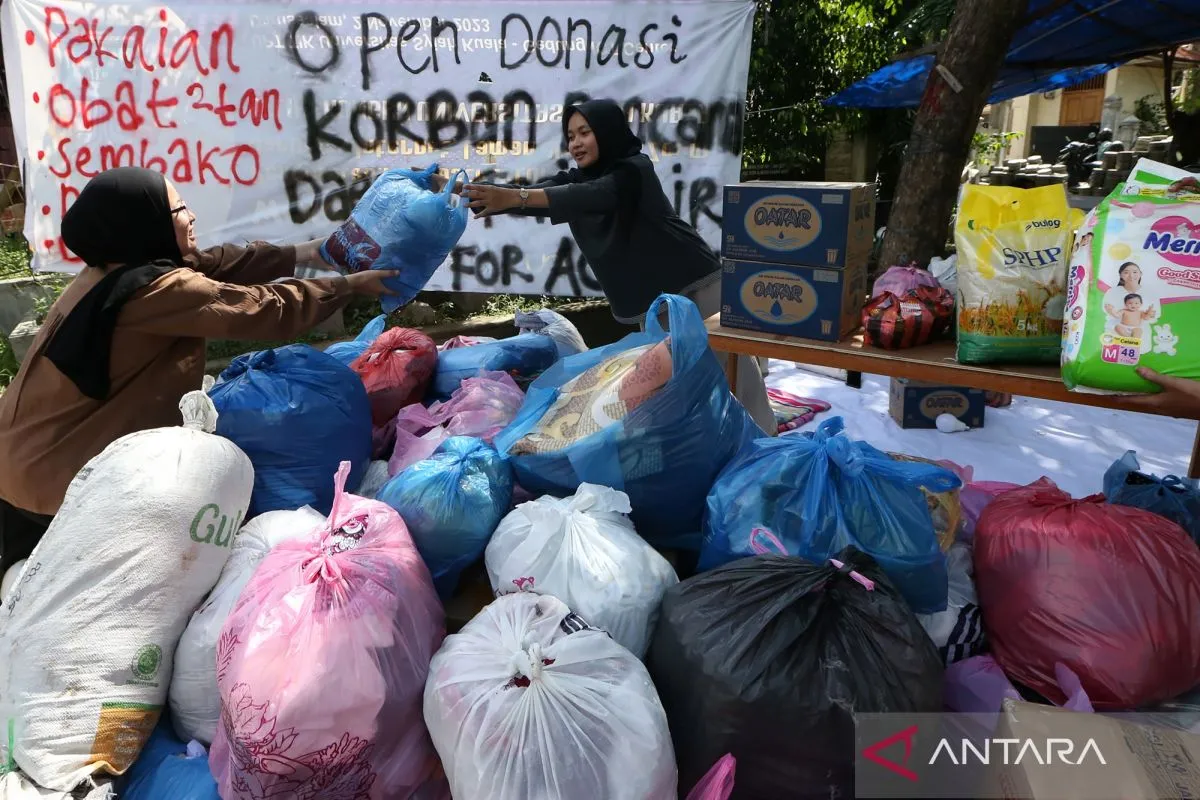
Overflowed rivers dragged mud, rocks, and wooden material, leaving thick sediment in the villages where residents previously carried out their daily activities.
Roads were cut off, bridges were swept away by the flood current, electricity and telecommunications networks were down, while about one million residents had to evacuate, carrying only a small portion of the possessions they managed to save.
Floods indiscriminately inundated residential areas and centers of community activities. Landslides in various locations blocked inter-regional routes, halting the mobility of residents and severely disrupting aid distribution.
Thousands of families were forced to leave their homes; some lost their dwellings, while others remained in locations difficult for vehicles to access.
In such circumstances, educational activities were also disrupted. Many primary and secondary schools in the flood-affected areas were forced to halt classes because the classrooms could not be used.
Universities in the affected provinces faced a similar situation as the devastating disasters made it difficult for students to reach campus. As a result, practical courses were postponed and academic calendars had to be adjusted to accommodate faculty members and students whose families were also impacted.
In several areas, internet and electricity networks were unstable, causing online lectures to be interrupted. This situation placed universities as part of the community that shares the burden of the disasters, signifying that universities are not detached from community problems.
Apart from universities in the disaster areas, several other universities that have students coming from Sumatra also made adjustments. Many students had to accompany their families at home, while some lecturers undertook fieldwork to assist the community in the relief process at the disaster sites.
Impactful Universities
Amid the situation, the Ministry of Higher Education, Science, and Technology has initiated a structured effort to strengthen the role of universities in the emergency response and recovery phase in Sumatra.
The ministry has opened a special community service scheme for disaster response, with funding support of up to Rp500 million (around US$29,986) per proposal, allowing each university to submit up to five proposals.
Budget flexibility of up to 85 percent is provided so that universities can adjust interventions to the constantly changing conditions on the ground.
Minister of Higher Education, Science, and Technology Brian Yuliarto has affirmed that amid an emergency situation such as the one in Sumatra, the presence of academics, researchers, and students on the ground is tangible proof that science, technology, and innovation must work to benefit the community.
The ministry has identified eight main focus areas of urgent post-disaster needs: logistics distribution, health and nutrition services, psychosocial support, sanitation and clean water recovery, emergency education, local economic recovery, strengthening public administration, and mitigation and disaster education.
Universities fundamentally possess the capacity to contribute in these fields. Many of them have study centers, applied laboratories, and volunteer student groups that are actively engaged in social programs. This special scheme makes that capability organized more systematically and supported by adequate funding.
The university networks have moved swiftly in responding to the call. As many as 28 universities serving as command posts and 11 supporting universities have been brought together to prepare joint efforts.
The deployed assessment teams reported various challenges, ranging from roads still blocked by debris, communication networks that have not yet recovered, to limited fuel supplies, which forced logistics distribution to take smaller routes.
The presence of volunteers from universities is vital in the disaster relief period. They possess local networks, small vehicles capable of traversing alternative routes, and the technical ability to assess needs on the ground.
Many universities also have health personnel who can be mobilized to provide mobile medical services, as well as psychology students who can assist with psychosocial support for children in evacuation centers.
The Ministry of Higher Education, Science, and Technology encourages intervention by universities to be coordinated by organizing technical guidance for proposal preparation, speeding up location assessment through digital forms, and opening quick consultation channels between command post universities, regional governments, and technical ministry units.
This ensures that actions taken by universities align with and do not overlap with the operations of other agencies.
The community service program is set to be carried out until December 31, 2025, and focuses on emergency response efforts, starting from distributing logistical aid to providing emergency educational services to the affected children who cannot return to learning at their schools yet.
Meanwhile, the second phase in 2026 will focus on rehabilitation, economic recovery, and technological innovation-based programs to support the communities in carrying out their daily activities.
The initiative has been divided into two phases to ensure that universities can play a role since the critical period up to the recovery period. It also reinforced the "Impactful Universities" concept which places universities as social force that presents in the lives of communities.
Collaboration
The ministry's Director General of Higher Education, Khairul Munadi, affirmed that his ministry continues to coordinate intensively with universities in the affected regions to ensure accurate aid delivery.
The diverse conditions on the ground have also made coordination crucial, especially because volunteers from universities are moving quickly in providing support in almost all areas.
For instance, several universities in Aceh have deployed technical and medical teams to strengthen emergency services, covering everything from assessment processes to health support.
Syiah Kuala University (USK) deployed four surveyors from the Tsunami and Disaster Mitigation Research Center (TDMRC) to Pidie Jaya District, Aceh, along with 15 resident doctors who assisted operations at Meureudu Regional General Hospital (RSUD).
Furthermore, Teuku Umar University (UTU) delivered aid to the sub-districts of Woyla and Pante Ceureumen in West Aceh District, as well as Beutong Ateuh Banggalang in Nagan Raya District, which are currently prioritized as they had not yet fully received adequate support.
In North Sumatra, Muhammadiyah University of North Sumatra (UMSU) took the step of providing emergency scholarships for students who are victims of the disasters in the three provinces.
Even from Central Java, Sebelas Maret University (UNS) Surakarta sent a volunteer team to conduct initial assessments and ensure aid routes, as well as prepare for subsequent shipments based on needs on the ground.
These collaborative efforts have reflected that universities in Indonesia do not only serve as space for learning but also a tangible presence for communities in need.
Related news: Ministry begins recovery for 60 universities hit by Sumatra disasters
Related news: Indonesia blocks local leaders' foreign trips amid disaster response
Related news: Manggala agni deployed for post-flood response in Sumatra
Translator: Sean Filo, Raka Adji
Editor: Azis Kurmala
Copyright © ANTARA 2025


