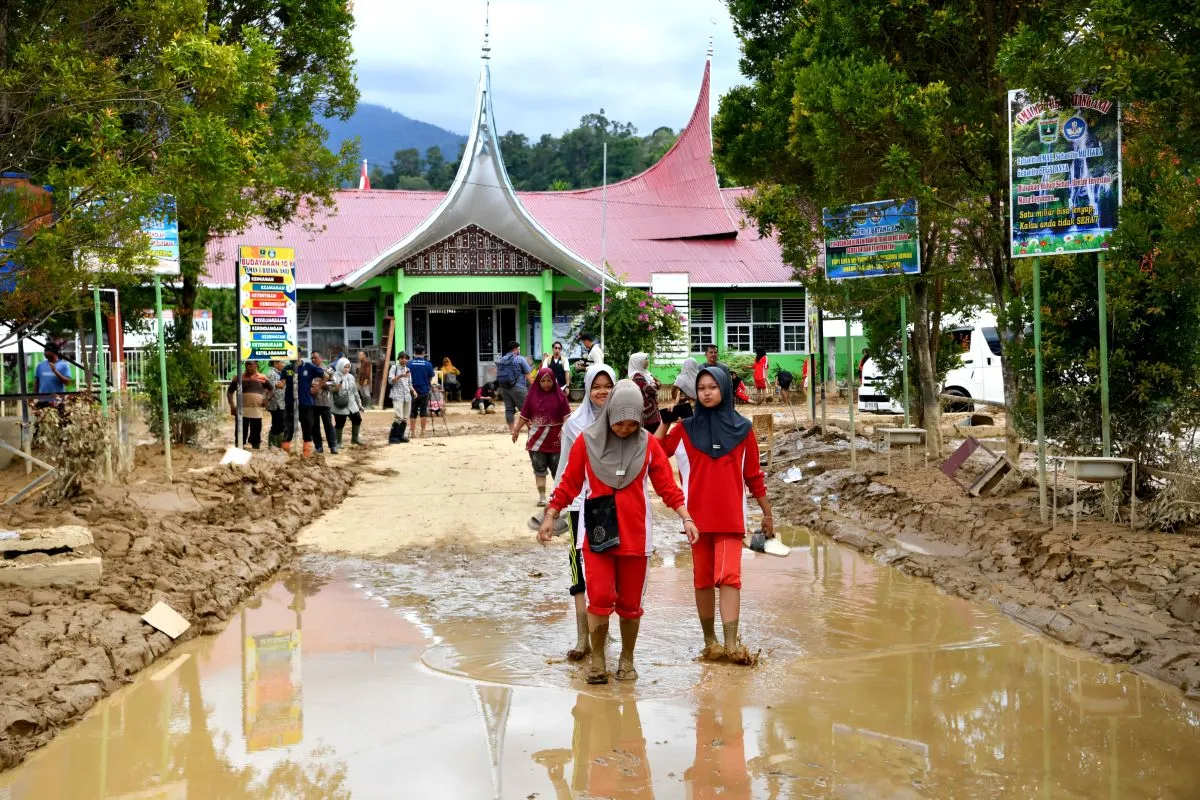
Primary and Secondary Education Minister Abdul Mu'ti affirmed that the continuity of the education and learning process must prioritize the safety, psychological well-being, and continued learning progress of students.
He stated here on Thursday that regional governments have full authority to determine learning arrangements according to the local situation.
"The most important thing is that the students' right to learn is fulfilled and their safety is guaranteed,” he stressed.
Mu'ti also mentioned that in the affected areas, various learning schemes have been implemented, ranging from a shift system, online learning, using other schools' facilities, to setting up learning in emergency tents.
Furthermore, the mechanism for semester exams can also be made flexible.
"Regional governments and schools are given the freedom to choose the most feasible learning mode and form of assessment," the minister remarked.
Meanwhile, the head of the ministry's Educational Standards, Curriculum, and Assessment Agency (BSKAP), Toni Toharudin, stated that for continuing education services after disasters, his agency had prepared a layered policy framework that applies during the emergency response up until years after the disasters.
“In the first three months, the focus is directed toward simplifying the curriculum to meet minimum essential competencies, providing emergency learning materials, adaptive learning in limited spaces, psychosocial support, and simple assessments that focus on student safety and involvement,” he explained.
Following that, he continued, in the period of three to twelve months, the policy is directed toward restoring students' basic abilities through a crisis-based adaptive curriculum, intensive remedial programs, flexible learning, and transition assessments based on portfolios and socio-emotional development.
“Within one to three years, the policy focus shifts to strengthening the quality of learning, permanent integration of disaster education, strengthening inclusive learning, and long-term monitoring and evaluation of student literacy, numeracy, attendance, and psychosocial well-being,” he said.
Furthermore, he stated that his agency had prepared the Implementation Guidelines for Disaster Education as a reference for schools to enhance disaster preparedness.
In addition, he also affirmed that the recovery process runs in line with the reconstruction of educational facilities in the disaster-hit regions.
Related news: Indonesia sets up emergency schools after Sumatra floods
Related news: RI Govt exempts tuition for students hit by Sumatra floods
Related news: Sumatra schools struggle to resume classes after floods, landslides
Translator: Hana Dewi, Raka Adji
Editor: Azis Kurmala
Copyright © ANTARA 2025


