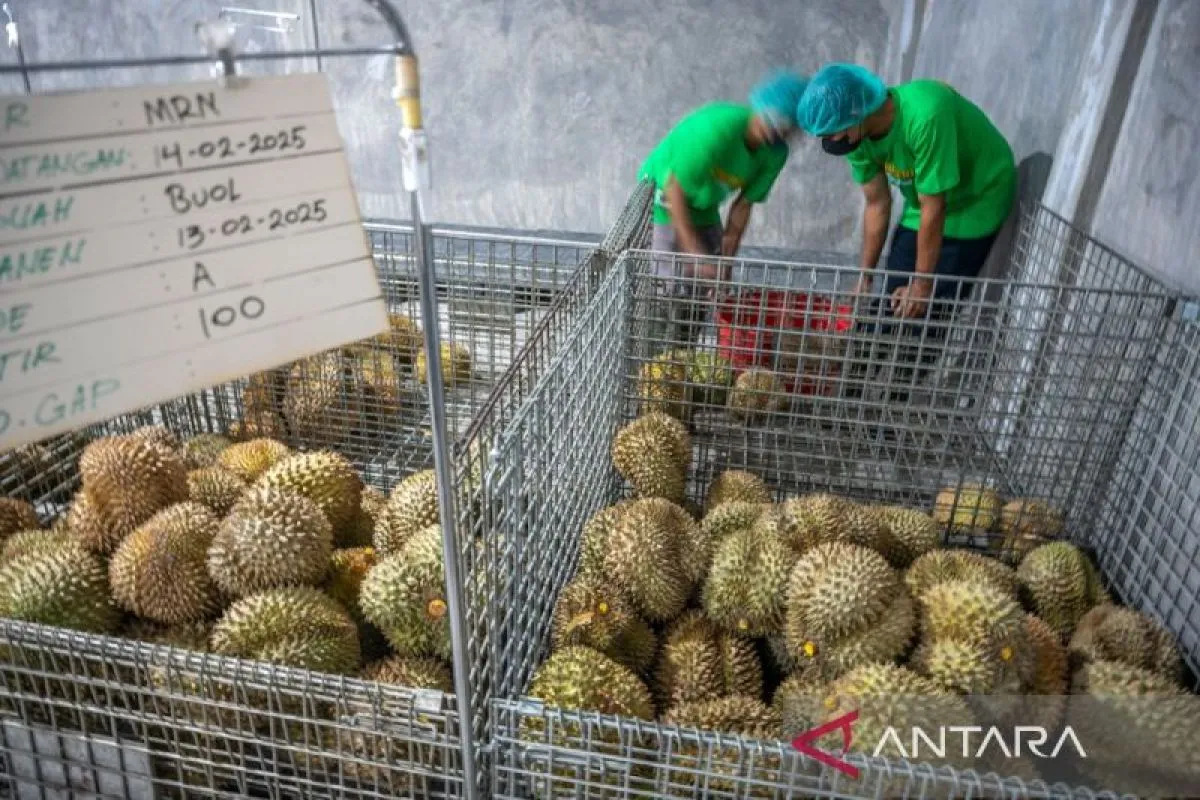
Barantin Head Sahat M Panggabean stated that the inaugural shipment, valued at Rp5.1 billion ($305,971 USD), was a follow-up to the signing of the frozen durian export protocol between Indonesia and the General Administration of Customs of the People’s Republic of China (GACC) on May 25, 2025.
“This marks the realization of Indonesia’s first frozen durian export to China, the result of a long process that required considerable time and resources,” Panggabean stated in Barantin’s official statement.
The frozen durians, processed in West Java, will be shipped via Tanjung Priok Port in Jakarta to Qingdao Port, China.
Previously, Indonesian durian exports to China were not conducted directly, but instead sent through neighboring countries that processed and repackaged the fruit before sending it to the Chinese market.
The government-to-government initiative with GACC has now paved the way for Indonesia to export frozen durian directly.
Barantin recorded that from January to November 2025, Indonesia exported 10,162 tons of durian in various forms, including durian pulp, durian paste, and whole durian.
The five main export destinations were Thailand (6,003 tons), China (2,574 tons), Malaysia (1,532 tons), Hong Kong (15 tons), and Germany (6 tons). Other destinations included Japan, Taiwan, Saudi Arabia, the Czech Republic, the Netherlands, Canada, the United States, and Norway.
On the same occassion, Secretary General of the Indonesian Durian Plantation Association (Apdurin), Aditya Pradewo, welcomed the opportunity for direct exports to China. He noted that the Chinese durian market is estimated at US$8 billion or around Rp128 trillion, annually.
He explained that with premium varieties such as Bawor, Super Tembaga, and Namlung, Indonesia is projected to secure 5–10 percent of the market share, which if achieved could generate foreign exchange earnings ranging from Rp6.4 trillion to Rp12.8 trillion per year.
Pradewo added that direct exports to China not only reduce logistics costs but also provide significant benefits for farmers and exporters.
According to him, durian prices in China are currently five to seven times higher than local prices, offering substantial economic opportunities.
Related news: Time for Indonesian durian to triumph in the global market
Translator: Shofi Ayudiana
Editor: M Razi Rahman
Copyright © ANTARA 2025


