Productivity is often dubbed a “silent investment” because its impact is not always as visible as the construction of roads, ports, or industrial estates. Yet, it serves as the foundation for a country’s long-term growth and competitiveness.
Without productivity gains, increased investment risks merely expanding the scale of the economy without being followed by a rise in value added per worker, making it difficult for national industrial competitiveness to improve sustainably.
Statistics Indonesia (BPS) data show that Indonesia’s labor force as of February 2025 reached 153.05 million people, with 145.77 million employed, while the open unemployment rate stood at 4.76 percent.
These figures indicate that Indonesia’s job market is relatively stable in quantitative terms. However, they do not fully reflect job quality or the overall level of labor productivity.
Manpower Minister Yassierli noted that the proportion of formal workers in Indonesia remains at around 39 percent, indicating that the majority of the workforce is employed in the informal sector.
The informal sector generally faces limitations in technology adoption, business management, and workforce skill development, resulting in productivity levels that tend to be lower than those in the formal sector.
Overall, these conditions point to quality challenges in Indonesia’s labor structure, as reflected in regional productivity comparisons.
Based on data from the Ministry of Manpower, Indonesia’s labor productivity in 2022 stood at around US$26.6 thousand per worker.
This figure remains below the ASEAN average of approximately US$30.2 thousand per worker, indicating Indonesia’s challenge in increasing value added per worker at the regional level.
Labor productivity per worker is a key indicator in economic analysis, as it describes the economic value generated by each worker within a specific period.
From a macroeconomic perspective, growth supported by productivity improvements is generally considered more sustainable than growth that relies solely on an increase in the number of workers.
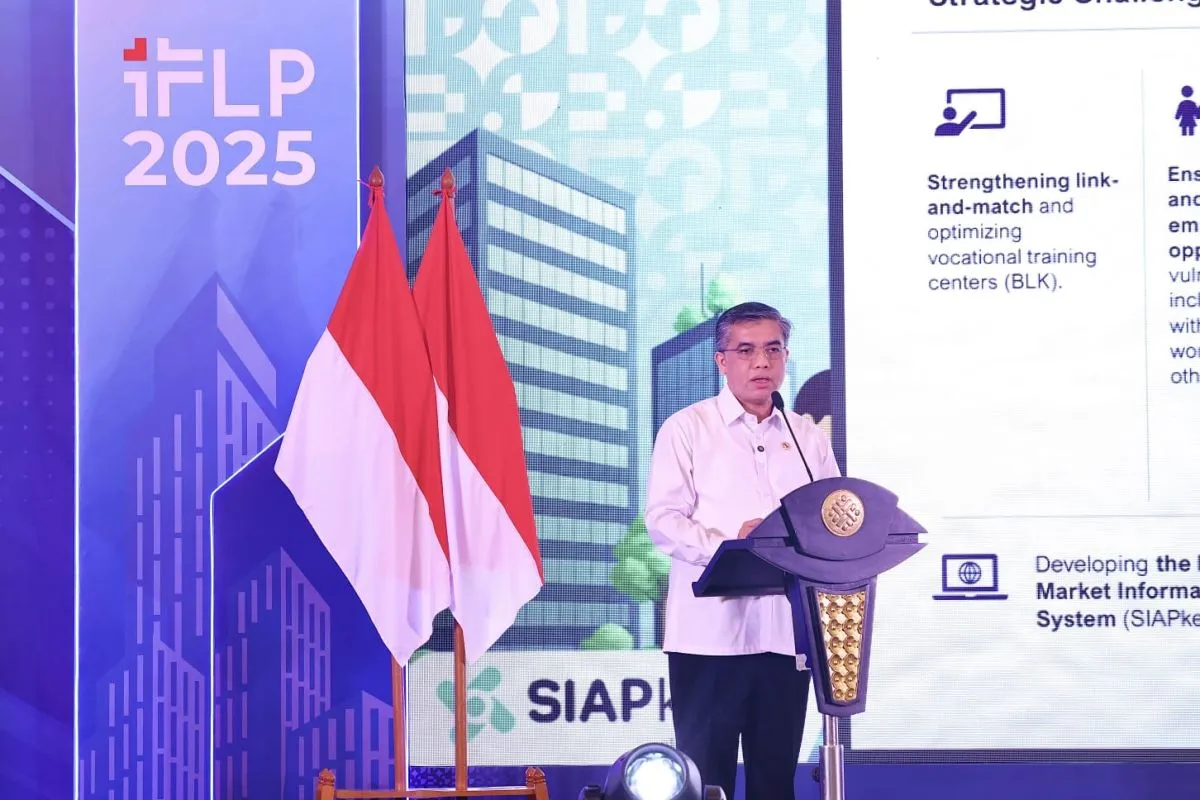
Speaking at the Indonesia Productivity Summit 2025, Yassierli asserted that productivity is the key to strengthening Indonesia’s competitiveness amid intensifying global competition. He emphasized that Indonesia’s productivity gap is evident not only at the ASEAN level but also when compared with countries that have undertaken industrial transformation and human resource development earlier.
Labor productivity among members of the Organization for Economic Co-operation and Development (OECD) ranges from tens of thousands of US dollars to nearly US$100,000 per worker per year. Meanwhile, productivity levels in upper-middle-income countries stand at around US$40,000 to US$50,000 per worker annually.
The minister stressed that productivity plays a crucial role in industries’ ability to adapt to technological transformation, global trade dynamics, and rising demands for efficiency.
Amid the transition toward a digital and green economy, workforce demand is shifting rapidly and becoming more complex.
Without consistent efforts to enhance productivity, economic growth risks being insufficient to sustainably drive an increase in per capita income.
This places productivity not merely as a labor issue, but as an integral component of the national strategy to build competitiveness.
Related news: Productivity key to strengthening RI's industry competitiveness: govt
Challenges and policy direction
Yassierli assessed that the challenges in Indonesia's productivity are structural in nature, especially related to the educational attainment of the country's labor force.
Approximately 85–86 percent of the Indonesian workforce has an educational attainment of high school (SMA) or vocational high school (SMK),
Meanwhile, industries continue to demand more complex skills driven by digitalization and automation.
This situation coincides with the high proportion of informal workers, which reaches around 60 percent.
This structure limits the labor force productivity from improving rapidly because access to training, technology, and upskilling is not yet evenly distributed.
In this context, the government is promoting a combination of top-down and bottom-up approaches to boost national productivity.
The top-down strategy is implemented through industrialization, downstreaming, and large-scale investment, which are expected to generate demand for a more productive workforce.
Meanwhile, the bottom-up strategy is directed at direct intervention at the company level, especially medium-sized companies that create a significant number of jobs.
The Ministry of Manpower has stated that it will establish productivity clinics in 15 vocational training centers in 2026.
Currently, the ministry manages 42 vocational training centers that serve as facilities to improve the quality of Indonesian human resources.
The government has also prepared certification programs for productivity experts and productivity service operations targeting medium-sized enterprises.
To improve labor force productivity, the Ministry of Manpower has also implemented the National Internship Program as an instrument to strengthen industry-based skills.
This year, the program targets 100,000 participants in paid internships across state-owned enterprises (SOEs), private companies, and strategic institutions, as part of the bottom-up strategy to boost productivity through direct work experience.
Unlike physical infrastructure development, productivity growth is largely achieved through non-physical investment, such as training, competency certification, improvements in work processes, and the strengthening of organizational culture.
Policy analyses consistently show that economic growth supported by productivity improvement is more resilient to external pressures than growth that relies on sectoral expansion.
Going forward, Indonesia’s challenge lies not only in attracting investment, but also in ensuring that investment generates optimal added value through sustained improvements in labor productivity—an essential foundation for the country’s economic competitiveness toward its Golden Indonesia 2045 vision.
Related news: Indonesia aims for productivity-driven employment growth in 2026
Related news: Improving human resource productivity to welcome demographic bonus
Editor: M Razi Rahman
Copyright © ANTARA 2025


