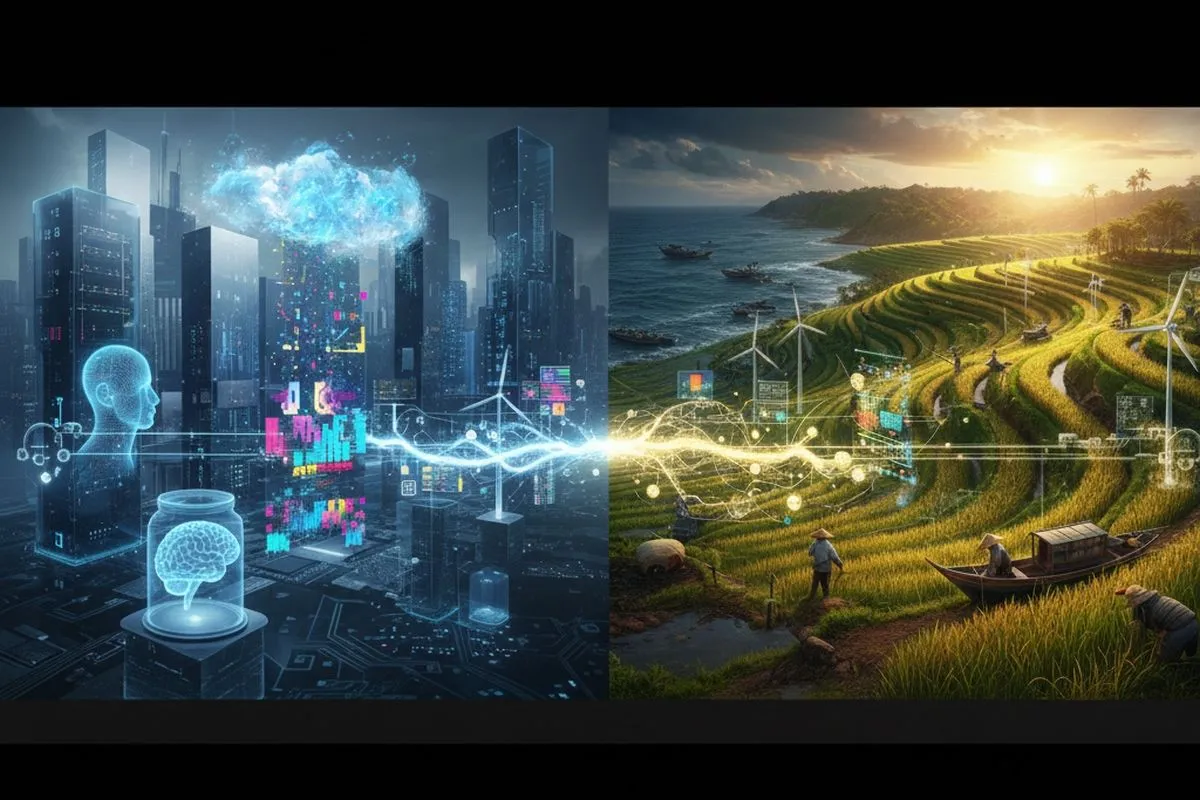
Farmers grapple with volatile weather and opaque fertilizer distribution, not the existential angst of AI poetry. Fishermen rely on satellite data to save fuel, while factory managers in Central Java prioritize predictive maintenance over hyper-realistic video animation.
The true face of the Global South's economy is physical, dirty, and urgent — far removed from the digital gloss of the metaverse. Yet, global headlines remain mesmerized by a narrative disconnected from these needs.
The public is force-fed Silicon Valley's "digital miracles" — generative AI capable of painting masterpieces — while the developing world still clamors for basic food security and energy stability. California appears busy perfecting a disembodied "brain in a jar," entirely detached from the realities of mud, sweat, and engine oil.
The pragmatism of the digital nervous system
This stark disparity triggers a fascinating shift in technological allegiance. Western observers often dismiss this as a hunt for bargains, but it is actually a profound quest for relevance.
When new Chinese AI models like DeepSeek emerge, what intrigues the developing world is not their academic prowess, but the grounded philosophy accompanying them.
Indonesia is pivoting toward technology that functions as a "digital nervous system" for the real economy, rather than merely a tool for content creation.
This pattern reflects a longing for the unity of concept and vessel where AI is deemed useful only if it "gets its hands dirty."
It must be embedded in irrigation networks to regulate water flow, integrate with power grids to balance renewable energy, and serve as the brain behind complex logistical supply chains. For this nation, technology is not about abstraction in the clouds; it is about efficiency on terra firma.
Material pragmatism is the only path forward. It is clear that AI skilled only in rhetoric will not rescue national industries from structural inefficiency.
Conversely, deep integration into physical infrastructure, such as smart ports or automated factories, is the only trajectory to ascend the global value chain.
Without such integration, domestic factories will shutter, unable to compete with neighbors employing algorithmic precision. The risk of premature deindustrialization looms large if the marriage between technology and the real sector fails.
Simultaneously, a geopolitical threat looms. The United States is pursuing a "Genesis Mission" — a systematic strategy to dominate global digital infrastructure (chips, data, and ethics) to maintain hegemony.
If Indonesia passively consumes these elite Western products, it walks into the trap of "digital colonialism."
By purchasing expensive, irrelevant technology while surrendering strategic data, the Global South transforms into a "data plantation": raw material is extracted from the South, processed in the North, and sold back as finished intelligence products at a premium.
Constructing digital sovereignty
Indonesia cannot afford to remain merely a market. The risk of becoming a "digital colony" is palpable. It would be a bitter irony if future generations are educated by culturally biased foreign AI, while the country's best engineers emigrate due to a lack of local innovation.
Domestic industry risks being relegated to a low-margin subcontractor role, with citizens' data monetized to turn them into products.
Therefore, policymakers in Jakarta must immediately formulate a "National AI Mission" grounded in sovereignty and real-economy pragmatism.
Rather than mimicking Western chatbots, the government must push strategic state-owned enterprises (SOEs) in energy, food, and transport to become locomotives for applied AI.
State utilities must transform into incubators, challenging local talent to create solutions specific to Indonesian problems.
Furthermore, sovereignty over educational and health data is non-negotiable. Independent platforms must be built where AI is used to educate according to national values.
Vocational education requires reform so graduates are ready to work alongside intelligent machines, rather than being replaced by them.
Ultimately, the AI revolution is not about possessing the most articulate robot, but utilizing technology to concretely improve welfare.
The choice is stark: will the nation be mesmerized by another's "brain in a jar," or will it build its own "digital nervous system" to drive the economy? Concrete action must be taken now, translating technology into solutions in the paddy fields and factories, before control over the future is irretrievably lost.
The views and opinions expressed on this page are those of the author and do not necessarily reflect the official policy or position of the ANTARA News Agency
Related news: Indonesia unveils new AI-driven customs technologies at Tanjung Priok
Related news: OJK refines AI ethics code to mitigate financial tech risks
Editor: Anton Santoso
Copyright © ANTARA 2025


