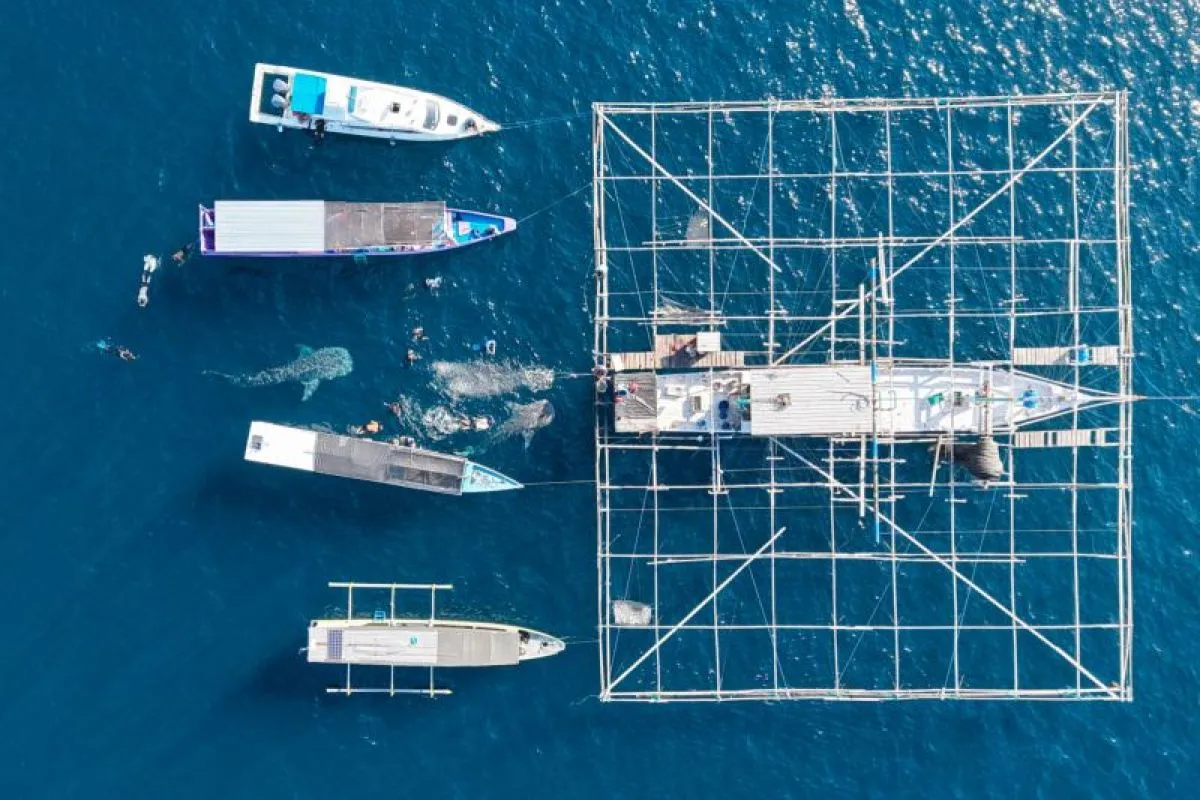
“Sightings of whale shark pups are extremely rare worldwide, and every new record strengthens the global dataset. This finding offers important clues about where and how whale sharks begin their lives,” Conservation scientist Edy Setyawan of the Elasmobranch Institute Indonesia said in a statement received in Mataram on Tuesday.
He noted that Saleh Bay remains a strong potential pupping ground, but cannot yet be confirmed as an official birthing site.
Scientists still require more conclusive evidence before designating the area as a whale shark nursery.
In August 2024, fishermen operating lift‑net vessels (bagan) in eastern Saleh Bay reported five sightings of a small whale shark estimated at 1.2 to 1.5 meters in length.
On September 6, 2024, a whale shark calf measuring roughly 135 to 145 centimeters was accidentally caught in a bagan net.
Fishermen temporarily placed the calf in a seawater‑filled Styrofoam box, allowing researchers to estimate its size accurately using visual comparison.
The discovery is the first confirmed record of a whale shark calf in Indonesia and one of the smallest free‑swimming individuals ever documented globally.
Scientists believe Saleh Bay may function as a birthing and early nursery area for whale sharks, highlighting the bay’s ecological importance for the species’ early life stages.
The findings also underscore the value of community‑based monitoring and the role of bagan fishers in contributing to research on the endangered species.
Konservasi Indonesia (KI) and its partners are working with government authorities to establish Indonesia’s first whale shark–focused Marine Protected Area (MPA) in Saleh Bay.
KI Senior Manager Mochamad Iqbal Herwata Putra said the pup’s discovery strengthens the scientific case for granting the area formal protection.
The young whale shark faces multiple threats in the bay, including entanglement in fishing gear, declining water quality from coastal activities, and increased vessel traffic.
Putra emphasized that survival during the earliest life stages is critical for the future of the global whale shark population.
KI plans to expand monitoring efforts to determine whether sightings of whale shark pups occur regularly, strengthen community reporting systems, and advance plans for an MPA that protects the species while supporting community‑based conservation.
Related news: Scientists confirm discovery of baby whale shark in Saleh Bay
Related news: Ministry, partners develop new whale shark conservation strategy
Translator: Sugiharto Purnama, Cindy Frishanti Octavia
Editor: Aditya Eko Sigit Wicaksono
Copyright © ANTARA 2025


