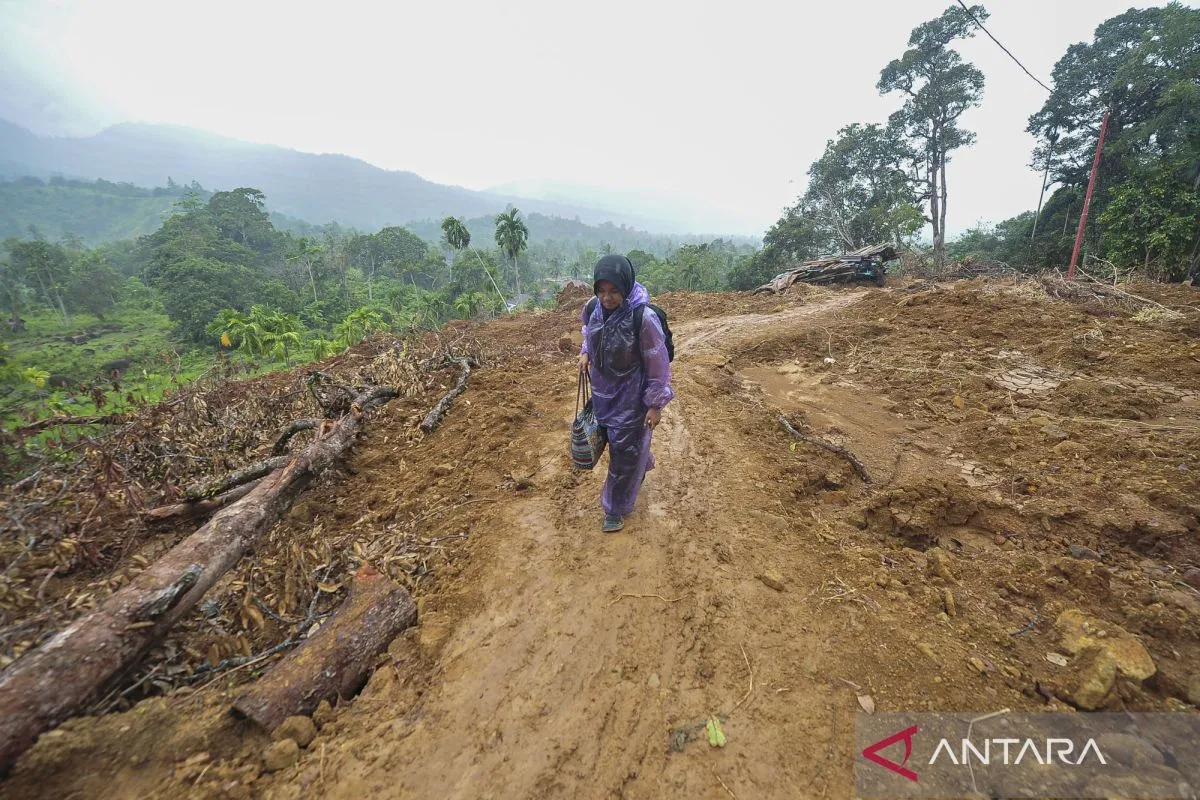
Flash floods and landslides that struck three provinces on the island of Sumatra — Aceh, North Sumatra, and West Sumatra — in late November claimed more than a thousand lives, left hundreds missing, and displaced thousands of residents from their homes.
Images of large logs swept away by floodwaters sparked public outrage, reinforcing perceptions that environmental damage contributed to the disasters. An aerial photograph showing vast palm oil plantations submerged by floodwaters also drew widespread attention.
In response to the catastrophe, Indonesia’s Ministry of Environment sealed and installed monitoring notices at the operational area of a palm oil plantation and mill owned by PT Tri Bahtera Srikandi (PT TBS) in Central Tapanuli, North Sumatra.
Minister of Environment Hanif Faisol Nurofiq said the measure was intended to temporarily halt activities that could potentially worsen hydrological conditions in the area.
He said the decision was taken to ensure compliance with environmental regulations, safeguard public safety, and support ecosystem restoration.
According to the minister, the move reflects the government’s recognition that land clearing for oil palm plantations, particularly when carried out in violation of regulations, can damage landscapes and pose serious risks to surrounding communities.
At the same time, the government continues to promote the development of environmentally friendly fuels, known as biofuels, using crude palm oil as the main raw material.
B50 and CPO Needs
The ambition to develop biofuels is reflected in the mandatory use of diesel fuel blended with vegetable oils, known as fatty acid methyl esters (FAME) or biodiesel. The FAME used in Indonesia’s biodiesel program is derived from crude palm oil (CPO).
The Ministry of Energy and Mineral Resources said the use of biodiesel between 2020 and 2025 helped save up to US$40.71 billion in foreign exchange by reducing diesel fuel imports.
Since early 2025, the ministry has implemented a policy requiring diesel fuel to contain a 40 percent blend of vegetable oil, known as biodiesel 40 or B40.
As of September 2025, the implementation of the B40 program reached 10.57 million kiloliters, increasing the added value of crude palm oil by up to Rp14.7 trillion, equivalent to about US$853 million.
The program also contributed to foreign exchange savings of Rp93.43 trillion, or around US$5.4 billion, supported employment for more than 1.3 million workers, and reduced carbon emissions by up to 28 million tons.
FAME demand under the B40 program stands at 15.6 million kiloliters and is projected to rise to 20.1 million kiloliters in 2026, as the government plans to implement the B50 mandate in the second half of that year as part of efforts to end diesel imports.
Rising demand for CPO-based FAME indicates that Indonesia will require additional palm oil supplies to support the B50 program.
To secure CPO availability, the government is considering several options, including intensifying existing oil palm plantations to boost productivity, opening new plantation areas, or reducing palm oil exports through the implementation of a domestic market obligation (DMO) policy.
These considerations emerge as crude palm oil remains a key raw material for a wide range of daily necessities, including cooking oil, cosmetics, and hygiene products.
Without alternative supply measures, the expansion of the B50 program could disrupt the availability of palm oil for essential consumer goods.
Furthermore, recent flash floods and landslides in Sumatra have also underscored concerns that land clearing should not be pursued as a solution to meet growing CPO demand.
Options for CPO Supply
To prevent further environmental damage, the government is considering several alternatives, including intensifying existing oil palm plantations, reducing crude palm oil exports, or implementing both measures simultaneously.
In early 2025, the Center of Economic and Law Studies (Celios) said Indonesia could increase palm oil output through land intensification and improvements in agricultural technology.
Celios data show that oil palm plantations in Indonesia produce an average of 12.8 tons per hectare of fresh fruit bunches, compared with up to 19 tons per hectare in Malaysia.
According to the National Research and Innovation Agency (BRIN), plantation intensification can be achieved through replanting, as oil palm trees have a maximum productive lifespan of around 25 years.
BRIN also emphasized the use of superior seeds developed through plant breeding programs. These seeds have undergone progeny testing using scientifically validated methods in line with Indonesian National Standard SNI 8211:2023.
The Ministry of Agriculture is also simplifying regulations to accelerate the People’s Oil Palm Rejuvenation program, aimed at boosting productivity in plantation commodities.
The regulatory reform includes reducing administrative requirements from 14 to two, cutting the verification process from three stages to one, and integrating the entire procedure through a national digital system.
Through these measures, intensifying existing plantations could increase crude palm oil production to meet the requirements of the B50 biodiesel mandate without clearing new land.
Another option under consideration is reducing crude palm oil exports through a Domestic Market Obligation (DMO) scheme, which requires producers to allocate part of their output to meet domestic demand.
The proposal to curb exports has also been echoed by Agriculture Minister Andi Amran Sulaiman.
He said the government plans to cut crude palm oil exports by up to 5.3 million tons to support the mandatory implementation of the B50 biodiesel program.
According to the minister, the B50 mandate requires around 5.3 million tons of crude palm oil. Indonesia’s total crude palm oil production stands at about 46 million tons per year, with roughly 20 million tons processed domestically and 26 million tons exported.
Sulaiman warned that reducing exports could push up global crude palm oil prices, noting that Indonesia supplies nearly 60 percent of global demand.
These policy options reinforce the view that opening new land for oil palm plantations should not be pursued.
Recent flash floods and landslides have served as a stark reminder that deforestation has reached critical levels, and further environmental disruption would only deepen the suffering of affected communities.
Related news: Berbak-Sembilang Park clears 98.8 hectares of illegal palm oil
Related news: Sustainability principles apply to all, not only palm oil industry
Editor: Primayanti
Copyright © ANTARA 2025