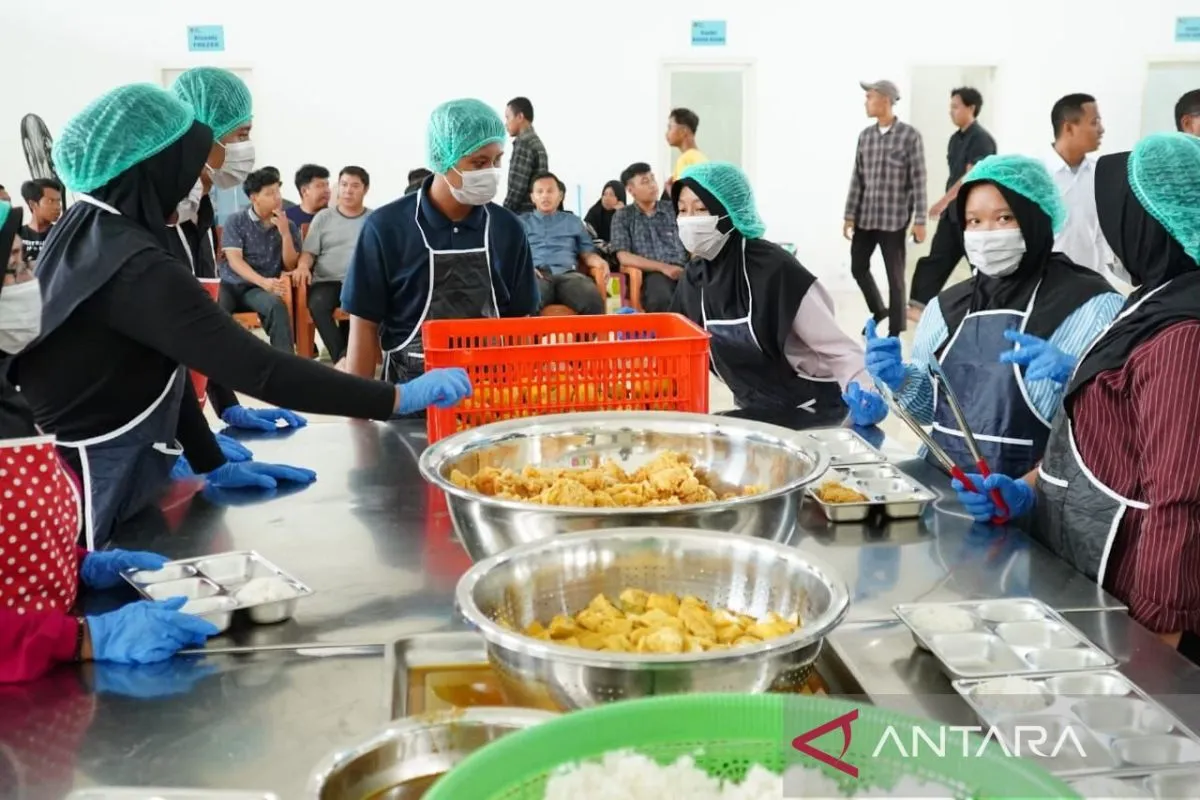
“We want to prove that hope for prosperity still exists, and that extreme poverty can be ended,” said Nunung Nuryartono, Deputy for Social Welfare Coordination at the Coordinating Ministry for Community Empowerment, in a statement released in Jakarta on Monday.
Nunung was speaking at the launch of a pilot programme titled Extreme Poor Must Work, held at an SPPG kitchen facility in Badang village, Jombang District, East Java.
The ministry expressed optimism that with more than 25,000 SPPG units operating across Indonesia, the programme can become a strategic instrument in the government’s effort to eliminate extreme poverty by linking social protection with access to productive employment.
As an initial target, the Coordinating Ministry for Community Empowerment aims to absorb at least 10,000 people living in extreme poverty into formal and semi-formal jobs generated through the scheme.
So far, a total of 300 participants have completed training under the pilot phase of the programme, preparing them for operational roles within the SPPG network.
Those 300 workers will be deployed across seven SPPG units in Jombang district, including facilities in Banjaragung, Diwek, Diwek Puton, Ngoro Badang, Ngoro Badang 2, Jombang Tambakrejo 5, and Jombang Kepanjen.
Related news: Free meals program creates up to 1 million jobs so far, BGN says
They are scheduled to begin work on January 5, 2026, taking up duties such as portioning free nutritious meals, cleaning food containers, and supporting other daily kitchen operations linked to the government’s Free Nutritious Meal programme.
Local authorities estimate that Jombang’s extreme poverty rate currently stands at about 0.4 percent, equivalent to roughly 5,100 people.
The ministry believes the figure can be further reduced through the expansion of SPPG facilities, which are designed to create local economic ecosystems involving farmers, traders, small and medium-sized enterprises, and kitchen workers.
If the pilot proves successful, the government plans to replicate the programme in other regions, strengthening coordination with local administrations, ministries and agencies, private-sector partners, and community organisations to scale up its impact nationwide.
Related news: Prabowo links free meal program, jobs to 8 percent growth target
Translator: Anita P, Tegar Nurfitra
Editor: Rahmad Nasution
Copyright © ANTARA 2025


