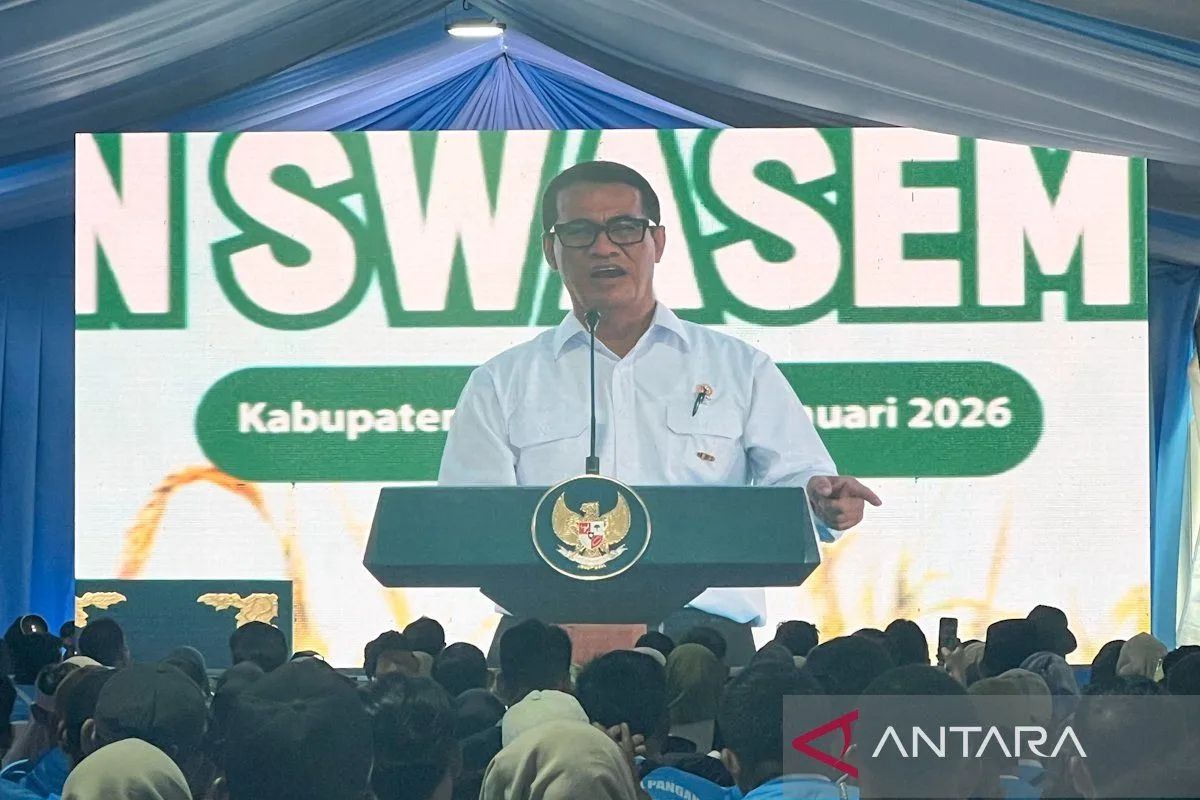
“The world rice price has dropped from USD650 per metric ton to USD340 per metric ton, a decline of 44 percent,” Sulaiman said at a grand harvest and food self-sufficiency event in Karawang, West Java.
He said Indonesia’s decision to halt imports created oversupply in the global market as major exporting countries were left with excess rice.
Sulaiman said President Prabowo Subianto’s firm food policy allowed Indonesian farmers to contribute indirectly to stabilising global rice prices.
Pro-farmer policies have driven a sharp increase in domestic output, with rice stocks at the start of 2026 reaching 3.25 million metric tons, he said.
Sulaiman described the figure as the highest opening stock in Indonesia’s history, noting stocks have never exceeded 3 million tons at the beginning of a year.
“There are currently no imports, which means oversupply in Vietnam, Thailand, India, Pakistan and others. Indonesian farmers are contributing to the world,” he said.
He added that the current government rice reserve, known as CBP, is entirely sourced from domestic farmers’ production.
Global rice price movements can be tracked on the Food and Agriculture Organization’s website through the FAO All Rice Price Index, or FARPI, Sulaiman said.
Related news: Indonesia eyes rice exports after achieving self-sufficiency
FARPI is a monthly index reflecting average prices of various rice types from major exporting countries.
According to FARPI data, the lowest index in the past five years was recorded in November 2025 at 96.9 points.
The previous lowest level was in August 2021, when the index stood at 97.9 points, the data showed.
In both 2021 and 2025, Indonesia did not import rice to replenish its government reserves, Sulaiman noted.
He said the pattern highlights Indonesia’s growing influence in the international rice market.
Over the past 18 years, CBP ending stocks without imports have never exceeded three million tons, he added.
In 2008, when Indonesia recorded no imports, year-end stocks stood at just 1.1 million tons.
In 2009, also without imports, stocks reached 1.6 million tons, while from 2019 to 2021 they stood at 2.2 million, 1.9 million and 0.8 million tons, respectively.
Related news: Indonesia pushes modern agriculture for food self-sufficiency
Translator: Muhammad Harianto, Resinta Sulistiyandari
Editor: Rahmad Nasution
Copyright © ANTARA 2026