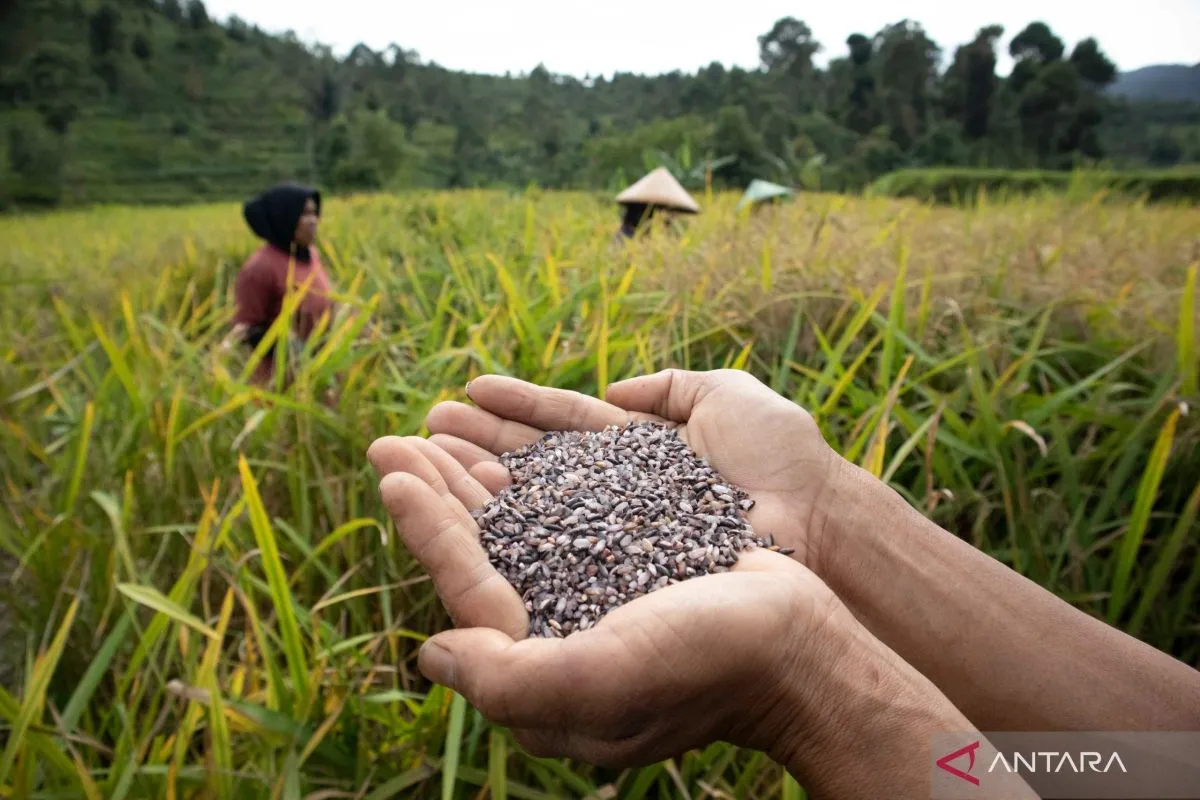
Lower prices and stable supply make a huge difference. When fertilizer is affordable, we can focus our limited funds on land preparation,Bandung, West Java (ANTARA) - A thin mist still clung to the ridges of Gununghalu Sub-district in West Bandung, West Java Province, as Juhdi, a man in his fifties, stood gazing over his rice fields—fields that looked different from the rest.
Across the plots, patches of dark grains stood out against the dominant yellowish-green of common rice. The dark husks rose tall, exuding a quiet elegance.
This was beas hideung cigadog—a local black rice variety and a hidden treasure of West Java’s Parahyangan highlands.
“This is the legacy of our ancestors, passed down through generations. I have been farming it intensively since the early 2000s,” Juhdi said, gesturing toward the stalks.
Black rice, known in Imperial China as “forbidden rice,” was once reserved exclusively for emperors, believed to promote longevity and vitality. Today, in Gununghalu, that aura of exclusivity has evolved into a tangible economic asset.
While ordinary white rice paddy sells for around Rp700,000 (US$41.7) per 100 kilograms, black rice can fetch up to Rp1,000,000 per 100 kilograms. Once milled, it sells for about Rp20,000 per kilogram at the farmer level—well above the price of premium white rice.
Yet behind the premium price lie significant challenges. Black rice takes longer to cultivate, with a growing period of five to six months—around two months longer than standard white rice. Productivity is also lower, averaging just three tons per hectare, about half that of white rice.
Still, Juhdi manages to harvest every four months, thanks to his valley location with abundant water supply.
Related news: Indonesia pushes modern agriculture for food self-sufficiency
Subsidies to digitalization
According to Statistics Indonesia (BPS), West Java’s rice harvest area reached 1.47 million hectares in 2024, producing 8.62 million tons of milled dry paddy.
In West Bandung District, black rice represents only a small portion of the 148,802 tons produced, yet it stands out as a high-value premium commodity.
To prevent production stagnation, state-owned fertilizer producer Pupuk Indonesia has stepped in—not merely as a supplier, but as a key pillar of food security, reaching even remote farming communities.
Donny Rachman Wiratama, regional manager for West Java Region 2 and Jakarta at Pupuk Indonesia Niaga, said the company’s commitment is concrete. Subsidized fertilizer distribution for 2026 officially began on January 1, ensuring farmers could access supplies immediately.
In 2025, West Java received an allocation of 1.1 million tons of subsidized fertilizer—urea, NPK, organic fertilizer, ZA, and SP-36—from a national total of 9.55 million tons. By the end of December, absorption reached about 891,000 tons, or roughly 80 percent.
“The remaining 20 percent reflects purchasing power dynamics and data accuracy issues,” Wiratama said. “Some farmers are not registered due to lack of awareness, and others face affordability constraints.”
The government’s decision to cut the retail price ceiling of subsidized fertilizer by up to 20 percent starting October 22, 2025, he added, was a major relief for farmers.
For Juhdi, the availability and affordability of subsidized urea and NPK fertilizers have been crucial. He mixes 100 kilograms of subsidized fertilizer with a custom organic blend per hectare to maintain the quality of his black rice.
“Lower prices and stable supply make a huge difference. When fertilizer is affordable, we can focus our limited funds on land preparation,” he said.
Related news: Lowered subsidized fertilizer prices boost farmers productivity: govt
Real time application
However, the distribution of subsidized fertilizer is not without its hurdles, as there are still cases of farmers struggling to redeem their allocation or missing data. To address these, Pupuk Indonesia has turned to digitalization as its primary strategy through the i-Pubers application.
Through the application, the distribution of fertilizer from production facilities to 3,207 warehouses across 27 districts and cities in West Java, and then to distributors, kiosks, and farmers, can be maintained accurately.
At Akbar Jaya kiosk, 32-year-old Yulia Septia Wahyuni—a third-generation fertilizer vendor in Gununghalu—is witnessing a change of eras.
From the rudimentary distribution methods of her grandmother’s time in the 1990s to the challenging, semi-manual T-Pubers era, she now enjoys a more streamlined process with i-Pubers.
"It used to be so complicated. There was so much paperwork that it would cause huge problems if anything went missing. Now? All you need is an ID card," she said.
All the requirements like farmers’ identities, GPS coordinates, photos, and digital signatures are now recorded in real time.
Claims outside the official Group Needs Plan (RDKK) are automatically rejected, reducing disputes at kiosks.
"If a farmer tries to claim their allocation without being registered in the RDKK (the Official Group Needs Plan), the system rejects it immediately. This minimizes conflicts at the kiosk because everything is recorded," she added.
In response to this sentiment, Wiratama noted that the application, indeed, ensures that the principle of accuracy in type, quantity, price, place, time, quality, and target is more than just a slogan. Digital footprints have significantly minimized the distribution discrepancies, addressing a long-standing challenge in the supply chain.
Related news: Fueling rice fields: Fertilizers and Indonesia's food security quest
Data and hope
Even though the use of i-Pubers has streamlined the redemption process, fundamental challenges related to data still linger, such as farmers remaining unregistered due to a lack of awareness or errors in inputting annual planting cycles.
A. Faroby Falatehan, the Head of the Regional Development Management Department at IPB University, revealed that data inconsistency remains a persistent issue within the current system.
"Our survey found a 68 percent discrepancy between the profession listed on farmers' ID documents and their actual work in the field. Furthermore, 12 percent of active farmers are not yet members of any farmers' group," he stated.
These inconsistencies have contributed to declining fertilizer uptake, from 79 percent in 2023 to 77 percent in 2024, dropping to 58 percent by September 2025.
Presidential Regulation No. 6 of 2025, which streamlined 145 previous regulations, allows data updates every three to four months to reflect planting cycles and add new beneficiaries—an approach experts say is crucial.
Synergy between extension workers, agricultural offices, and Pupuk Indonesia in validating the RDKK every three to four months is also key to ensuring no farmers are left behind.
"The regulation allows for adjustments to be made every three to four months to update planting cycles and add new beneficiaries," he said.
Back in Gununghalu, as rice fields turn golden, Juhdi hopes the beas hideung he cultivates will fund his children’s education.
“Let us, the elders, do the farming,” he said. “Our children must be smarter, so they can protect and develop this legacy.”
Once forbidden, black rice has become a symbol of food security—rooted in tradition, strengthened by technology, and sustained by hope.
Related news: Indonesia achieves food self-sufficiency by 2025: Prabowo
Related news: Indonesia pledges annual food self-sufficiency after 2025 rice surplus
Editor: M Razi Rahman
Copyright © ANTARA 2026


