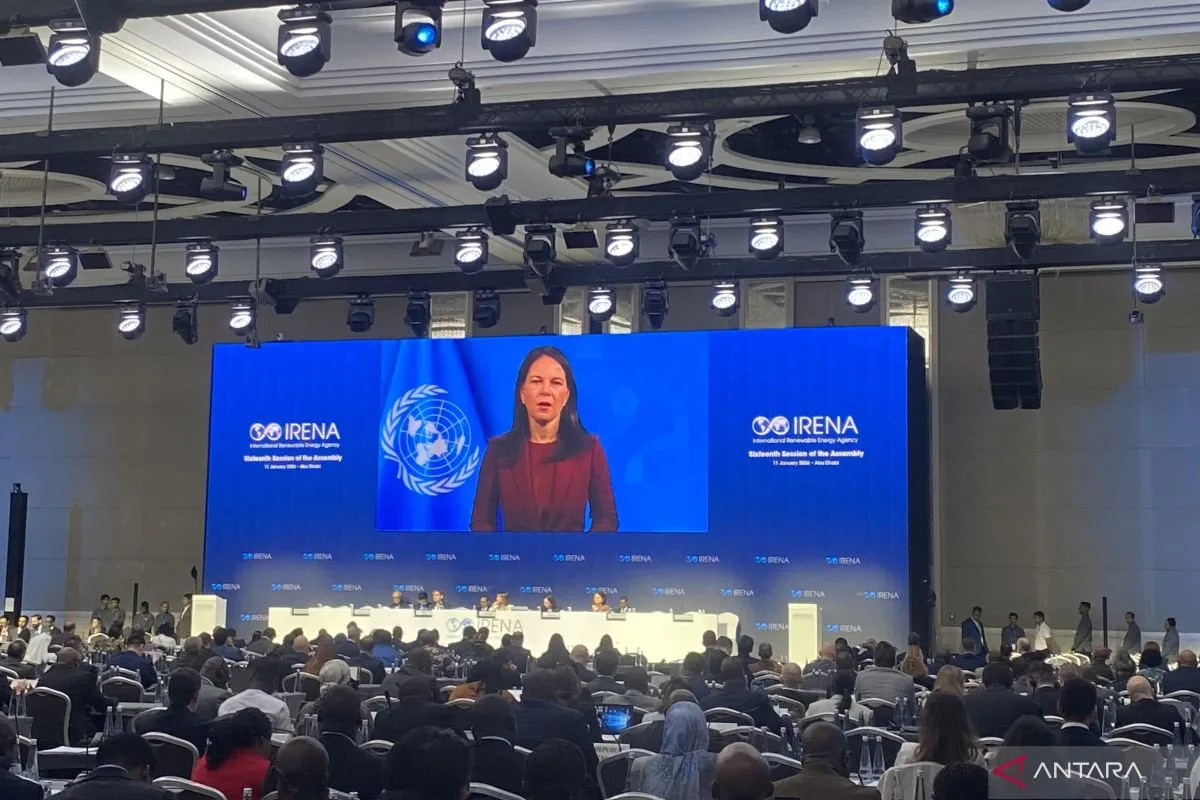
Speaking at the 16th International Renewable Energy Agency (IRENA) Assembly during Abu Dhabi Sustainability Week on Sunday, Baerbock said the pace of renewable energy deployment over the past decade shows the world is moving decisively toward a clean-energy future.
She recalled that when the Paris Agreement was adopted in 2015, global renewable energy capacity stood at just 153 gigawatts.
By last year, she said, installed capacity had climbed to more than 4,400 gigawatts, nearly 30 times higher than a decade ago.
Baerbock said the adoption of the UAE Consensus at the COP28 climate summit in Dubai in 2023 further solidified that direction by committing countries to accelerate the transition toward renewables and low-carbon energy systems.
As the custodian responsible for tracking progress on the UAE Consensus, the General Assembly, she said, welcomed IRENA’s role in helping member states advance energy transitions through cooperation on technology development, investment mobilization and policy support.
She described the current moment as a “positive tipping point” for the global energy system, driven largely by market forces rather than political ideology.
“No investor wants stranded assets, no matter how political winds may shift,” Baerbock said, noting that a record $2.4 trillion was invested globally in the energy transition in 2024. “There is no way back.”
Despite the gains, Baerbock said the world has failed to deliver on one of the Paris Agreement’s central promises: using renewable energy to electrify the African continent.
She said Asia, Europe and North America together account for more than 85% of installed renewable capacity, while Africa represents only 1.6 percent of global capacity and 2.3 percent of investment, despite vast solar and wind potential.
Baerbock urged governments and financial institutions to scale up financing, deepen partnerships and invest in training a skilled renewable energy workforce across developing regions.
She also called for reforms to the international financial system, including debt relief measures, to secure stable and affordable supply chains for renewable technologies, critical minerals and clean-energy infrastructure.
Related news: Shift toward green energy, industry inevitable, not optional: minister
Reporter: Shofi Ayudiana
Editor: Rahmad Nasution
Copyright © ANTARA 2026


