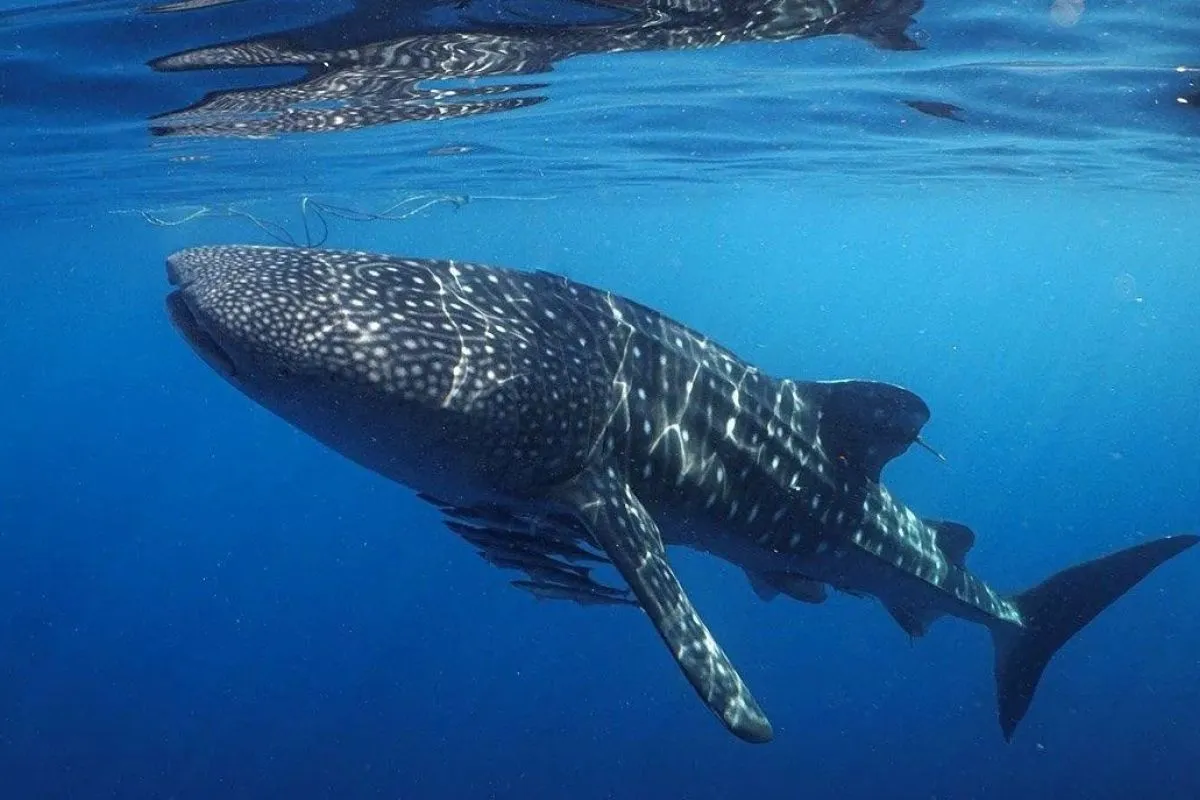
In the waters of West Nusa Tenggara (NTB), particularly Saleh Bay and its surroundings, the sighting of whale sharks is no longer uncommon. However, each sighting carries an important message about the state of the ocean, the relationship between humans and nature, and the policy choices that determine the future of the ecosystem.
The stranding of a whale shark on the coast of Satonda Island, Bima District, in mid-January 2026, serves as a stark reminder that marine wildlife protection is never finished.
The animal survived and was successfully rescued thanks to the collaborative efforts of residents and officials. The incident is not simply a natural occurrence but also a reflection of the preparedness, public knowledge, and effectiveness of conservation governance in the region.
NTB is now at a crucial juncture. On the one hand, the region is blessed with one of the largest whale shark habitats in Indonesia. On the other hand, development, tourism, and coastal activities continue to increase.
The article starts from a simple but fundamental question: How can we keep whale sharks alive and protected while ensuring that the ocean continues to benefit humans?
Nature sign
The appearance of whale sharks in West Nusa Tenggara (NTB) waters is no coincidence. Saleh Bay, covering over a thousand square kilometers, is known for its fertile and rich plankton. This is where whale sharks frequently appear following fishermen's nets, feeding on small fish and rebon shrimp.
The discovery of a whale shark pup, measuring approximately 135 to 145 centimeters in length, in this area reinforces the suspicion that Saleh Bay serves as an early nursery area.
Ecologically, the appearance of whale shark pups is an important indicator. The early stages of whale shark life are extremely rare worldwide.
Global records spanning over a century indicate that whale shark pups have only appeared dozens of times. The fact that this event is repeated in Saleh Bay places the area on the map of global marine conservation importance.
However, the nature sign also carries significant responsibilities. Whale sharks sit at the top of the planktonic food chain and play a key role in maintaining ecosystem balance.
If their habitat is disturbed, the impacts are not limited to one species, but to the entire marine system. Coastal pollution, increased vessel traffic, uncontrolled tourism interactions, and environmentally unfriendly fishing gear pose real threats.
The stranded whale shark on Satonda Island demonstrates another side of the relationship. The whale sharks followed a food source too close to shore, where they were trapped by waves and their own weight.
Without a swift response, the outcome could have been different. In this context, local communities are at the forefront of protection, even before formal policies are implemented.
Conservation
Whale sharks are not only ecologically valuable but also socially and economically valuable. Whale shark tourism in Saleh Bay has developed into a new source of income for coastal communities.
Fishermen who previously relied solely on catches have shifted to roles as tour guides or boat operators. The model demonstrates that conservation and welfare do not have to be mutually exclusive.
However, this balance is fragile. Tourism based on charismatic animals can easily become exploitative if not strictly regulated. Too close proximity, direct contact, engine noise, and boat crowding can cause stress to whale sharks.
In the long term, animals will move away or suffer injuries, and the tourist attraction will be lost.
The local government in West Nusa Tenggara (NTB) has begun to respond to the challenge by establishing biota-based conservation areas, surveying core zones, and strengthening regulations on tourist interactions.
The zoning approach is key to spatial management, separating core conservation areas from limited-use zones. The principle is simple: not all marine space should be treated equally.
On the other hand, the development of strategic areas such as Samota on Sumbawa Island carries the narrative of a blue economy. The concept promises economic growth in harmony with ecosystem health.
However, promises are only meaningful if monitoring is consistent and scientific data informs decisions. Without them, the blue economy risks becoming an empty slogan masking pressures on the ocean.
The experience in Saleh Bay demonstrates that collaboration is key. The government, scientists, conservation agencies, and the community must move in unison.
Local fishers, with their on-the-ground knowledge, have proven to be crucial partners in monitoring and reporting. The approach is not only effective but also empowering.
Protection
Whale shark protection in West Nusa Tenggara (NTB) cannot rely on incidental responses. It requires a system that works before a crisis occurs. Public education is the initial foundation.
Awareness that whale sharks are a protected species and indicators of marine health must be instilled early, from schools to coastal communities.
Institutional strengthening is also urgent. Conservation area management requires trained human resources, an open information system, and sustainable funding.
Without it, regulations will remain on paper. Integration between central and regional policies must be smooth to prevent overlapping authority.
At the local level, the wisdom of coastal communities needs to be continuously nurtured. The cooperation practice that saved the whale sharks on Satonda Island is a clear example that social values are still alive. The state needs to be present by strengthening, not replacing, these initiatives.
Whale sharks teach important lessons about scale. These giant creatures depend on the plankton, ocean currents, and everyday human decisions.
Protecting whale sharks means protecting the sea, and protecting the sea means protecting the future of West Nusa Tenggara as an integral part of maritime Indonesia.
Whale shark protection isn't just about saving a single species. It's a moral and policy choice about how development proceeds.
Is the ocean viewed as a space for short-term exploitation, or as a legacy to be safeguarded for generations? In Saleh Bay, the answer to that question is being tested today, and for the long term.
Related news: Whale sharks become new tourist magnet in E Kalimantan's Pulau Miang
Related news: NTB sets new rules to promote responsible whale shark tourism
Editor: Rahmad Nasution
Copyright © ANTARA 2026


