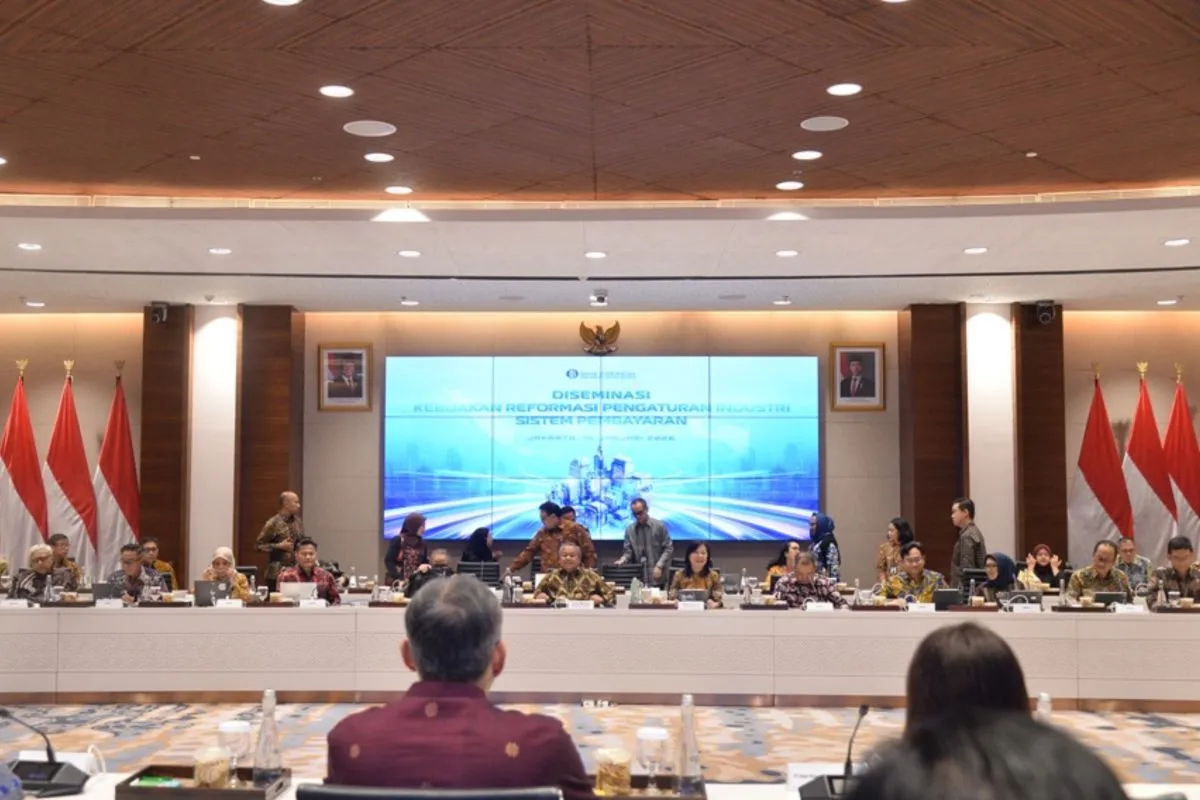
“Various payment digitalization initiatives under the 2025 Indonesian Payment System Blueprint have significantly boosted the growth of digital transactions,” Perry said during the Dissemination of Policy Reforms on Payment System Industry Regulation, as quoted from Bank Indonesia’s official statement here on Thursday.
Bank Indonesia projects that the volume of digital transactions will reach 147.3 billion transactions by 2030. This acceleration is driven by the expanded use of QRIS, BI-FAST, and SNAP, as well as stronger digitalization of government transactions at both the central and regional levels.
However, the rapid growth of digital transactions has also been accompanied by increasing risk complexity, including operational and cyber risks.
Therefore, Bank Indonesia considers that strengthening the structure of the payment system industry must go hand in hand with improvements in industry players’ competencies, risk management, and information technology infrastructure.
Bank Indonesia emphasized that the very rapid acceleration of payment digitalization needs to be balanced by a more reliable and resilient payment system industry structure.
To this end, the central bank is carrying out reforms in payment system industry regulation, including the implementation of the TIKMI framework, which covers transactions, interconnection, competence, risk management, and information technology infrastructure, as part of the Indonesian Payment System Blueprint 2030.
This move also reflects Bank Indonesia’s commitment to fulfilling its mandate under the Law on the Development and Strengthening of the Financial Sector.
As the regulatory foundation for these reforms, Bank Indonesia has issued Bank Indonesia Regulation No. 10 of 2025 on Payment System Industry Regulation and Regulation of the Members of the Board of Governors No. 32 of 2025 on Payment System Industry Regulation. Both regulations were enacted on December 24, 2025, and will take effect on March 31, 2026.
Deputy Governor of Bank Indonesia Filianingsih Hendarta said the regulatory reforms require close attention from payment system industry players as they encompass comprehensive strengthening of the industry structure.
The provisions regulate the use of TIKMI as a benchmark for assessing the performance of payment system service providers and determining their classification, the structuring of activities, participation in retail payment system infrastructure, arrangements for cooperation with third parties, particularly supporting service providers, as well as strengthened supervision and monitoring.
In addition, the regulations provide a legal framework for strengthening payment system infrastructure, including data infrastructure, and for reinforcing institutional capacity to support future digital innovation.
Bank Indonesia underscored that the formulation of the reforms involved empirical testing with payment system industry players to ensure smooth and effective implementation.
The enforcement of the provisions will also be accompanied by an adequate transition period to allow industry players sufficient time to adjust.
Through this policy, Bank Indonesia has called on all payment system industry participants to continue enhancing their capacity and capabilities, strengthen synergies, and jointly safeguard payment system stability in support of sustainable national economic growth.
Related news: RI Govt plays down central bank independence fears over BI nominee
Related news: Finance Minister confident rupiah to strengthen within two weeks
Translator: Rizka Khaerunnisa, Primayanti
Editor: M Razi Rahman
Copyright © ANTARA 2026