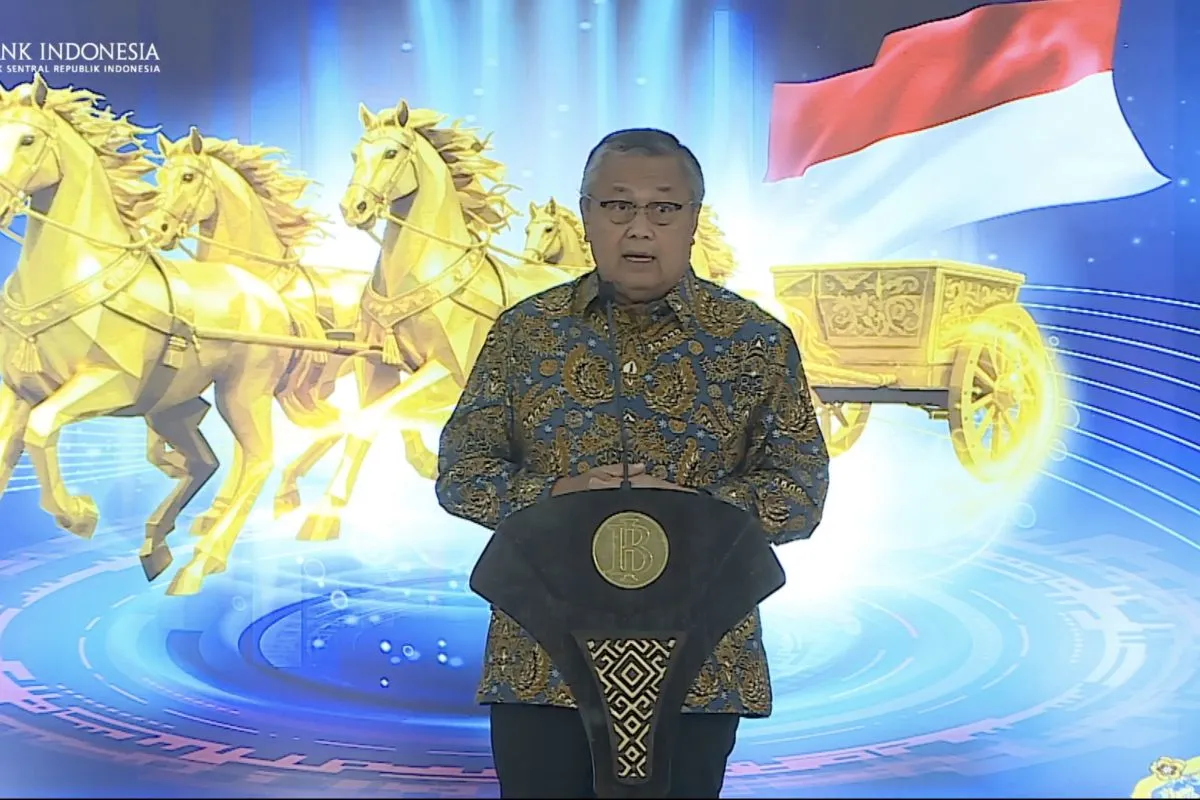
Bank Indonesia (BI) launched its 2025 Indonesia Economic Report on Wednesday, with Governor Perry Warjiyo saying the country had weathered external shocks better than many peers.
“Thank God, we should be grateful that Indonesia’s economy in 2025 continued to perform well and demonstrated strong resilience amid intense global economic and geopolitical volatility,” Warjiyo said in Jakarta.
The report assessed Indonesia as one of the best-performing Emerging Market Economies (EMEs), citing relatively high growth and well-maintained macroeconomic stability throughout the year.
Inflation stayed within BI’s target range of 2.5 percent plus or minus one percentage point, while the rupiah remained under control, supported by strong policy commitment.
Financial system stability was preserved, with banks maintaining solid capital buffers and low non-performing loan risks.
Rapid growth in payment system digitalisation also helped strengthen the national digital economic and financial ecosystem, providing broad support to economic growth in 2025.
Warjiyo said the positive performance reflected collective national efforts, underpinned by strong policy coordination between BI, the central and regional governments, and other relevant authorities.
BI’s policy mix in 2025 was consistently strengthened and directed at promoting growth while safeguarding stability, in close alignment with the government’s Astacita development agenda.
The first key measure was cutting the BI-Rate benchmark interest rate five times, totaling a 125-basis-point reduction to 4.75 percent in December 2025, the lowest level since 2022.
The second was a rupiah stabilisation policy aimed at protecting the economy’s external resilience from global shocks.
This was followed by monetary liquidity expansion through pro-market monetary operations to strengthen interest rate transmission, boost liquidity, and deepen money and foreign exchange markets.
BI also purchased government bonds in the secondary market, in line with its accommodative monetary stance through rate cuts and liquidity expansion.
A fifth policy involved macroprudential liquidity incentives for banks to encourage lending to government priority sectors under Astacita.
The final measure was accelerating digital payment systems to boost efficiency, productivity and more inclusive economic growth.
Warjiyo said Indonesia’s resilience in 2025 offered three key lessons: the importance of consistent and prudent macroeconomic policy, strong policy synergy among authorities, and leadership that combines technical expertise, practical experience and ethical integrity.
While optimistic about improving economic prospects, he warned global uncertainty remains.
“Going forward, we must stay optimistic while remaining alert and cautious amid continuing global volatility,” he said.
Related news: Bank Indonesia pushes payment system reforms to boost digital economy
Related news: BI launches new forward-looking credit incentives to boost key sectors
Translator: Alatas, Kenzu
Editor: Rahmad Nasution
Copyright © ANTARA 2026


