The fisheries sector is regarded as one of the driving forces of economic growth in Indonesia, including in Jayapura City, Papua.
Papua’s fisheries are highly productive, particularly in the Pacific Ocean to the north and the Arafura Sea to the south, with an estimated annual potential of 1.3 million tons of seafood, including tuna, skipjack, and mackerel.
Jayapura City is among the regions in Papua with significant fisheries potential, directly bordering the Pacific Ocean. Annual fish catch production in Jayapura City reaches 45 tons.
The fisheries sector is also a mainstay of the area nicknamed Port Numbay, where fish consumption is remarkably high at 93.5 percent.
However, the primary challenge fishermen face during peak fishing seasons is the lack of adequate drying facilities.
For example, when catches are abundant, fishermen on Kosong Island in Kayo Pulo Village dry their fish along a bridge frequently used by residents.
This practice increases the risk of bacterial contamination and can result in significant losses.
Solar Technology as a Solution
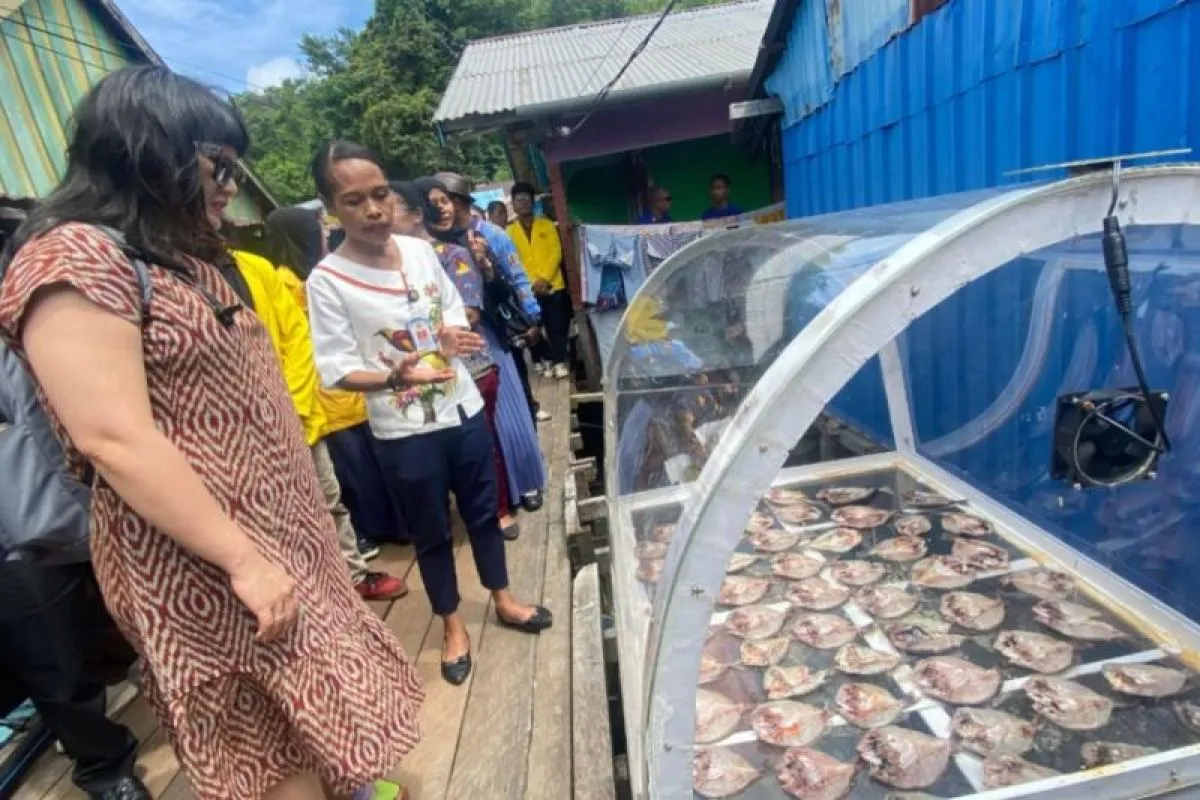
To address this issue, a community service team from Cenderawasih University in Papua is offering solar technology as a solution for drying fish without bacterial contamination.
The solar technology consists of a modified storage device with a greenhouse-like lid that maintains the quality of dried fish, prevents bacterial contamination, and ensures controlled water content.
The use of solar energy is intended to reduce electricity consumption among fishing households in the area.
The team designed the device to capture solar energy through solar cells, store it in batteries, and convert it into electricity distributed to the fish storage unit.
Popi L. Ayer, Head of the Marine and Fisheries Science Study Program at Cenderawasih University, explained that during peak fishing seasons, losses are substantial due to the lack of drying facilities.
Spoilage rates can reach 75 percent, while the shelf life of fresh fish is only one to two days.
Fishermen on Kosong Island also produce salted fish.
In addition to the greenhouse-based drying device, another technology has been introduced: a solar-powered storage facility designed to reduce electricity costs for the community.
With this innovation, fish can be stored for three to five days. Furthermore, the percentage of fish that deteriorates, which was previously 75 percent, has now decreased to less than 20 percent.
Production capacity for dried fish has also increased significantly, from 100 kilograms per week to 300 kilograms.
Reaching Fishermen
Neighborhood Unit 02 of Kosong Island in Kayo Pulo Village is home to around 150 families, 99.9 percent of whom rely on fishing for their livelihood.
The three-hectare island accommodates 20 fishing groups.
Marzuki, a representative of the Kosong Island fishermen, stated that large catches occur only between February and August.
In other months, the catch is significantly reduced, and at times fishermen do not catch any fish at all.
According to Marzuki, catches during the fishing season can reach hundreds of tons per month, with each boat (group) receiving around 15 tons per month.
However, the large volume of fish cannot be fully sold or consumed, forcing some of it to be discarded due to spoilage.
The community service program from Cenderawasih University, in collaboration with the Ministry of Higher Education, Science, and Technology, provides assistance to the community in drying fish safely, without fear of bacterial contamination.
The solar drying process also saves considerable time. Previously, drying fish under sunlight could take three to four days, but with solar technology, the process is completed in just four to five hours.
Deputy Minister of Higher Education, Science, and Technology, Stella Christie, emphasized that science and technology-based innovations provide real economic value to communities.
Fish drying technology allows for increased processing yields, making it essential to sustain this innovation.
This program is a concrete manifestation of the ministry's policy, which emphasizes delivering campus-based science and technology solutions that directly benefit communities.
The ministry fully supports the solar-powered storage technology and greenhouse-based drying system developed by Cenderawasih University and will continue to encourage the use of appropriate technology on small islands.
Strengthening Fishermen’s Institutions
Popi also emphasized the importance of strengthening fishermen’s institutions to increase independence, professionalism, and welfare.
Without strong institutions, fishermen remain in a weak bargaining position, requiring local government assistance. Ideal support includes the formation and strengthening of fishermen’s groups, coastal cooperatives, and coastal regional-owned enterprises.
Administrative assistance—such as group legality, access to government programs, and simple financial management—is equally crucial.
Moreover, government support should not only involve funding but also policies that enable fishermen to grow and guarantee access to capital, markets, information, and appropriate technology.
Physical assistance must be accompanied by capacity building, ensuring that equipment does not quickly deteriorate or become abandoned due to lack of use.
Social and cultural considerations also require attention. This includes recognizing customary marine rights, involving coastal customary structures (ondoafi or hereditary leaders, village heads, and customary councils), and adopting a communal approach. Assistance that ignores customary law often triggers conflict and social resistance.
Editor: Aditya Eko Sigit Wicaksono
Copyright © ANTARA 2026


