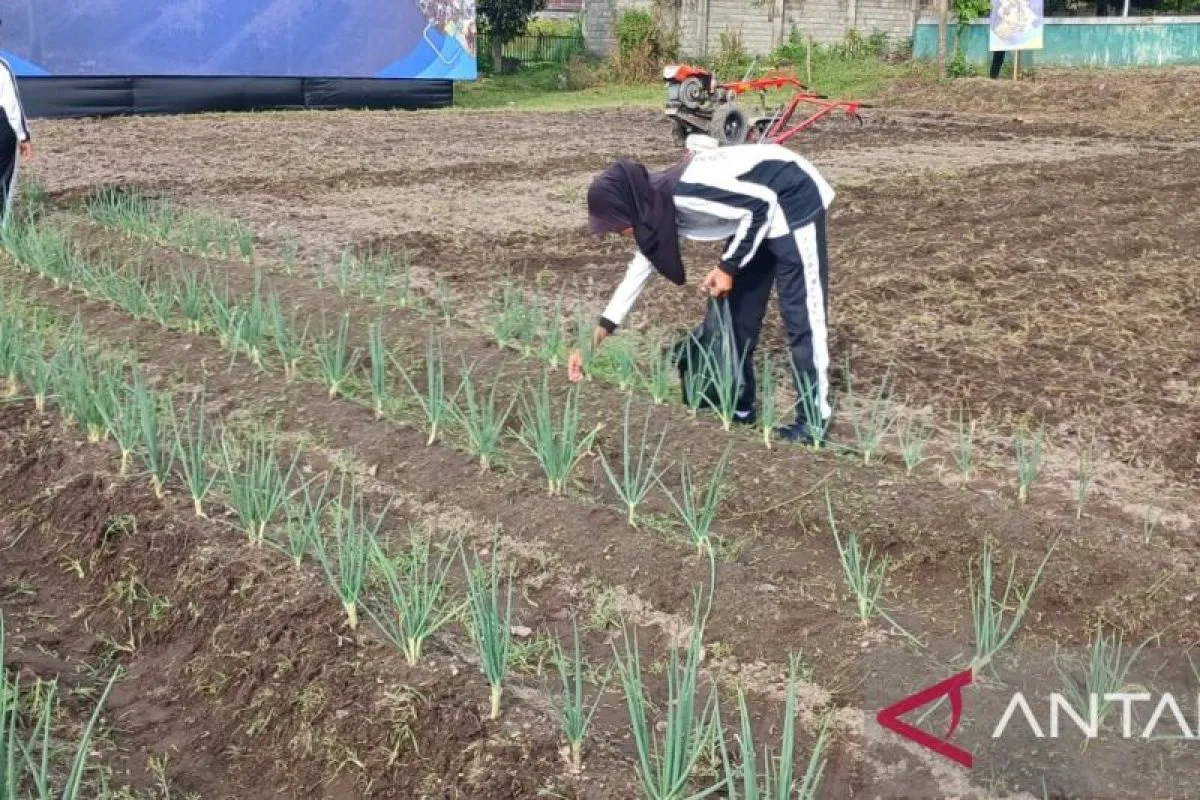
This is a routine afternoon at Public Vocational High School (SMKN) 1 Plosoklaten in Kediri, East Java, where learning does not stop at the classroom door but continues in barns, fields, and fish ponds.
Here, students work in teams based on their majors, responsible for livestock or crops that mirror real-world agricultural enterprises, blending formal education with daily responsibility and hands-on problem-solving.
For Aditya Mahendra, an 11th-grade student, choosing animal husbandry was not accidental. It reflected a childhood fondness for animals and a desire to learn skills that could immediately improve his family’s livelihood.
At school, Aditya does far more than read textbooks. He cleans pens, prepares feed, monitors animal health, and observes growth patterns—skills that no written exam alone could ever fully teach.
Each day, he helps care for dozens of sheep of different breeds, ensuring they are fed properly and housed in clean conditions to produce healthy, market-ready livestock.
The school removes logistical barriers that often limit vocational training. A dedicated grass-growing area within the campus supplies animal feed, eliminating the need for store-bought fodder.
That setup allows students like Aditya to focus on nurturing animals rather than sourcing materials, reinforcing discipline, consistency, and responsibility.
For Aditya, sheep breeding is not just a school assignment. It directly improves how he manages the eight goats kept by his family at home.
“I’m happy here because I learn animal farming properly,” he said. “I can apply what I learn at school directly at home.”
Beyond sheep, students receive instruction in cattle farming, including feed formulation and milking techniques, preparing them for diverse livestock operations.
Animal health is also emphasized, with hands-on lessons covering disease prevention, early detection, and basic treatment—skills essential in rural farming communities.
On the agricultural side, first-year student Adinda is part of a different learning ecosystem, one rooted in soil rather than stables.
Each agriculture class is divided into teams of 10 students, each assigned responsibility for specific crops grown on school-managed land.
Adinda’s group cultivates leeks, managing the entire cycle from planting and fertilizing to irrigation and harvesting.
Their garden plots sit on elevated land to prevent waterlogging, supported by sheds and infrastructure designed to mimic real farming conditions.
At just one month old, the leek plants already show promising growth, the result of careful planning and daily maintenance by the students.
“All the seeds and fertilizers are provided,” Adinda said. “Our job is to grow the crops properly until they are ready to sell.”
Incentives matter. The school has promised students a share of the profits from crop sales, reinforcing entrepreneurship alongside technical skills.
That approach reflects the vision of principal Hadi Sugiharto, who has led the school since 2024 with a clear emphasis on practical education.
Sugiharto believes vocational schools must go beyond theory, producing graduates ready to work, innovate, and adapt in real economic conditions.
Under his leadership, SMKN 1 Plosoklaten has expanded hands-on programs across majors, aligning education with local economic needs.
Agriculture students cultivate crops such as leeks and eggplants, while animal husbandry students manage sheep, cattle, omega-egg chickens, and aquaculture systems.
The school’s 10 hectares of land serve as a living laboratory, integrating classroom lessons with daily production activities.
Roughly 1,600 students are trained to understand food systems from the ground up, using locally sourced materials to strengthen food security.
Sugiharto said the school also facilitates 18-week internships, allowing students to deepen skills through industry exposure.
Partnerships with local government institutions further strengthen the school’s role as a regional vocational education hub.
He credited the East Java provincial government for launching the Sekolah Inovasi Ketahanan Pangan, or SIKAP, program, which supports national food self-sufficiency efforts starting at the school level.
Food security laboratory
Under Governor Khofifah Indar Parawansa, East Java has positioned schools as laboratories for food security through SIKAP.
The program aims to cultivate young talent capable of supporting Indonesia’s long-term goal of food independence, once achieved during the era of former president Soeharto.
To promote SIKAP, the governor recently led large-scale planting, fish-stocking, and harvesting activities involving thousands of teachers and students across East Java.
Participants included students from general and special-needs high schools, underscoring the program’s inclusive approach.
SIKAP redefines schools as more than centers of academic instruction, transforming them into strategic spaces for food security awareness.
Students gain hands-on experience in planting, harvesting, processing crops, and managing livestock, grounding abstract policy goals in everyday practice.
The program aligns closely with the central government’s food self-sufficiency agenda, a core pillar of President Prabowo Subianto’s Asta Cita missions.
Alongside Vice President Gibran Rakabuming Raka, Prabowo has placed food independence at the heart of national development strategy.
The results are already visible. In December 2025, just one year into Prabowo’s administration, Indonesia declared rice self-sufficiency.
That milestone was significant for a nation of roughly 280 million people, where rice remains the daily staple for most households.
East Java’s SIKAP program is increasingly viewed as a model that could be replicated nationwide.
By embedding food security lessons in schools, the province is mobilizing students not just as learners, but as future producers, innovators, and stewards of Indonesia’s food system.
As the sun sets over SMKN 1 Plosoklaten, students finish their chores and head home, carrying with them more than homework.
They leave with practical skills, a sense of ownership, and a quiet understanding that national food security begins with small, disciplined actions—often after the school bell rings.
Editor: Rahmad Nasution
Copyright © ANTARA 2026


