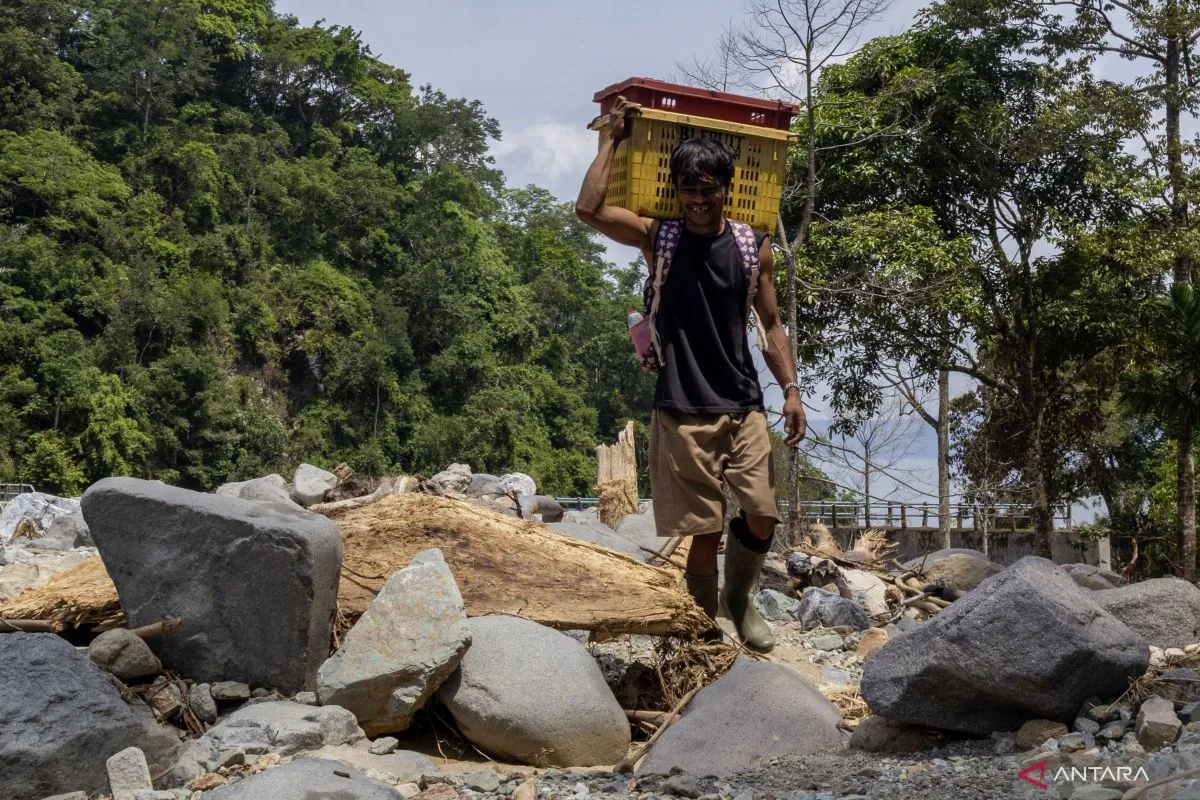
Now, two months after the disasters, life in the three affected provinces is gradually recovering as residents begin to look toward the future despite the ongoing struggles.
In West Sumatra, survivors and affected residents refuse to let the disasters hold them back.
One such example is Basri, a collector and small business owner specializing in fried bilih fish (Mystacoleucus padangensis) in Guguak Malalo Village, Tanah Datar District, West Sumatra. Following the recent disasters, he has already begun reviving his business.
Basri shared that in the early days after the disasters hit, several fishermen around Lake Singkarak continued their catches and sold them to collectors. As usual, Basri accepted whatever the fishermen brought in.
However, he soon noticed a difference in the fish caught during that early period. Customers began complaining that the meat did not taste like it usually did.
Realizing that the flash floods and landslides had compromised the quality of the fish, Basri decided to stop accepting fishermen's catches temporarily until the river and lake conditions improved.
This brief suspension proved to be a blessing in disguise. A few weeks later, Basri and other fish collectors saw a massive surge in supply, with average daily catches skyrocketing from 15 kilograms to 200 kilograms.
The increase in bilih fish production has created a ripple effect on the local community. From previously needing only three to four workers to help clean and process the bilih fish, he had to employ 15 people per day due to the high demand and supply of fish.
The purchase price for bilih fish depends on the season and availability. When supply is abundant, Basri buys them for Rp50,000 (approximately US$3) to Rp60,000 per kilogram. However, when fish are scarce, the price can reach as high as Rp100,000 per kilogram.
In addition to West Sumatra—specifically around Lake Singkarak and Payakumbuh City—Basri also sells bilih fish to Depok City in West Java and Dumai City in Riau Province.
Through this business, he has not only successfully put his children through school but also helped create jobs for the local community.
A similar determination to recover was also shown by Bustami, a mangosteen farmer and resident of Nagari Malalo. This young Minangkabau man refused to dwell on his losses or simply wait for government aid.
Even though the main road to his mangosteen plantation was cut off by the November flash floods, Bustami did not lose hope. Instead, he saw it as a challenge to overcome.
Bustami said the floods completely destroyed the sabo dam and the main access road to the forest where he grows his mangosteens.
Consequently, he now has to walk two kilometers, navigating a dry riverbed filled with massive boulders and piles of logs, as well as steep and slippery trails.
After harvesting the mangosteens, he has to shoulder two baskets at once, each filled with 20 kilograms of fresh fruit. This means he carries a total of 40 kilograms on his back, trekking those same two kilometers on the return journey.
Just like other residents, in the early days after the disasters hit, he did not harvest his mangosteens out of fear of follow-up floods. He let the fruit spoil on the trees, leaving the rest to be eaten by monkeys.
"Before the disaster, I could harvest 200 to 300 kilograms. But now, it is only 100 kilograms on average because so many were eaten by monkeys after the disaster hit," he said.
He sells his harvest to a collector for Rp27,000 per kilogram. In addition to farming mangosteens, he also works as a rice farmer and takes on manual labor jobs whenever there are construction projects in his village.
Tourism agenda
Tanah Datar District Head Eka Putra stated that the district government has prepared several tourism events to revive the local economy after the floods.
As an international tourism destination renowned for its arts and culture, Tanah Datar has prepared a series of tourism events, including the Pacu Jawi bull race.
Held every Saturday, this tradition features the thrilling sight of skilled riders racing pairs of bulls through a muddy track.
Ahead of the Islamic holy month Ramadan, the Tanah Datar District Government will also hold a horse racing event on February 8–9, 2026, in Lima Kaum Sub-district.
Another captivating event to be held is the fish-netting activity (manjalo ikan bilih) at Lake Singkarak. This event showcases the skill and technique required to catch the lake’s endemic bilih fish.
Putra expressed optimism that these tourism initiatives will accelerate economic growth and movement for the community after the flash floods and landslides.
"We must rise above this disaster," the district head said.
The devastating floods and landslides were indeed a nightmare for many—taking loved ones, homes, and livelihoods.
Two months have passed, and the community is slowly beginning to look toward the future, refusing to remain trapped in the shadow of the disasters as they keep the spirit of resilience alive and well.
Related news: Sumatra recovery: places of worship prioritized ahead of Ramadan
Related news: West Sumatra accelerate to complete temporary housing ahead of Ramadan
Related news: Govt speeds up temporary shelters, weather modification for Sumatra
Translator: Muhammad Zulfikar, Raka Adji
Editor: Azis Kurmala
Copyright © ANTARA 2026


