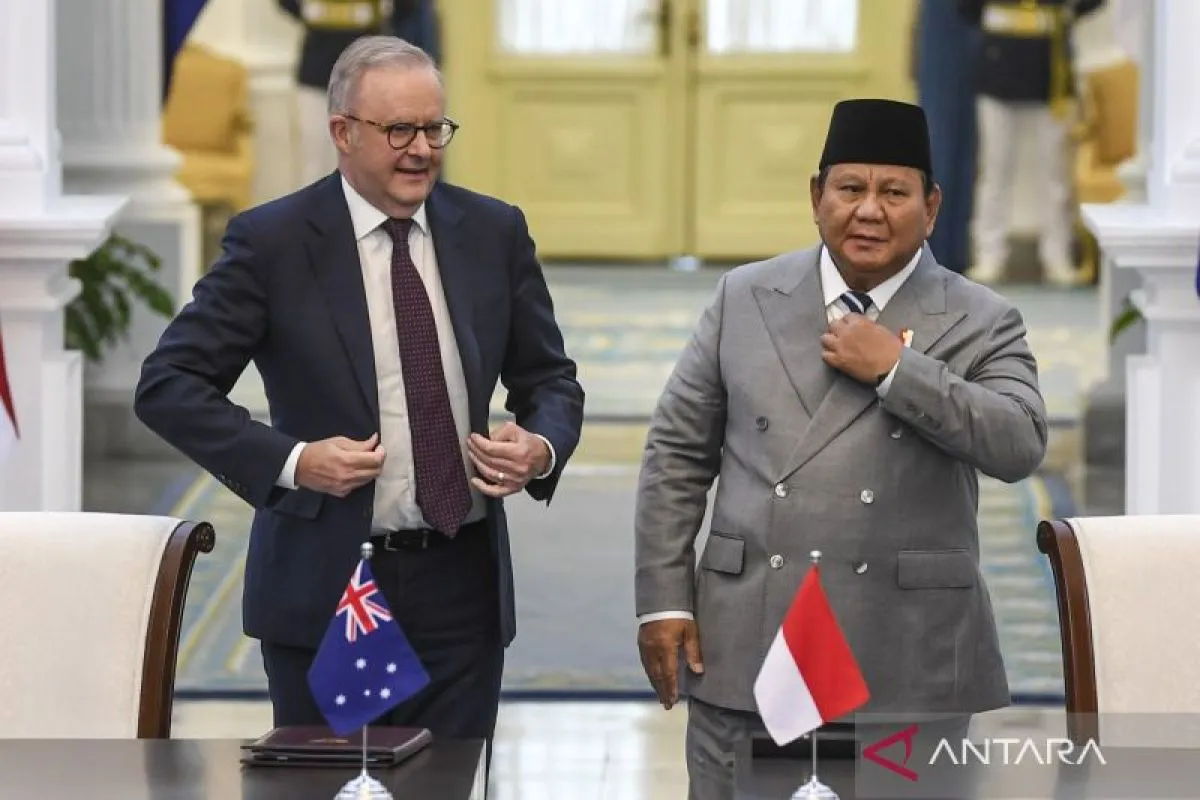
According to a release from Indonesia’s Government Communication Agency (Bakom), the meeting served as momentum to strengthen bilateral relations that have long been supported by cooperation in various sectors, especially in education and the economy.
Citing data from the Australian Government’s Department of Foreign Affairs and Trade on Friday, Indonesia-Australia relations continue to grow. This is reflected in increased student mobility, university cooperation, and a surge in the value of trade between the two countries in recent years.
Education cooperation
Educational ties are one of the main pillars of the Indonesia-Australia partnership. In 2025, around 24 thousand Indonesian students were recorded as studying at various Australian universities. In total, more than 200 thousand Indonesians have pursued education in the country.
Indonesia is also one of Australia’s largest sources of international students. The Australian government provides around 220 scholarships and short-term programs each year through the Australia Awards Indonesia scheme.
Several Australian universities have also begun opening campuses and cooperative programs in Indonesia, including Monash University in Jakarta, Western Sydney University in Surabaya, and Deakin University in Bandung.
The presence of these campuses is part of Australia’s commitment to developing Indonesia’s human resources.
Educational cooperation between the two countries also includes a number of strategic programs. The Australia-Indonesia BRIDGE School Partnerships Program brings together schools from both countries for learning cooperation, teacher training, and the exchange of experiences.
In addition, the Innovation for Indonesian School Children (INOVASI) program serves as basic education cooperation to strengthen literacy and numeracy. The program entered its third phase for the 2024-2027 period with funding of 55 million Australian dollars.
At the higher education level, the two countries are implementing joint campus and joint program schemes to strengthen academic and research collaboration.
Meanwhile, various scholarship schemes continue to run, such as the Australia Awards Scholarship, LPDP-Australia Awards, and the Australia-Indonesia Youth Exchange Program, which promotes youth exchange and leadership development.
Economic cooperation
In the economic sector, Indonesia-Australia relations are supported by the Indonesia-Australia Comprehensive Economic Partnership Agreement (IA-CEPA), which came into effect in July 2020. The agreement encourages increased trade and investment between the two countries.
The value of two-way trade increased significantly from AU$12.91 billion in 2020 to AU$35.38 billion by the end of 2024. Throughout 2024, Australia was recorded as Indonesia’s ninth-largest trading partner in terms of two-way trade value, amounting to 16.13 billion Australian dollars.
In the same year, Indonesia recorded a trade surplus of AU$3.13 billion against Australia. In the 2024–2025 period, Indonesia also became Australia’s ninth-largest trading partner, with trade valued at around AU$34.83 billion.
Trade growth is also reflected in rising exports. Over the past five years, Indonesia’s exports to Australia increased by around 14.46 percent, while Australia’s exports to Indonesia rose by 17.42 percent over the same period.
In terms of investment, Australian investment in Indonesia reached US$1.36 billion in 2024. Conversely, Indonesian investment in Australia was recorded at US$1.42 billion in the same year.
Economic relations between the two countries are also strengthened by people mobility. In the 2024-2025 period, around AU$1.75 million were recorded as visiting Indonesia, making tourism one of the drivers of bilateral economic relations.
Albanese traveled to Jakarta, Indonesia, from February 5 to 7, 2026. Indonesia and Australia are set to sign a cooperation treaty on joint security.
He emphasized that Indonesia and Australia have an increasingly close relationship as neighboring countries as well as friends.
The visit, Albanese said, was not his first. According to him, the frequency of such visits reflects the close ties between the two countries.
He added that the current visit was indeed brief as it took place amid the Australian parliamentary session. However, he assured that the next visit would be longer.
Responding to the remarks, Prabowo expressed his hope that relations between the two countries would continue to grow and bring benefits to both nations.
Last year in August, Indonesia’s Minister of Foreign Affairs, Sugiono, during a working visit to Canberra conducted a 2+2 meeting with Minister of Defense, Sjafrie Sjamsoeddin, and Australia’s Deputy Prime Minister/Minister of Defence, Richard Marles, as well as Australian Foreign Minister Penny Wong.
According to the Foreign Ministry's press release, the 2+2 meeting was held at the Australian Parliament House and marked the ninth meeting between the foreign and defense ministers of the two countries since the forum was initiated in 2011.
The meeting discussed various strategic issues related to political, defense, and security cooperation, as well as developments in the geostrategic situation in the Pacific region and the Middle East.
“The 2+2 meeting holds strategic significance for Indonesia-Australia relations, particularly in the foreign policy and defense sectors, as well as in joint efforts to maintain peace and regional stability,” Sugiono said in his opening remarks.
He continued, "Indonesia-Australia relations are currently at a very good point. This is inseparable from the shared interests of both countries, the proactive efforts of the two governments, and support from the public across various sectors of cooperation."
Related news: Prabowo invites Australia to invest with Danantara in farming, mining
Related news: What to expect of the upcoming Indonesia -- Australia defense treaty
Editor: Rahmad Nasution
Copyright © ANTARA 2026


