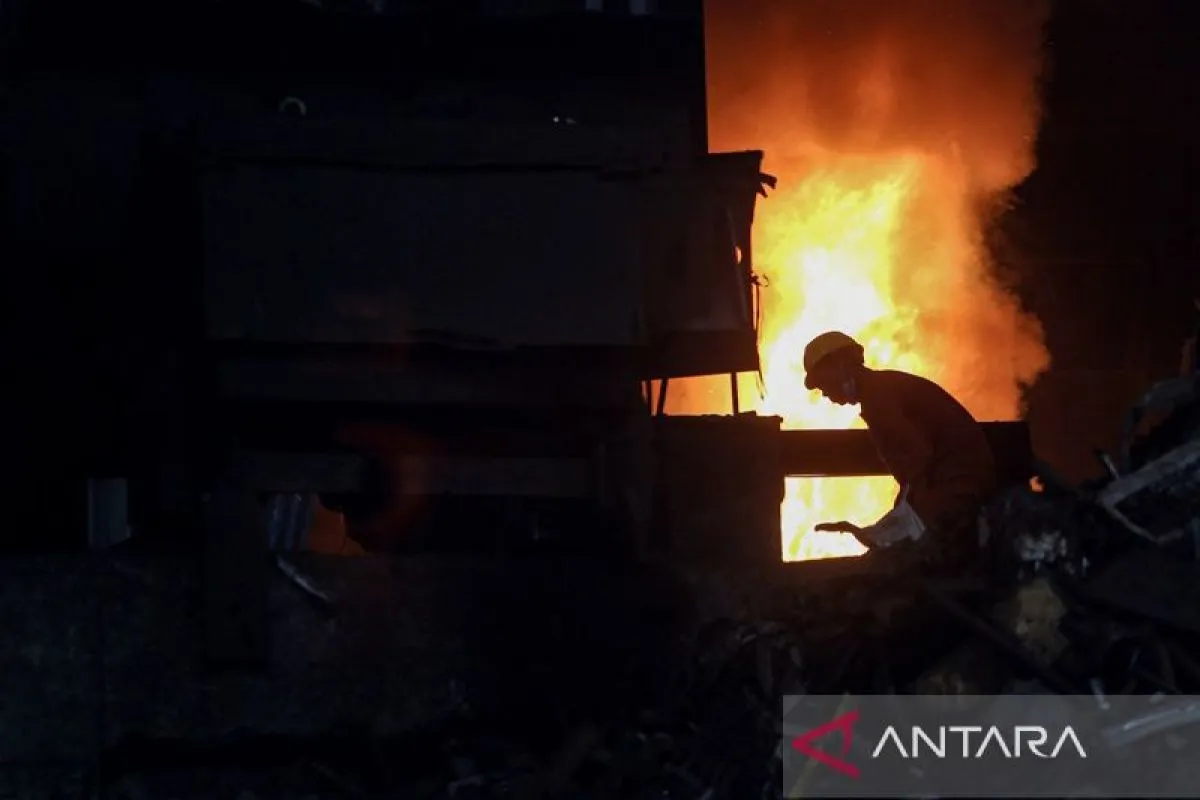
The country ranks among the world’s five largest exporters of iron and steel products amid the government’s ongoing efforts to increase the value of national resources through its downstreaming agenda, Trade Minister Budi Santoso highlighted.
During a meeting with Commission VI of the House of Representatives (DPR) in Jakarta on Wednesday (February 4), he noted that Indonesia had risen from 17th place in 2019 to fifth place at present, ranking behind only China, Germany, Japan and South Korea.
He attributed the major progress to downstreaming efforts and the strengthening of domestic industrial capacity.
The minister said the development was reflected in favorable trading trends over the past few years. In 2023, Indonesia recorded a surplus of US$15.07 billion in its iron and steel trade balance, with exports valued at US$25.80 billion.
In 2024, he continued, the surplus rose to US$18.44 billion, as the country exported US$27.97 billion worth of iron and steel, while imports declined to US$9.53 billion.
"These consecutive trade balance surpluses are in line with Indonesia's stronger foothold in global trade," Santoso added.
Ministry data show that Indonesia has maintained a surplus in iron and steel trade since at least 2020, with US$6.85 billion in 2020, US$11.96 billion in 2021, US$13.93 billion in 2022, and US$11.40 billion in 2023.
On the same occasion, Deputy Minister of Industry Faisol Riza briefed lawmakers on the sharp increase in Indonesia’s steel export volume over the past six years, rising from 9.3 million tonnes in 2020 to 23.97 million tonnes in 2025.
Meanwhile, imports, which had climbed to 17.9 million tonnes in 2022, fell to 14.8 million tonnes last year, he said.
The official emphasized that the trend reflected a combination of the government’s downstreaming policy, stronger domestic production, global pricing dynamics and geopolitical factors.
He also described the development as evidence of Indonesia’s success in enhancing the competitiveness of its steel industry.
Strategic measures
Strengthening the steel industry should remain a priority considering its vital role as the backbone of national development and the foundation for various downstream industries, Faisol said.
Accordingly, the Ministry of Industry, together with businesses and related stakeholders, has prepared comprehensive measures to strengthen the national steel industry.
These efforts begin with protecting domestic producers from unfair trade practices through the implementation of trade remedies aimed at limiting the entry of imported products that may harm local industries.
In addition, the government is encouraging the accelerated adoption of more efficient and environmentally friendly technologies in the steel sector. Modernizing production facilities is crucial for improving product quality while reducing production costs, which have historically been relatively high, Faisol noted.
The ministry also emphasized the importance of implementing mandatory Indonesian National Standards (SNI) for downstream steel products that come into direct contact with consumers, as a measure to maintain quality and protect the domestic market.
On the upstream side, increasing investment in the crude steel sector is a focus so the national steel industry's raw material needs can be met domestically. This step is expected to reduce dependence on imports while strengthening the overall industrial structure.
Furthermore, support for steel downstreaming is aimed at meeting the needs of strategic sectors and encouraging new investment growth.
"Support the downstreaming of national steel for consumption by the shipping, automotive, military and construction industries," Faisol noted.
The downstreaming efforts also involve the country’s investment and sovereign wealth manager, Danantara.
These initiatives include revamping state-owned steel producer Krakatau Steel, developing downstream projects and integrating steel demand for the shipping and railway sectors, Danantara Indonesia Chief Operating Officer Dony Oskaria said.
One of the main focuses is the improvement of PT Krakatau Steel, which has entered a phase of healthier financial conditions following various interventions and fundamental reforms.
In addition to restructuring and strengthening the company’s performance, Danantara is encouraging the development of the upstream sector of the steel industry through a downstream project that will enter the groundbreaking stage next month.
"The groundbreaking next month will add 3 million tons of our steel capacity," Dony said, during a meeting with Commission VI of the DPR.
The capacity expansion is considered crucial, given that national steel demand remains heavily dependent on imports.
By strengthening domestic production capacity, the government expects steel supply for strategic industries to be met domestically.
Dony emphasized that steel industry development cannot stand alone and must be integrated with other industrial sectors that are major steel users.
In this context, Danantara is promoting industrial integration among state-owned enterprises under its management.
In the shipping sector, Danantara will make state-owned shipbuilder PT PAL Indonesia the anchor of the national shipbuilding industry.
"We are merging companies operating in the shipping industry, but we will require all companies requiring ship manufacturing within Danantara's scope to do so at PT PAL," he said.
In addition to the shipping, Danantara is strengthening the railway industry through the development of PT INKA.
Currently, PT INKA has manufacturing facilities in Madiun and Banyuwangi, and will expand production capacity in Banyuwangi—all are located in East Java.
In the future, Dony continued, the government will require all process of repairing and manufacturing of national trains to be carried out at PT INKA.
This policy aligns with the government's transportation roadmap, which positions trains as the backbone of mass transportation.
Challenges
Despite the comprehensive development measures prepared by the government, the national steel industry continues to face several challenges that must be addressed gradually.
One key issue is the wide gap between national steel consumption and domestic production capacity.
“This gap is filled by imported products, most of which come from China,” Faisol said.
In addition, most domestic steel producers remain focused on the construction and infrastructure sectors, while underutilizing opportunities in higher-value segments such as automotive, shipping and heavy equipment industries.
Products such as alloy steel and special steel offer significantly higher added value, yet remain underdeveloped domestically.
Product diversification, Faisol stressed, is an urgent requirement for the national steel industry to compete in broader markets.
Another challenge lies in aging production facilities that are technologically outdated and not yet fully environmentally friendly.
This affects product quality and results in less competitive production costs, making it difficult for domestic producers to compete with imported steel on price.
To address these issues, the Ministry of Industry has initiated an integrated industrial policy aimed at sustainably developing the steel sector.
From the energy perspective, the government is providing certainty on gas supply volumes and prices through the Specific Natural Gas Price (HGBT) scheme, while expanding the scope of HGBT recipients within the nationwide steel industry.
Raw material policies are also designed to ensure the stability and sustainability of key inputs, enabling the industry to operate more efficiently and sustainably.
Related news: Finance Ministry targets 40 steel firms over Rp5 trillion VAT losses
Related news: Indonesia hits top five in iron and steel exports via downstreaming
Editor: M Razi Rahman
Copyright © ANTARA 2026


