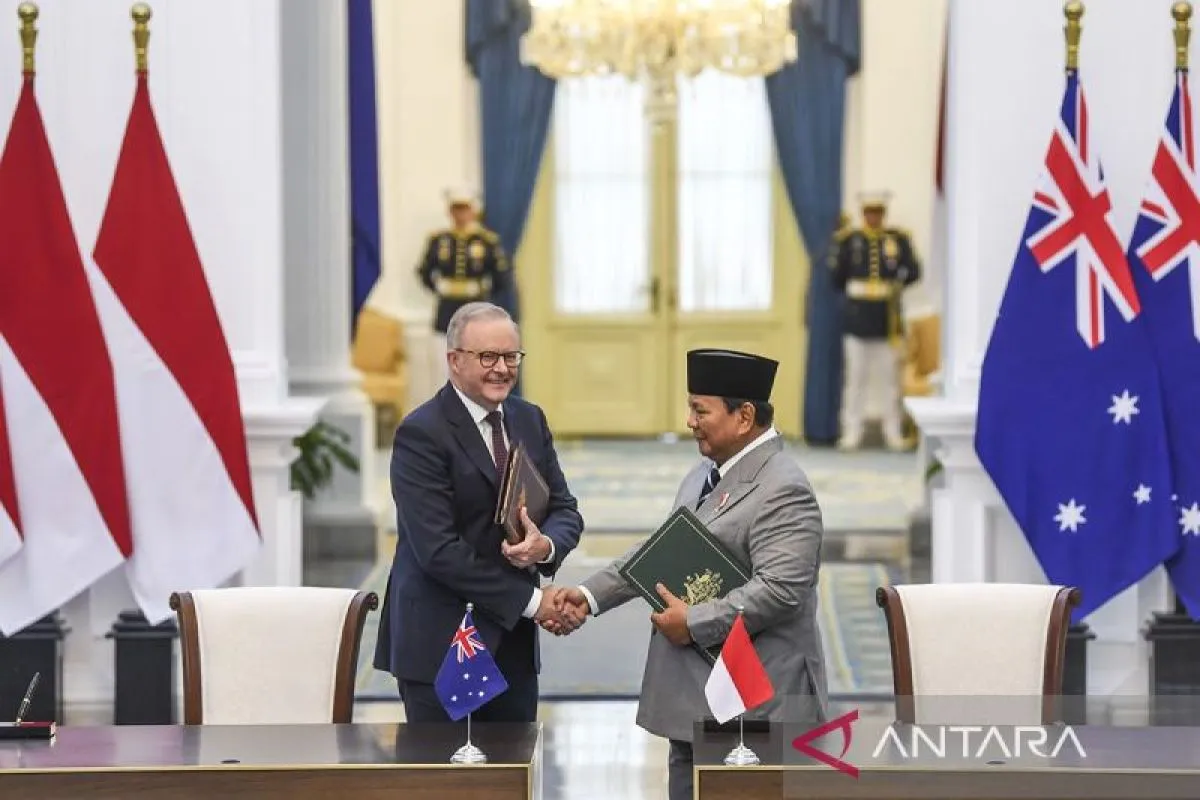
As reported by national media, this maneuver transcends bilateral formality, acting as a decisive response to Indo-Pacific complexities that demand absolute maritime legal certainty.
By establishing this legally binding framework during PM Albanese’s visit from February 5 to 7, Indonesia is constructing a critical security anchor to shield national interests amidst sharpening global volatility and shifting power dynamics.
During their joint press conference at the Merdeka Palace, President Prabowo strategically invited PM Albanese to the Ocean Impact Summit in Bali this June.
This invitation underscores the thesis that maritime security is no longer a matter of passive neutralism but a fundamental requirement for sustainable development.
The President emphasized that Australia's presence is crucial to ensure the summit yields tangible, actionable achievements rather than mere declarations.
This signals a shift from the traditional "free and active" doctrine toward a "strategically engaged" posture, where Indonesia actively recruits regional partners to secure its vast oceanic territories.
The maritime domain has transformed into a high-stakes arena for resources, where sovereignty in the Exclusive Economic Zone (EEZ) is frequently tested by unilateral claims.
Such volatility creates systemic risks that disrupt global logistics and inflate shipping insurance costs, directly affecting commodity prices for the Indonesian public.
Consequently, the 2026 Jakarta-Canberra Treaty acts as a "shield and lever"—a legal shield to enforce sovereignty and an economic lever to accelerate industrial downstreaming and integrate Indonesia deeper into global supply chains.
Related news: Indonesia, Australia sign investment MoU to boost global access
Securing maritime jurisdiction
Legally, the treaty’s strength derives from the principle of pacta sunt servanda under the 1969 Vienna Convention, which mandates that parties perform obligations in good faith.
By elevating cooperation from a memorandum of understanding to a formal treaty, both nations possess a mutual international obligation to respect maritime sovereignty.
As cited in international law journals, this legal certainty is the bedrock of effective UNCLOS 1982 enforcement.
Explicit Australian support for Indonesia’s position adds global legitimacy, narrowing the maneuvering room for third-party actors intending to bypass international rules in regional waters.
This legal dimension is vital for the protection of subsea infrastructure, particularly the fiber-optic cables that serve as digital arteries of global communication.
High-tech collaboration ensures these assets are shielded from sabotage or cyberattacks, addressing anxieties regarding data sovereignty and national resilience.
Furthermore, the pact catalyzes domestic regulatory reform, compelling the harmonization of national protocols with global standards.
Such predictability is the primary metric for assessing a state's credibility in an era of global fragmentation, ensuring Indonesia's maritime policies remain robust and constitutionally sound.
The treaty also institutionalizes a mechanism for regular high-level consultation, reducing diplomatic friction.
By codifying security arrangements, Indonesia ensures regional stability, allowing the government to focus on internal development goals.
This acts as a stabilizing force that prevents regional tensions from spilling into the economic sphere, providing a "tranquility premium" essential for a nation transitioning from a middle-income country to a global economic powerhouse.
Related news: Indonesia, Australia sign joint security treaty in Jakarta
Advancing economic synergies
Economically, the treaty directly lowers Indonesia’s risk premium for global investors sensitive to regional stability.
According to an analysis by the Economic Policy Institute, security guaranteed by robust bilateral agreements stimulates long-term Foreign Direct Investment (FDI).
This is critical for the national industrial downstreaming program. The synergy between Indonesian nickel and Australian lithium now operates within a secure legal corridor, providing the foundation for a global electric vehicle battery manufacturing hub free from the shadow of regional conflict.
Strategically, this move fortifies "ASEAN Centrality" through bold leadership. Indonesia is not abandoning regional collectivity but strengthening it by demonstrating that member states can take strategic initiatives to balance regional powers.
By taming friction with external security pacts through measured diplomacy, Jakarta ensures southern stability remains under regional control rather than being dictated by distant powers. This "smart diplomacy" bolsters national bargaining power, positioning Indonesia as an "honest broker" in the broader Indo-Pacific theater.
Implementation remains the final test. The government must ensure this cooperation provides tangible security for maritime stakeholders, from local fishermen to multinational industry players.
Regional stability is a premium commodity maintained only through concrete action and fair law enforcement.
Indonesia is signaling that sovereignty is not traded but strengthened through equitable, mutually beneficial collaboration.
The upcoming Ocean Impact Summit in Bali will serve as the first major test of this newly forged strategic synergy.
The Jakarta-Canberra treaty manifests a vision to position Indonesia as a global anchor of stability. By using international law as a foundation and economic cooperation as a goal, Indonesia has successfully mended the frayed edges of regional security.
Sovereignty and prosperity are inseparable sides of the same coin. Through this alignment, Indonesia is no longer merely a spectator; it has become the strategic cornerstone of a resilient and prosperous southern Indo-Pacific.
*) Rioberto Sidauruk is a strategic industry analyst, currently serving as Expert Staff to Commission VII of the House of Representatives (DPR).
The views and opinions expressed on this page are those of the author and do not necessarily reflect the official policy or position of ANTARA News Agency.
Copyright © ANTARA 2026


