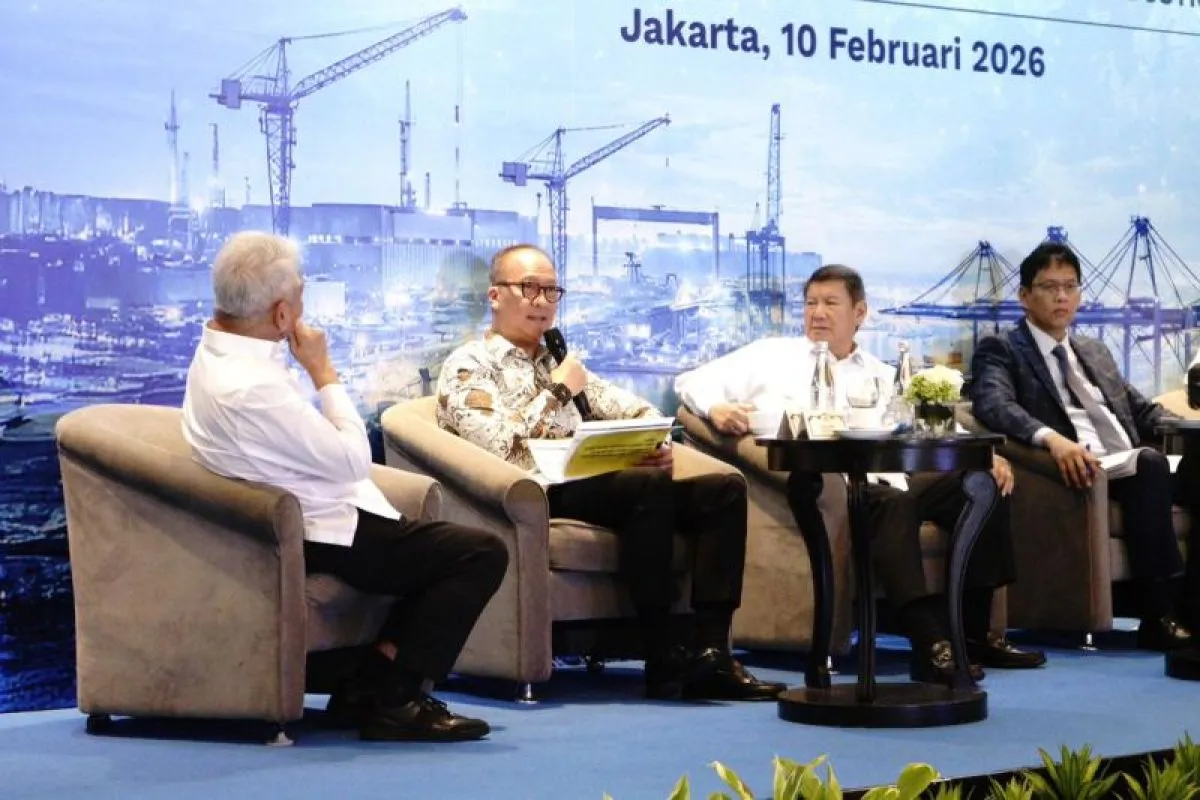
Indonesia will strengthen its shipbuilding industry to accelerate logistics transformation, support food security, and boost manufacturing competitiveness, Industry Minister Agus Gumiwang Kartasasmita said on Tuesday.
He said the strategy is crucial to improving inter-island goods distribution across the archipelago, where maritime transport forms the backbone of the national logistics system.
In 2025, manufacturing output grew 5.30 percent, outpacing national economic growth of 5.11 percent, marking the sector’s strongest performance in more than a decade and reaffirming its role as a key economic driver.
"Strengthening the shipbuilding industry is no longer a policy option, but a strategic necessity,” Agus said, noting its broad multiplier effect across raw materials, components, technology, financing, human resources, infrastructure, and logistics services.
Indonesia has about 342 shipyards across 29 provinces, employing tens of thousands of workers and capable of building various vessel types, including large-capacity ships.
The ministry’s strategy includes integrating supply chains, upgrading production equipment and technology, improving regulations, enhancing workforce skills, expanding financing schemes, and strengthening logistics infrastructure.
However, the industry still faces structural challenges, notably weak demand and heavy reliance on imported raw materials and components, which continues to weigh on domestic content levels.
Agus said procurement rules under Presidential Regulation No. 46 of 2025 and Industry Ministry Regulation No. 35 of 2025 aim to raise local content and stimulate domestic ship component manufacturing.
He added that shipyard utilization remains low due to limited new vessel orders, despite national production capacity of about 1,242 units annually, underscoring the need for policies that create sustained demand.
To address this, the government is rolling out permit simplification, low-interest financing support, expanded export assignment schemes to substitute imports, fiscal incentives, and tighter import entry-point port rules.
Agus said the government’s priority program to build 975 vessels offers major opportunities for domestic shipyards to raise output, utilization, and competitiveness.
"I am confident Indonesia’s maritime industry can become the backbone of national logistics and connectivity through strong policy synergy and broad stakeholder collaboration,” he said.
Related news: Indonesia eyes global ship production hub status
Related news: Indonesia to build ship industry for blue economy development
Translator: Ahmad Muzdaffar Fauzan, Martha Herlinawati Simanju
Editor: Primayanti
Copyright © ANTARA 2026


