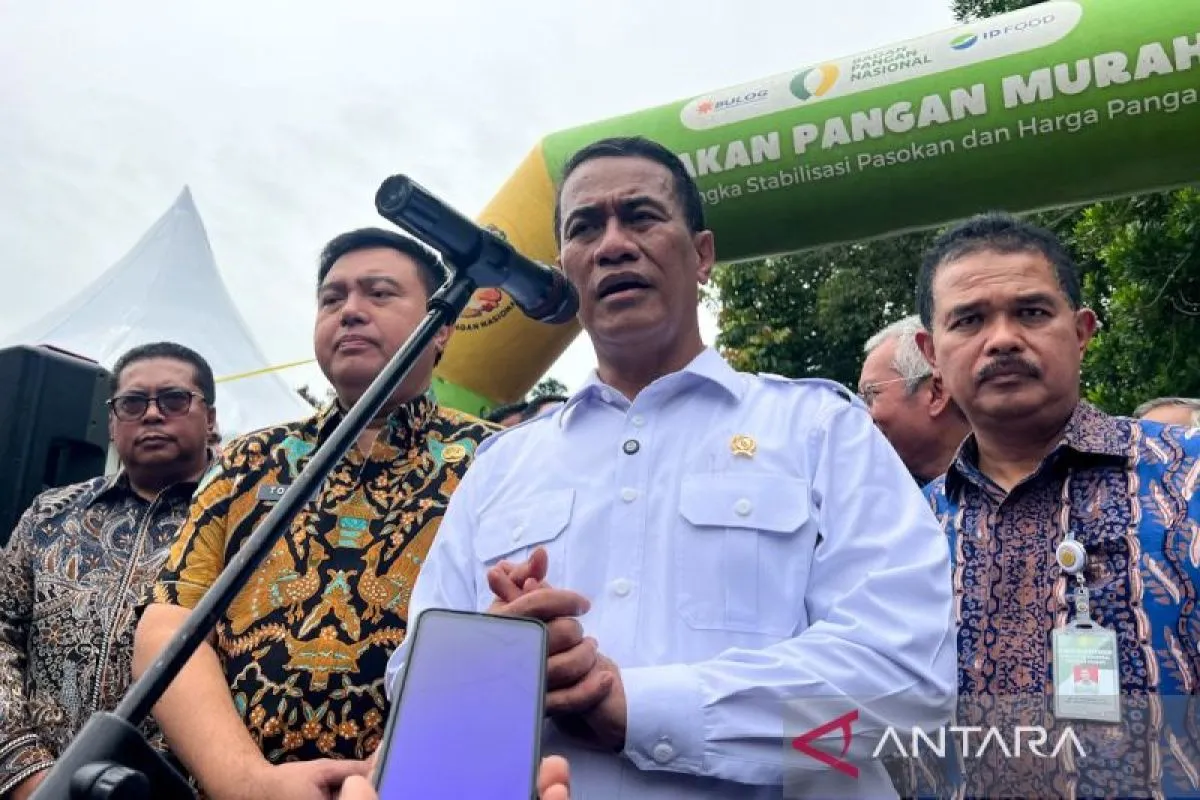
"We are already self-sufficient in nine (commodities), but we are still lacking three. These three (commodities) are not yet self-sufficient, but we have ample stocks," he said at the inauguration of the National Simultaneous Affordable Food Movement (GPM) in Jakarta on Friday.
According to him, Indonesia has achieved self-sufficiency in nine strategic commodities, with a strong production surplus to support supply stability.
The food commodities include rice, consumer sugar, large chilies, cayenne pepper, corn, cooking oil, chicken, eggs, and shallots. Meanwhile, the other three commodities that have not yet achieved self-sufficiency are garlic, soybeans, beef/buffalo meat, and industrial sugar.
The government is striving to boost production of these commodities to attain self-sufficiency and strengthen Indonesia’s overall food sovereignty, Sulaiman emphasized. Furthermore, he mentioned that the surplus in food production that achieves self-sufficiency provides a strong buffer to maintain stable supply and prices for consumers ahead of Ramadan and Eid al-Fitr 2026, which fall between February and March.
This approach ensures the government can secure the national food supply ahead of and during the National Religious Holidays (HBKN), Chinese New Year, Nyepi Day, Ramadan, and Eid al-Fitr 1447 H.
The minister underlined that strong government reserves are key to controlling food prices, while warning businesses against selling goods above the stipulated highest retail price (HET).
He said that the current national rice stock is at its highest level in history. Availability of meat and other animal protein commodities is also at a safe level, with some even reaching export markets.
In addition, Statistics Indonesia (BPS) noted promising production potential for early 2026. In the January–March 2026 period, potential rice production is estimated to reach 10.16 million tons, an increase of 1.39 million tons, or 15.79 percent, compared to the same period last year.
To ensure effective pricing policies, monitoring of stocks and distribution will be strengthened through collaboration across ministries/agencies, regional governments, and the Food Task Force to maintain affordable prices for the public during Ramadan and Eid al-Fitr.
Sulaiman warned that any attempt to raise prices would prompt firm action from the government and the Food Task Force. Monitoring will target major distribution channels rather than small traders, with audits focusing on factories, primary distributors, and upstream supply chains.
The government began implementing the GPM simultaneously across Indonesia on Friday as part of its strategy to stabilize food supplies and prices through direct market intervention while ensuring that the public has access to sufficient, safe, and affordable food.
The GPM is being implemented simultaneously in 38 provinces and 514 districts/cities in collaboration with the National Food and Agriculture Agency, Ministry of Agriculture, local governments, state-owned food enterprises (SOEs) such as Perum Bulog, and businesses to ensure effective distribution, market operations, and price controls across all regions.
Related news: Indonesia's food stocks secured ahead of Ramadan, minister says
Related news: Prabowo says food, energy self-sufficiency key to Indonesia's future
Translator: Muhammad Harianto, Resinta Sulistiyandari
Editor: M Razi Rahman
Copyright © ANTARA 2026


