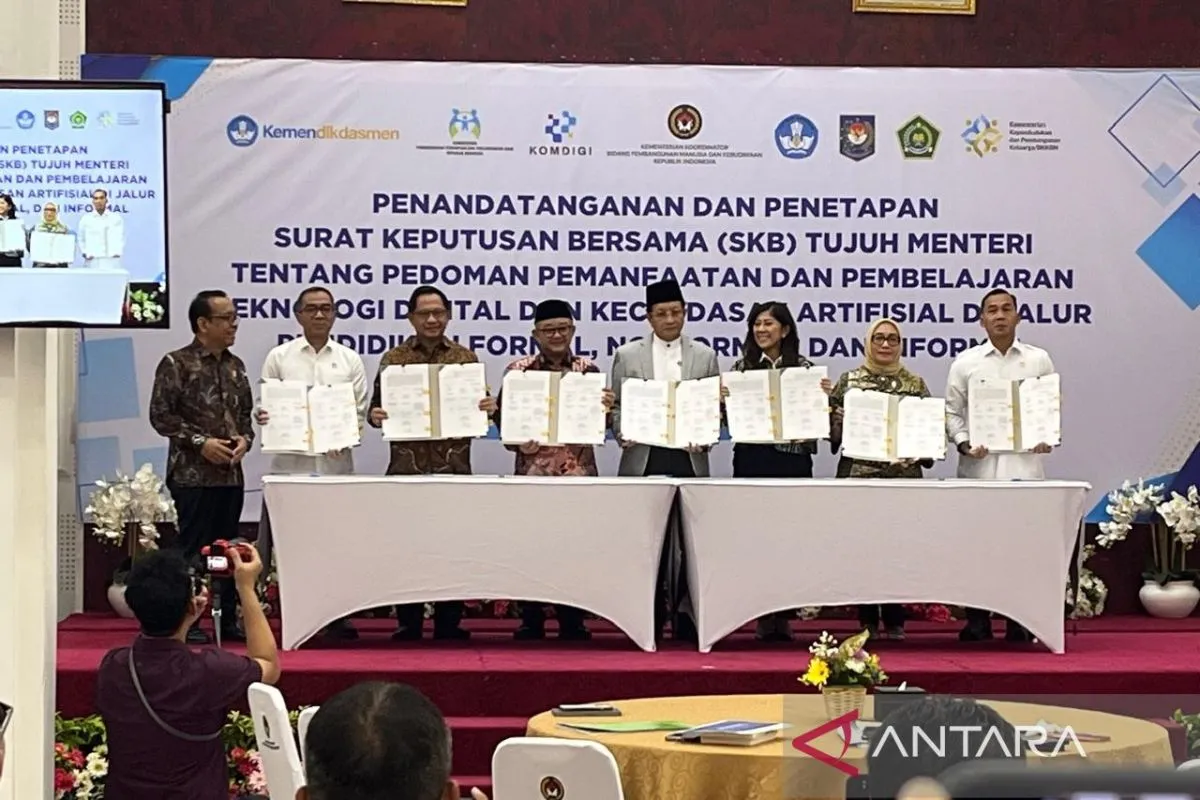
Coordinating Minister for Human Development and Culture Pratikno said his office facilitated and coordinated the policy, which was signed by seven cabinet ministers in Jakarta on Thursday to guide responsible technology use across schools.
The signatories include Home Affairs Minister Tito Karnavian, Religious Affairs Minister Nasaruddin Umar, Primary and Secondary Education Minister Abdul Mu’ti, and Higher Education, Science and Technology Minister Brian Yuliarto.
Also signing the decree were Communication and Digital Affairs Minister Meutya Hafid, Population and Family Development Minister Wihaji, and Women’s Empowerment and Child Protection Minister Arifah Fauzi.
Pratikno said the regulation stresses the importance of prudent digital technology and AI use in education while considering children’s developmental readiness and capacity to interact responsibly with emerging technologies.
The decree sets guidelines on the minimum age for using digital technology and AI, types of permitted use, and recommended duration of use tailored to different education levels.
Related news: Indonesia, UAE strengthen cooperation in digital talent, research
As students progress to higher education levels, technology use will become more flexible because older students are considered more capable of understanding digital tools and managing their use responsibly.
In contrast, technology use among early childhood and primary school students will be more tightly regulated, particularly regarding screen time and the type of digital content accessible in learning environments.
“The lower the educational level, the more controlled it becomes. It is not just about duration but also about the content,” Pratikno said.
He added that at primary and secondary school levels, students will not be allowed to use instant AI applications that directly generate answers to questions submitted by users.
However, artificial intelligence tools may still be permitted if specifically developed for educational purposes and designed to support structured learning activities.
“For example, robotics simulations used in primary schools may incorporate AI because they are designed to meet educational objectives,” he said.
Pratikno said the government hopes the policy will encourage responsible use of digital technology among children while ensuring learning benefits without exposing students to excessive risks.
He added that clear guidelines were needed as AI tools become increasingly accessible to students and educators across Indonesia’s education system.
Related news: Indonesia to add coding, AI to Sekolah Rakyat curriculum
Translator: Asep Firmansyah, Raka Adji
Editor: Rahmad Nasution
Copyright © ANTARA 2026


