..the fisheries sector is projected to become a key pillar of Papua’s economy.Jayapura, Papua (ANTARA) -
Blessed with abundant marine and fisheries resources, Papua has yet to fully maximize its contribution to the nation’s export value.
In response to this situation, the central and regional governments continuously developing integrated strategies, from upstream to downstream, to encourage increased fish exports and simultaneously strengthen the blue economy in eastern Indonesia.
The Head of the Papua Provincial Marine Affairs and Fisheries Office, Iman Djuniawal, said Papua’s marine product potential reaches approximately 1.3 million tons per year, primarily from northern waters within Fisheries Management Area (WPP) 717.
This potential reflects the abundance of fisheries resources, though they have not been fully utilized in exports.
One of the main problems lies in limited fisheries infrastructure. To date, Papua lacks a large-scale fishing port capable of accommodating large-tonnage vessels and adequate cold storage facilities. As a result, the majority of fish caught in Papuan waters is transported elsewhere for processing.
This condition results in the loss of added economic value that should benefit local communities. Furthermore, dependence on other regions also makes the distribution chain longer and less efficient.
"Until now, the catch has not been fully utilized in Papua due to limited facilities. However, if processing were carried out locally, the added value would be much greater," Djuniawal remarked.
As a strategic step, the regional government is promoting infrastructure strengthening by developing the Hamadi Fish Landing Base (PPI) in Jayapura City into a modern, integrated fisheries center.
Currently, the Hamadi PPI serves only as a loading and unloading location for fishermen's catches. In the near future, it is projected to accommodate processing, distribution, and transaction centers.
With a land area of approximately two hectares, the PPI is being developed vertically to accommodate various activities in one area. This concept is expected to provide a solution to space constraints and increase the efficiency of economic activities in the fisheries sector.
However, another challenge arises when data shows that approximately 90 percent of fishermen in the region are still traditional fishermen, consisting of 1,181 people, including 256 indigenous Papuans (OAP).
This situation impacts production capacity limitations, both in terms of volume and consistency of supply, when the export market demands the availability of large, sustainable products with strict quality standards.
To address these issues, the government is pushing a capacity building effort for fishermen through fishing gear assistance, training, and strengthening of fishermen's group institutions. These efforts are expected to increase productivity while improving the quality of the catch.
This measure is also part of the strategy to achieve Papua's 230,000 tons of fisheries production target by 2026, covering both the capture fisheries and aquaculture sectors, which are considered crucial for supporting food security and exports.
For the regional government, an increase in production is not merely oriented towards quantity, but also the quality and sustainability of resources. Therefore, the approach taken must consider the balance between utilization and conservation of marine resources.
In addition to strengthening the upstream sector, the development of large-scale fishing ports is a major strategy for strengthening the supply chain. These ports are expected to serve as integrated fisheries logistics hubs, from landing, storage, to distribution.
Therefore, Papua needs large ports capable of accommodating high-tonnage vessels and equipped with modern facilities.
These ports will streamline the distribution process, enabling Papuan fisheries to more effectively reach export markets.
Moreover, the government is also encouraging the downstream processing of fishery products to increase added value. Currently, most exported products are raw materials with a relatively low sales value.
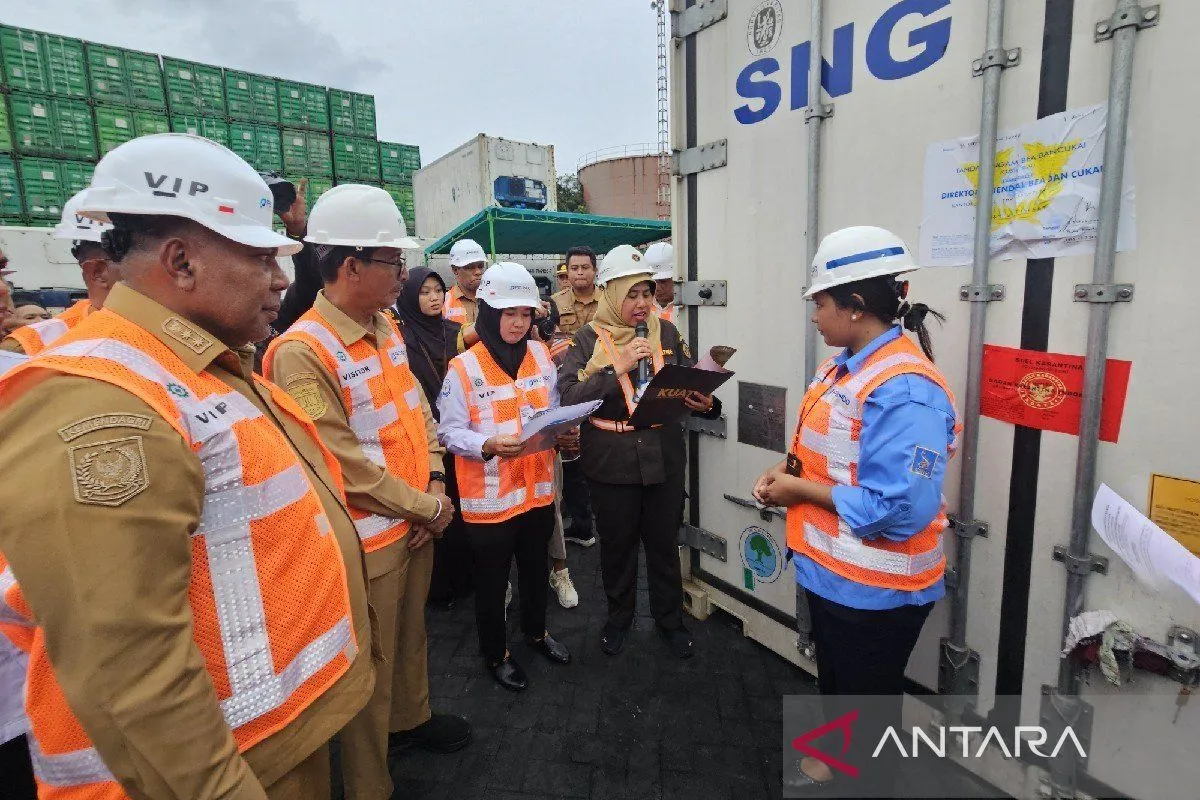
Through processing, fishery products can generate higher economic value and open up broader market opportunities. This is evident in the inaugural export of 17.8 tons of processed tuna to the United States.
With exports including frozen yellowfin loin, ground meat, and poke cubes worth roughly Rp1.9 billion (US$108 thousand), Papuan fishery products have proven their global market competitiveness.
These processed exports demonstrate the ability of Papua’s marine potential in penetrating the international market.
To support increased exports, quality assurance is a crucial factor.
Acting Head of the Jayapura Marine and Fisheries Product Quality Control and Supervision Center (PPMHKP), Fitriah Haji Ali, explained that quality control is implemented comprehensively across the entire value chain, from upstream to downstream.
She said fishery products bound for export must meet international standards, such as Hazard Analysis and Critical Control Points (HACCP) and various other certifications, serving as the primary requirement for product acceptance in the global market.
She emphasized that monitoring the export market covers the entire production chain, from fishing to distribution.
Meanwhile, Acting Head of Papua Quarantine Agency, Krisna Dwiharniati, noted that quarantine acts as a gatekeeper for quality, ensuring that every product meets the health and food safety standards of the destination country.
Every export commodity must undergo document verification, physical inspection, and laboratory testing. This process is crucial to prevent potential rejection in the destination country, which could be detrimental to business actors.
To improve service efficiency, the government is also promoting digitalization through the Single Submission Quarantine Customs (SSmQC) system that integrates quarantine and customs services.
This system reduces the service process from 10 stages to just three, resulting in a time efficiency of up to 73 percent. This digitalization is considered capable of accelerating the flow of goods while reducing logistics costs.
As a sustainable effort, the Papua Provincial Government, along with relevant agencies, has developed a fisheries sector development roadmap until 2040. This plan includes strengthening production, infrastructure development, and improving fisheries sector governance.
In addition to tuna, the government is also encouraging the development of other commodities, such as seaweed, crab, and reef fish. Seaweed is even projected to become a new export commodity with significant potential, particularly in districts of Yapen, Supiori, and Biak Numfor.
With these strategies in place, the fisheries sector is projected to become a key pillar of Papua’s economy. Progress in exports are expected not only to boost regional revenue but also to create jobs and enhance the welfare of coastal communities.
Moving forward, strong synergy among the government, businesses, and the community will be crucial to advancing fish export development in Papua. With sustained support, the region’s vast potential can be fully realized as a globally competitive economic force.
Related news: Indonesian minister pushes export villages to boost West Papua economy
Related news: VP Gibran visits Wamena market to boost indigenous Papuan economy
Related news: Highland Papua pledges full support for Prabowo’s Asta Cita
Editor: M Razi Rahman
Copyright © ANTARA 2026