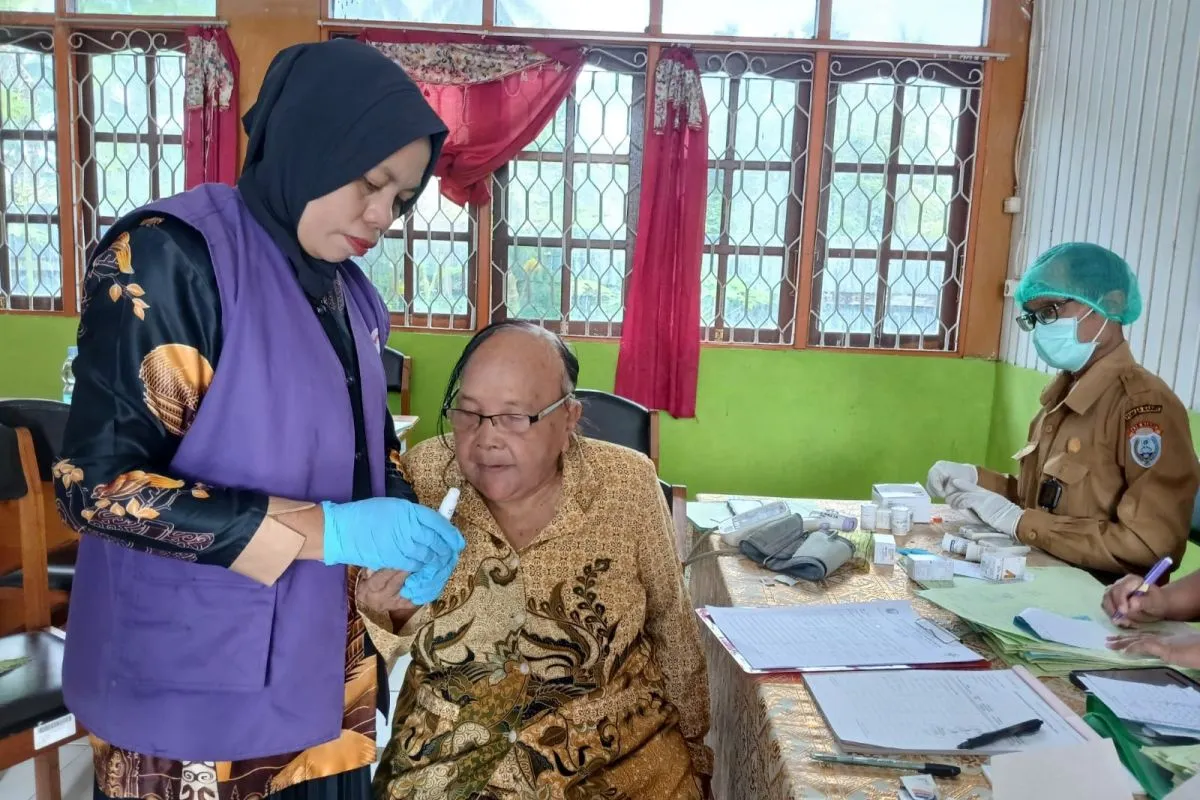
..the solutions remain rarely practiced: keeping surroundings neat and clean, shielding beds with mosquito nets, applying repellent lotions, and being open to examinations..Nabire (ANTARA) - As a new day unfolded, a woman with years of dedication navigated narrow alleys, arriving at a plank house in her signature purple vest emblazoned “Kader Perkasa,” meaning mighty, or strong, cadre.
Her name is Siti Ismawati Made. Carrying only a modest bag of tools and the knowledge gained from training, she stepped inside with confidence to check on an ailing resident that morning.
“Fever? Shivering?” she asked gently, straining to observe the patient's condition.
After a preliminary examination suggested malaria symptoms, Siti urged the family to take their loved one to a puskesmas, or community health center.
Before taking her leave, she reminded the family of the importance of hygiene and cleanliness, hoping they could proactively keep malaria-carrying mosquitoes at bay.
Such visits have become routine here in Kalisusu Village, Nabire District, Central Papua. She is often one call away from extending her service beyond medical facilities, going door-to-door upon residents’ reports.
Spearheading state’s work
A Nabire native, the 47-year-old Siti has become known as a reliable health cadre in her community.
Her service began during the COVID-19 pandemic, starting with malaria-handling training. Since then, her role has steadily gained prominence.
“We cadres used to focus solely on malaria. After being promoted to Mighty Cadres, we now handle malaria, TB, and HIV/AIDS,” she told ANTARA at her home on April 25, coinciding with the 2026 World Malaria Day.
She is part of a trio entrusted to monitor eight neighborhoods in Kalisusu Village.
Their work often starts with reports from the Karang Mulia Puskesmas, where they respond not only with treatment but also by probing the roots of transmission.
Siti and her two comrades are like vital cogs in Indonesia’s malaria elimination drive. Their efforts helped push screening coverage in the Papua region up 337 percent, from 983,000 tests in 2021 to 4.3 million in 2025, a trend confirmed by the Health Ministry.
Pressing through challenges
The cadre’s work is far from easy. Siti recalled how her team often faced unwelcoming responses, ranging from hesitation and reluctance to outright rejection.
“Many hesitate to report HIV/AIDS. They feel ashamed,” she said, noting that Nabire remains a hot spot for TB and HIV/AIDS cases.
Trusting that openness, education, and medication are key to prevention, Siti pressed on—knocking on doors day after day to strengthen public health in her beloved hometown.
Just the other day, Siti examined a resident in the Kali Harapan area who tested positive for malaria despite reporting no symptoms. She advised the patient to seek further checks at a puskesmas.
She noted that public awareness is not the only obstacle, pointing to limited access to tools and equipment needed for thorough examinations.
It is her hope that the government will soon address the issue.
Fighting carriers off
Medications alone, she said, can prove powerless against malaria without awareness of environmental cleanliness.
Female Anopheles mosquitoes, the carriers of malaria, thrive in dirty standing water often found in neglected items and corners around the house—places they deem suitable for reproduction.
While seemingly simple, the solutions remain rarely practiced: keeping surroundings neat and clean, shielding beds with mosquito nets, applying repellent lotions, and being open to examinations and treatment.
Dr. Agus, acting head of the Central Papua Health Office, stressed that collaboration across all elements of society is key to breaking the chain of transmission and curbing the province’s malaria case count, which reached more than 204,000 across eight districts in 2025.
Nabire accounted for 8,744 cases that year, second only to Mimika’s 190,597. In the January–March 2026 period alone, Nabire logged 776 cases.
The office’s malaria program manager, Silas Elias Yenice Derek, said the provincial government had gone full throttle against malaria, boosting personnel, stepping up diagnosis, and intensifying public dissemination.
Meanwhile, Nabire Health Office head Silas Elias Numobogre highlighted a 2026 district circular rallying all stakeholders, down to the village level, to play an active role in combating malaria.
Novi, who leads the district’s anti-malaria agenda, said tackling the disease is about shaping the future. She reported that Nabire recorded malaria infections in 790 infants and 108 pregnant women last year.
“Malaria is particularly dangerous for pregnant women and toddlers. It can cause severe anemia, post-delivery bleeding, miscarriage, premature birth, and babies born underweight,” she explained.
The local government hopes cross-sector collaboration and active community involvement can accelerate malaria elimination efforts while protecting pregnant women, infants, toddlers, and the elderly, as they are considered most vulnerable.
Amid persistently high case numbers, Siti the Kader Perkasa continues her rounds from one house to another. The purple vest she wears has become a simple symbol of a struggle that often goes unseen.
She does not speak of statistics or sweeping policies. Her wish is singular: a healthy community living in clean surroundings.
From Kalisusu Village, she keeps that small yet impactful step alive—moving from one door to the next, from one resident to another—fighting malaria in the simplest way possible: by being present and caring.
It is in talents like Siti that Indonesia pins its hope of doing away with malaria by 2030.
Related news: Health Ministry applies TOKEN strategy to curb malaria in Papua
Related news: Indonesia integrates malaria control for 2030 elimination
Editor: M Razi Rahman
Copyright © ANTARA 2026