The Financial Services Authority (OJK) is also carrying out stress tests using various scenarios for the financial services industry and strengthening supervision of financial services institutions.
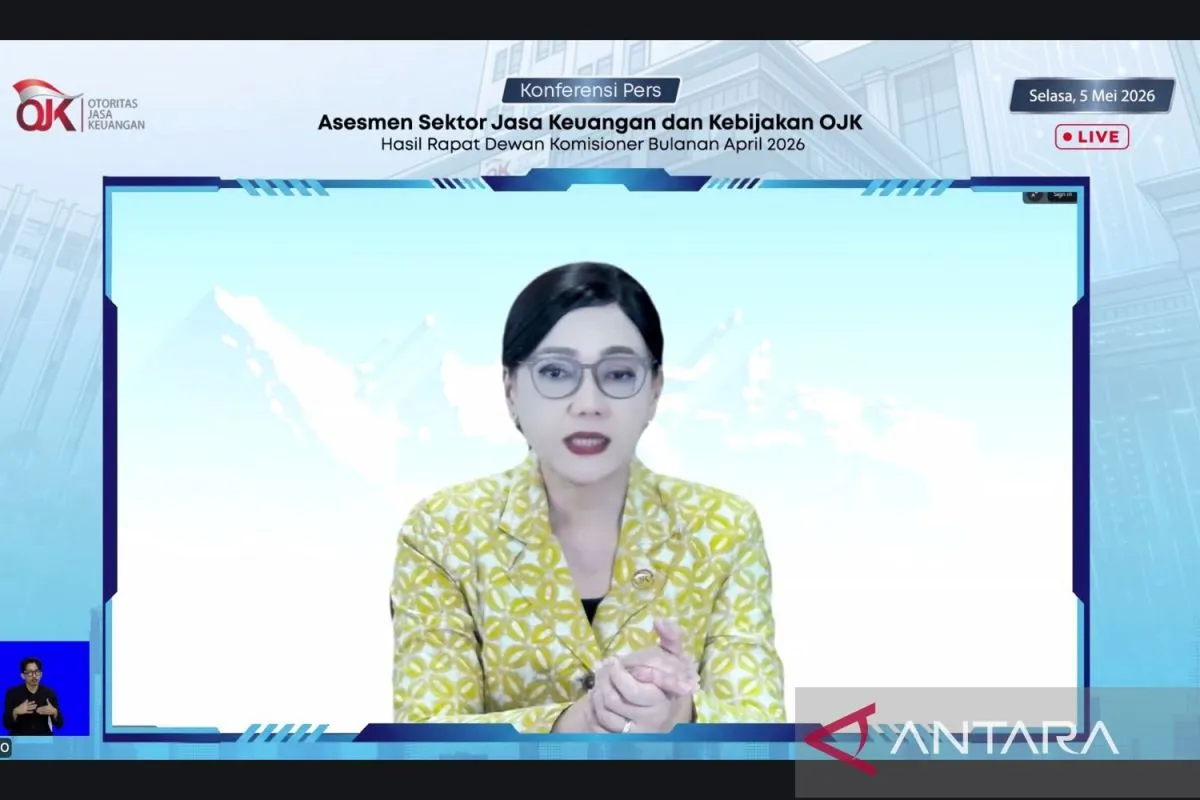
"Our primary focus is maintaining the stability of the financial services sector as a modality for sustainable national economic growth," Friderica Widyasari Dewi, chair of the OJK Board of Commissioners, said in a press conference here on Tuesday.
She explained that prolonged global geopolitical uncertainty has the potential to put pressure on the global economy, which is reflected in increasing financial market volatility, global inflation rates, and capital outflows from most emerging markets.
To anticipate the spillover impact of global uncertainty on the domestic stock market, OJK, along with self-regulatory organizations (SROs), has extended the validity period of the share buyback policy without a general meeting of shareholders (GMS).
The OJK has also postponed the implementation of short selling transaction financing, implemented a trading halt policy, and maintained the auto-rejection limit until September 2026.
"We hope these policies will maintain stability in the Indonesian stock market," Friderica noted.
Furthermore, she ensured that the capital market integrity reform agenda will continue as a primary foundation for gaining investor trust and strengthening credibility, allowing the capital market to grow sustainably.
Considering recent developments, the OJK has strengthened its monitoring of foreign exchange activities at financial services institutions by more intensively monitoring the daily net open position (NOP) and compliance with related forex regulations, as well as conducting supervisory dialogue with financial services institutions.
Friderica emphasized that her office continues to coordinate and synergize with institutions within the Financial System Stability Committee (KSSK) and relevant ministries/agencies to ensure the financial sector remains stable and resilient amidst global turmoil.
"The stability we maintain will certainly be the main capital for us to continue driving future growth," she said.
In general, the OJK assesses that the stability of the financial services sector remains well-maintained amidst the turmoil of the global economy.
From a global perspective, global economic performance in April 2026 faced continued geopolitical uncertainty despite the ceasefire agreement between the US and Iran.
The closure of the Strait of Hormuz remains ongoing due to the blockade by both parties, resulting in disruptions to global energy distribution that have not fully subsided. This situation has kept oil prices volatile and at high levels.
In its April 2026 World Economic Outlook, the IMF cut its global growth projection to 3.1 percent in 2026 and assessed the risk of stagflation as increasing.
The US economy is showing signs of weakening, with growth expected to decline in the first quarter of 2026. Meanwhile, China’s economy recorded growth in the first quarter of this year, on target at 5.0 percent.
Domestically, the national economy grew solidly at 5.61 percent in the first quarter of 2026, supported by household consumption and increased government spending.
Related news: Indonesia able to escape 5 percent growth trap: Purbaya
Related news: Indonesia records 5.61 percent economic growth in Q1 2026
Related news: Prabowo pushes US$6.7 bln downstream projects to boost economy
Translator: Rizka Khaerunnisa, Yashinta Difa
Editor: Azis Kurmala
Copyright © ANTARA 2026


