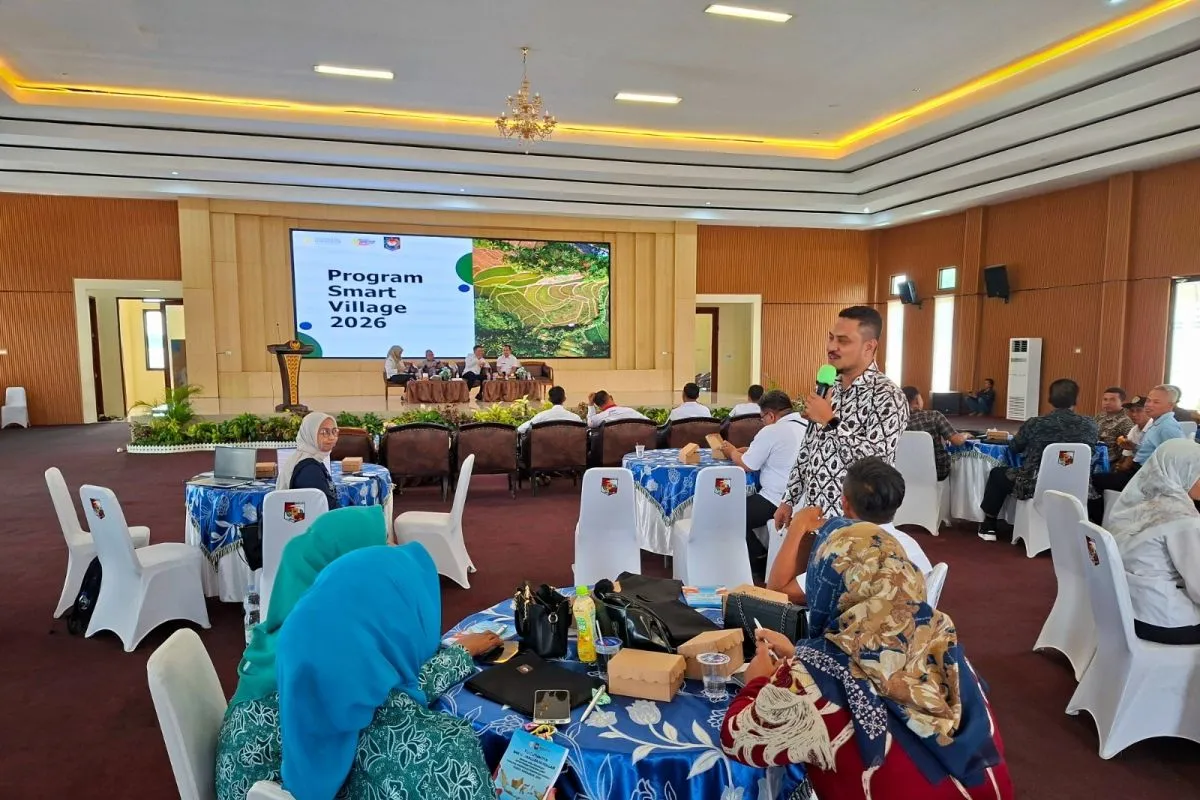
The Head of the Sub-Directorate of Empowerment and Social Innovation of DPIS UI, La Ode Abd Rahman, here on Thursday, emphasized that a Smart Village is not just administrative digitalization but a participatory and sustainable transformation of the village ecosystem.
"Smart Village is not just about village digitalization, but about a society that is digitally literate, responsive, and adaptive," he stressed.
He emphasized the importance of the role of the digitally literate young generation as technology translators in villages, who are able to connect villages with the wider community.
UI also promotes the idea that the success of a Smart Village must be measured by its impact, not just its output. The new paradigm of village development demands a participatory approach, where villagers become key actors, not simply program recipients.
This idea is in line with the Socio-technical System theoretical framework, which emphasizes the close relationship between technology and human social elements in order to function effectively.
The Smart Village pillar, initiated by the University of Indonesia (UI), encompasses four main points. The first is Smart Governance, which emphasizes digital-based public services, data transparency, and information-based governance.
The second is the Smart Economy, which encourages the digitalization of Micro, Small, and Medium Enterprises (MSMEs), the development of village marketplaces, and technology-based tourism.
The third is Smart Society, which focuses on digital literacy, community empowerment, and social inclusion. The fourth is Smart Environment, which emphasizes renewable energy, environmental management, and smart agricultural practices.
UI believes that technology is only an enabler, while the key to success depends on community participation and adaptive village governance.
Related news: Digitalization key for smart village status: RI Govt
Related news: Ministry targets digitalizing all Indonesian villages by 2025
Related news: Indonesia, World Bank collaboration aims to realize Smart Village
Translator: Feru Lantara, Katriana
Editor: Azis Kurmala
Copyright © ANTARA 2026


