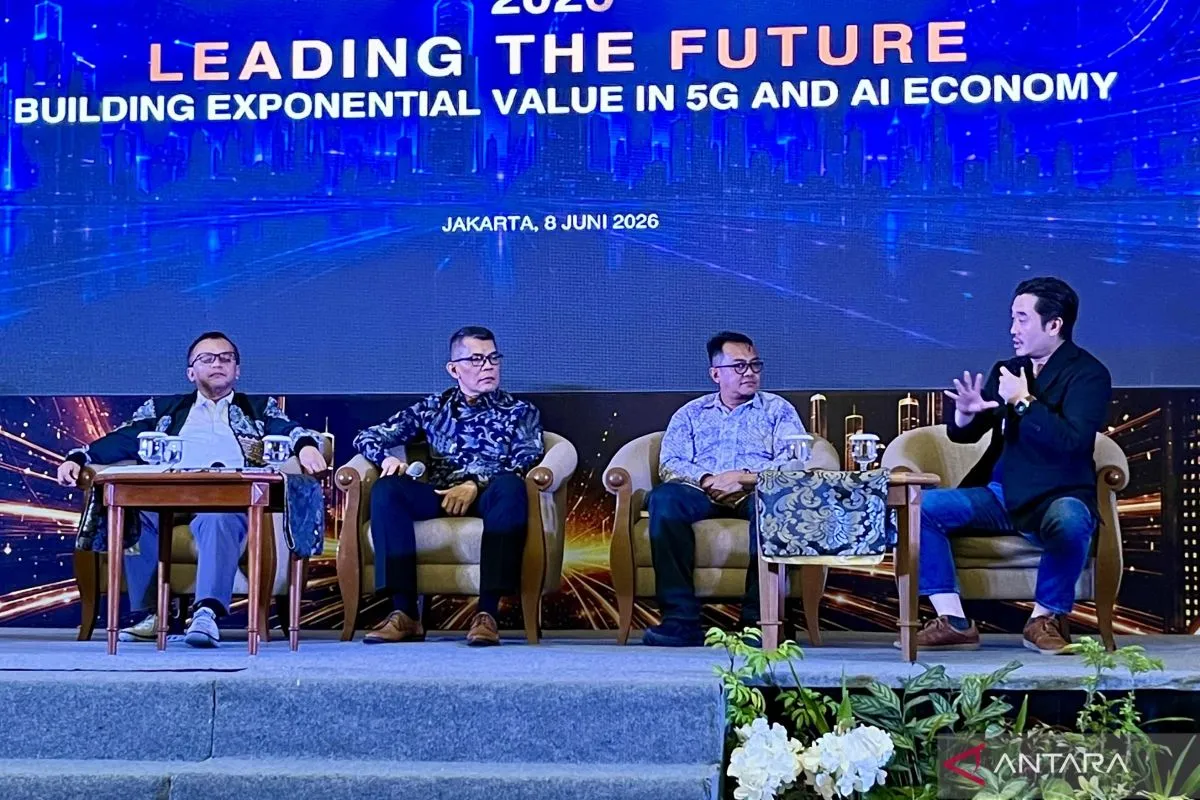
The ministry’s Director of Strategy and Policy for Digital Infrastructure, Denny Setiawan, noted that the telecommunications sector has long been searching for the catalyst that would justify and accelerate the shift to 5G technology.
“We are always wondering what the killer content of 5G is. Could AI be the killer content? It seems so,” he said at the Selular Award 2026 here on Monday (June 8).
The surge in AI utilization marks a fundamental shift in how data moves across networks. He explained that while the 4G era has been overwhelmingly dominated by data downloads - such as video streaming and browsing - AI applications introduce highly complex, bi-directional traffic patterns that demand far more robust infrastructure.
As AI-driven services rely on massive, real-time data processing, the synchronization of AI development and 5G deployment is now seen as vital to unlocking new economic value in the digital era.
Beyond infrastructure, the ministry highlights AI’s immediate impact on everyday productivity across multiple sectors, including education and corporate business.
"I personally use AI to make quick presentations," Setiawan noted, pointing out how the technology streamlines workflows for students and consultants alike.
"They become more productive,” he added.
The ministry remains highly optimistic about the rapid acceleration of AI within the country, citing Indonesia's massive domestic digital market, which currently commands roughly one-third of the entire ASEAN population.
To sustain this momentum, the Indonesian government is actively reinforcing the country's underlying digital framework, which currently focuses on expanding frequency spectrum allocation to accommodate 5G demands, constructing robust fiber optic networks and submarine cables, scaling data center capacities to handle AI processing, and broadening national connectivity to bridge regional gaps.
Denny emphasized that establishing this comprehensive ecosystem is critical.
Without it, the broader public cannot fully realize the benefits of AI, nor can the technology effectively drive the growth of Indonesia's national digital economy.
Related news: Indonesia intensifies ASEAN collaboration to accelerate AI adoption
Related news: Indonesia targets 32 percent 5G network coverage by 2030
Translator: Farika Nur Khotimah, Yashinta Difa
Editor: Primayanti
Copyright © ANTARA 2026


