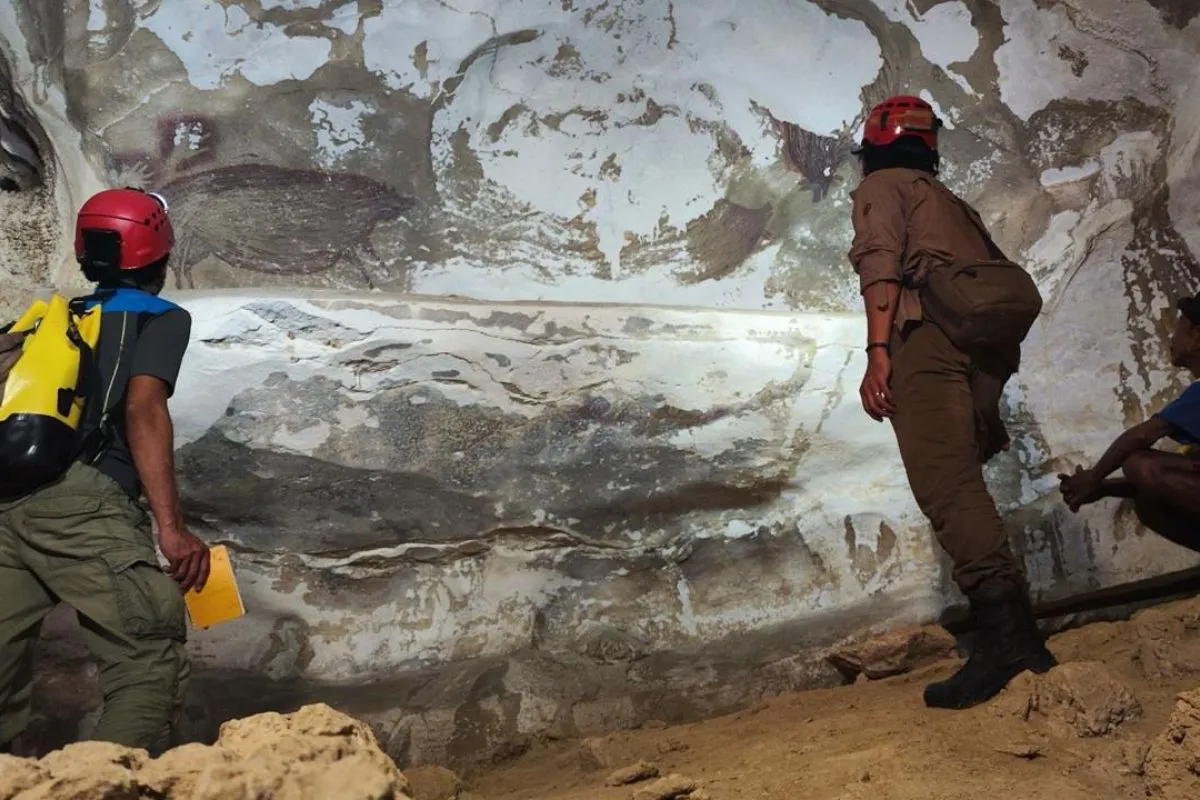
The paintings are found at cave sites including Leang Maros and Leang Pangkep in South Sulawesi and Liang Metanduno on Muna Island in Southeast Sulawesi.
Hasanuddin University archaeology researcher Prof. Akin Duli said the findings challenged the long-held view that the earliest cave paintings originated in Europe.
“This research challenges what we have learned from books that the oldest paintings originated in Europe. That theory has now been disproved,” Akin said in Makassar.
The rock art includes pointed-finger motifs, animal figures and depictions of hunting strategies. The images were painted in a maroon-red color using ocher and remain clearly visible on the cave walls despite their age.
Analysis showed some images were hand stencils, but researchers found an unusual feature in which the fingertips appeared pointed rather than rounded, resembling animal claws.
Uranium-series dating put the age of the paintings at about 67,800 years, a finding researchers said provided evidence of early human artistic expression as well as technology and social organization.
“Sulawesi is part of the Wallacea region and plays an important role. This evidence provides a basis for challenging the idea that cave painting culture originated in Europe,” Akin said.
Researcher Muhamad Nur said the findings also challenged the notion that artistic expression originated exclusively in Europe, arguing that a sense of beauty was inherent in humans regardless of where they lived.
“The sense of beauty exists alongside traits such as anger and laughter. Humans everywhere have the potential to create it,” Nur said.
Archaeologists identified aesthetic elements in the paintings, including sharp lines and human figures surrounding prey such as wild pigs and anoa, a small buffalo native to Indonesia.
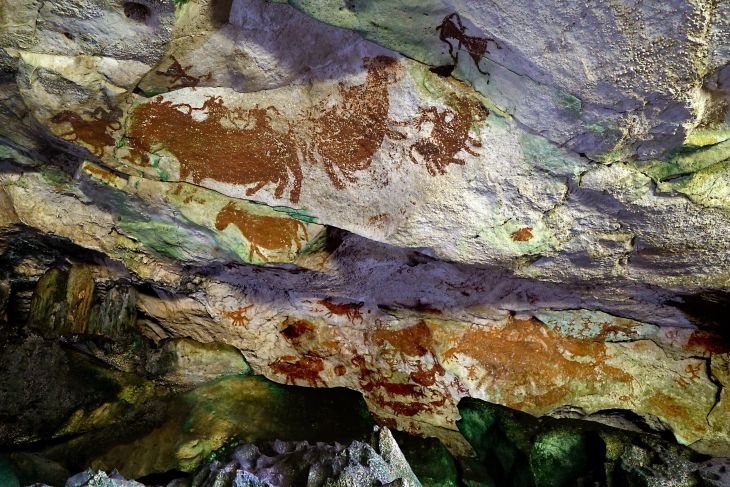
The oldest rock art, or figurative painting, estimated to be 67,800 years old, at Liang Metanduno site on Muna Island, Liangkobori Village, Lohia Sub-district, Muna District, Southeast Sulawesi. /ANTARA/HO-BRIN Documentation.
At sites such as Bulu Sipong, the scenes appear to depict coordinated hunting strategies in which groups of hunters drove wild pigs or anoa together, Akin said.
“These are not just pictures, but depictions of social activity related to hunting,” said Akin, a specialist in Indonesian prehistory at Hasanuddin University.
Archaeologists now view the paintings not simply as aesthetic markings but as records that may provide insights into ancient technology and social organization.
“The depiction has a very close relationship with how humans survived. Modifying fingers to resemble animal claws had already been practiced by early modern humans for a long time,” said BRIN archaeologist Budianto Hakim.
The paintings suggest that people in the Indonesian archipelago had established social rules about hunting and group movement as early as 67,000 years ago, researchers said.
Hakim also drew a connection between the cave paintings and traditions among modern Bugis and Makassar communities, where handprints are still made on posts of newly built houses as a ritual believed to ward off misfortune.
The interpretation suggests that humans in Sulawesi about 67,000 years ago were capable of complex abstract thought, researchers said.
Related news: Indonesia to date Meratus cave art in Australia's lab tests
Related news: Indonesia's oldest cave paintings found in S Sulawesi
Translator: M Darwin Fatir, Martha Herlinawati Simanjuntak
Editor: Primayanti
Copyright © ANTARA 2026


