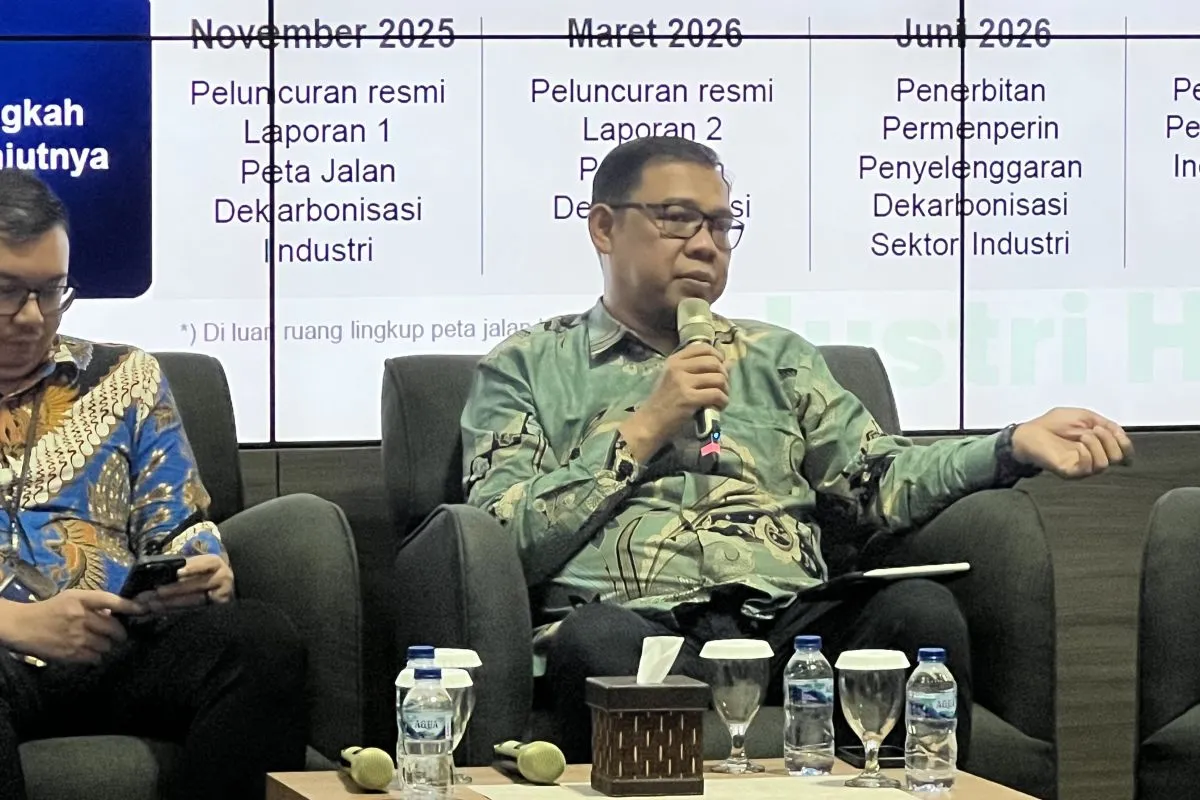
Indonesia’s Industry Ministry is pushing industrial decarbonization to help keep global warming within 1.5°C, reaffirming its net-zero emissions target for 2050 through a roadmap covering the country’s highest-emitting sectors.
Apit Pria Nugraha, head of the ministry’s Center for Green Industry, said the industrial decarbonization roadmap—previously launched by the government—aligns with the 1.5°C pathway and outlines major emissions cuts by 2035 and 2050.
The roadmap projects a reduction of 66.5 million tCO2e, or about 30 percent of industrial emissions, by 2035 and 289.7 million tCO2e by 2050, enabling the sector to reach net-zero. Industry currently contributes 34 percent of Indonesia’s total greenhouse gas emissions.
The plan targets heavy-emitting sectors including cement, iron and steel, fertilizers, chemicals, pulp and paper, textiles, glass and ceramics, automotive, and food and beverages, Apit said at an Energy Outlook seminar in Jakarta on Thursday.
He said the alignment with the 1.5°C threshold also strengthens Indonesia’s access to financing from the World Bank and other international institutions, which increasingly prioritize low-carbon industrial pathways.
He added that companies with lower emissions are expected to secure transition financing and long-term contracts more easily, as energy-transition efforts have become critical for maintaining export access and market competitiveness.
Apit warned that firms that fail to cut emissions risk higher costs or losing bids, as the European Union’s Carbon Border Adjustment Mechanism (CBAM) and Scope 3 requirements from global Original Equipment Manufacturers (OEMs) demand low-carbon supply chains.
Related news: COP30: Indonesia targets 1.5 gigaton CO2 emission cut by 2035
Related news: Indonesia plans 81% cut in nickel industry emissions
Related news: Energy sector decarbonization higher than target: ministry
Translator: Putu Indah Savitri, Martha Herlinawati Simanjuntak
Editor: Azis Kurmala
Copyright © ANTARA 2025


