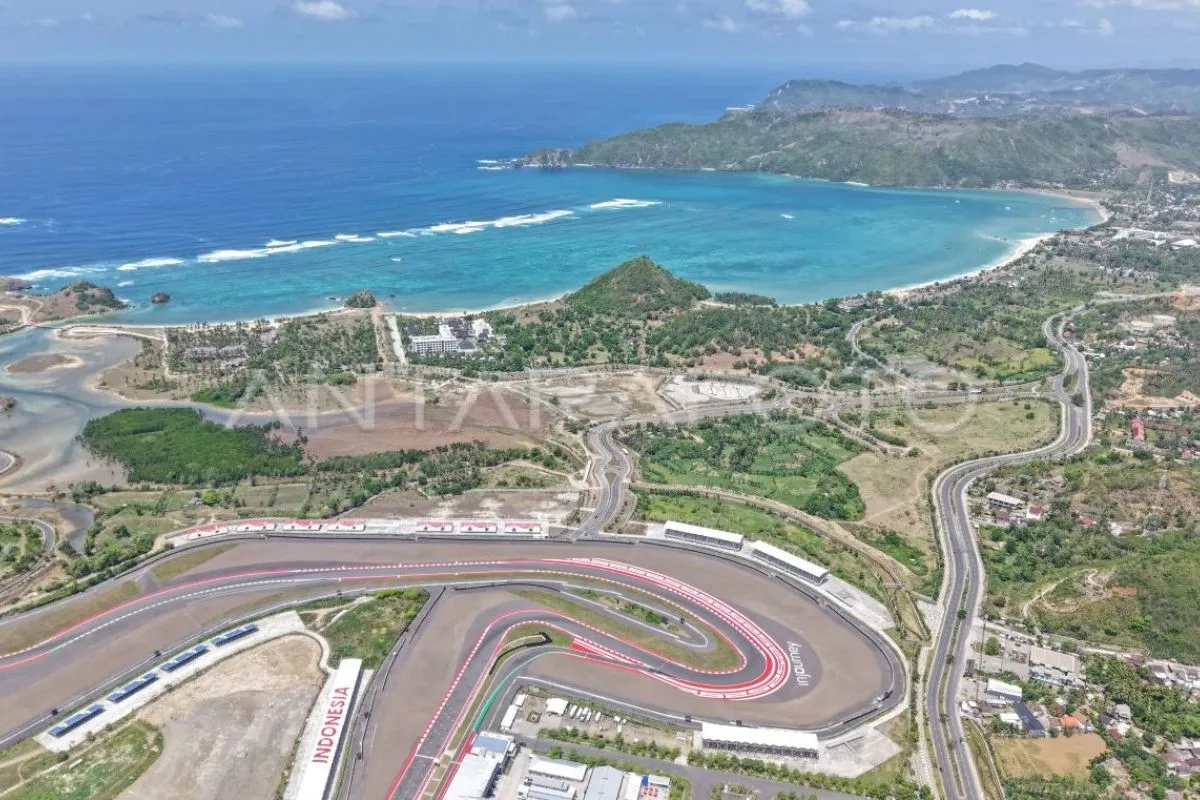
After facing earlier delays, the project has entered a decisive phase as it moves toward its target of becoming operational in 2026.
The pier is expected to function as more than just marine infrastructure. It is envisioned as a new gateway that will remove connectivity barriers and open a tourism corridor between Mandalika and Bali.
A trial service on the Sanur–Mandalika fast boat route in 2022 briefly carried thousands of passengers, demonstrating significant potential before operations were halted due to permit and facility readiness issues.
Construction has since resumed with clearer direction. The pier’s physical progress is expected to reach around 70 to 75 percent by the end of 2025.
Key permits, including environmental impact assessments (AMDAL), marine space approval, and fast boat docking permissions, are currently being processed across district, provincial, and central levels of government.
With the feasibility study completed and private sector support secured through the developer, the main question now is whether the pier can help Mandalika advance its ambition to become a world-class tourism destination.
The project warrants close attention because it sits at the strategic intersection of the tourism sector’s needs, the push for improved connectivity, and substantial state investment in the Mandalika Special Economic Zone.
Connectivity
The Mandalika SEZ in Lombok, West Nusa Tenggara (NTB), is not only designed to become a world-class area but also as a new center of economic growth.
In the tourism industry, the quality of tourist attractions is often overshadowed by concerns over connectivity. This is where the fast boat pier plays a crucial role.
The planned Sanur-Mandalika route could cut the travel time for tourists from Bali to approximately two hours, offering Mandalika the opportunity to attract millions of tourists.
The 2022 experience proved that demand was very high, reflected by the high occupancy of boats, frequent trips, and extraordinary market response. This means the market is already there; now it is the infrastructure that needs to be enhanced.
Investment data demonstrates the commitment of both the state and the area's management to making Mandalika an international-standard tourist destination.
In the first semester of 2025, the investment realization reached Rp14.66 billion (around US$880,427) from the target of nearly Rp537 billion. Though it is still below the target, the achievement signaled momentum.
The Mandalika SEZ has created more than 19 thousand jobs and manages hundreds of hectares of land that continue to be developed based on priority zones.
However, investment in physical infrastructure alone is not enough. Academics from the Lombok State Tourism Polytechnic underlined the classic problem: that human resources readiness and social behavior have not yet aligned with world-class tourist destination standards.
While physical infrastructure is built using contractors, service standards must be built through training and behavioral change. Without them, even the best facilities can lose their impact.
On the other hand, permitting issues have become recurring. Operational permits for piers often get stuck at various stages due to safety aspects.
The fast boat operators' association demands that the pier be 100 percent complete before they start operations, while the relevant ministries require full safety assurance.
From the regulator's side, prudence is crucial. However, from the tourism side, time means opportunity. Thus, the two must meet halfway.
This triggers a fundamental question: has the Mandalika SEZ positioned marine connectivity as a strategic priority? If the answer is yes, permit issuance acceleration must be pursued without overlooking the safety aspects.
The coordination system between the central, provincial, and district governments must be more solid to ensure aligned policies.
Tourism
Once the pier construction is completed, the real challenge is ensuring it truly becomes a new hub of Mandalika's connectivity.
Therefore, first, the supporting facilities must be strengthened. The road access, waiting area, digital ticketing system, marine safety, and service standards must be prepared early.
Many tourist attractions in the world fail to make the most of piers due to focusing only on the construction, not the operations.
Second, the route plan must be developed beyond just Bali-Mandalika. The opportunity to connect other tourist attractions, such as other coastal areas on neighboring islands, can be tapped into. This aligns with the goal of making Mandalika an epicenter of tourism, not just a single destination.
Third, bolstering the readiness of human resources must be a priority. Training for tour guides, pier front-desk service officers, safety operators, and even micro, small, and medium enterprise (MSME) players must not be overlooked.
Fourth, attracting more private investment is essential. The third-party funding scheme already used for the acceleration of the pier facility is evidence that collaboration can speed up the work.
If this model is expanded with transparent governance, the acceleration in constructing new facilities can be realized.
At the end of the day, Mandalika must prove that pier construction is not a ceremonial project that is initiated only for certain international events.
Beyond that, the pier must be a long-term investment that benefits the surrounding communities, expands business opportunities, and strengthens the region's pride in the national tourism industry.
The fast boat pier is a symbol for the transition towards a new phase in the development of the Mandalika SEZ, namely building access and quality.
While the physical construction may be completed in 2026, work on the social aspect, regulations, and management is much longer. This is what decides the long-term success.
Marine connectivity can change the trajectory of the regional tourism, expand the market, and speed up the community's economic growth.
Nevertheless, these can only be possible if the regional and central governments, the management, and business players move with the same rhythm with a long-term orientation.
Related news: NTB: new flight routes and hope for new connectivity hub
Editor: Primayanti
Copyright © ANTARA 2025


