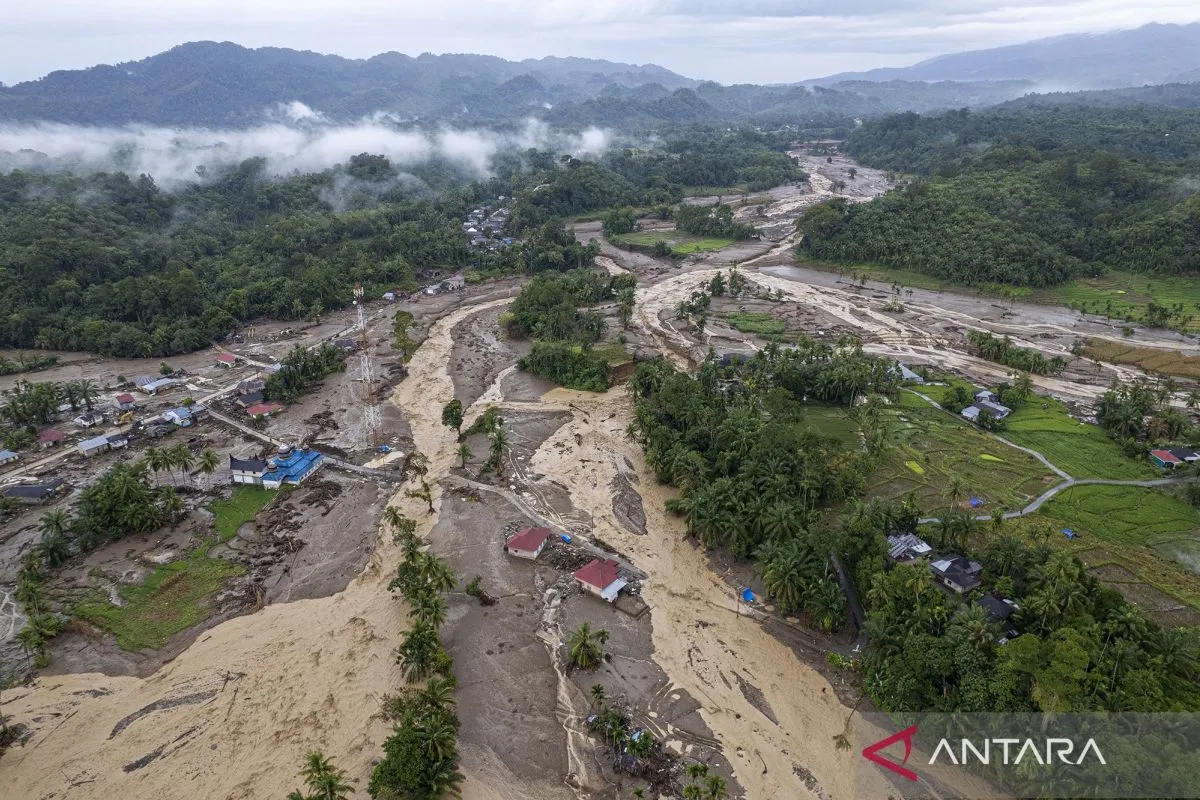
According to data from the National Disaster Mitigation Agency (BNPB), the disasters had claimed 971 lives as of December 11. Road access, bridges, and electricity networks were heavily damaged, isolating many communities and hampering the movement of residents and emergency responders.
In the wake of the disaster, the Indonesian government intensified efforts to restore key infrastructure and reconnect affected communities. Various ministries and agencies have coordinated to expedite the recovery of transportation, electricity, communication networks, and public services.
Ensuring the return of road access and communication channels remains a priority, as these are essential for residents trying to reconnect with relatives and obtain accurate information about the situation.
During the emergency phase, the Ministry of Communication and Digital Affairs focused on accelerating the restoration of telecommunications and internet services.
Within 24 hours, 707 telecommunications towers were brought back online, down from the initial 2,463 towers that experienced disruptions as of Friday, November 28, at 7:00 a.m. Western Indonesia Time.
Restoring access has been crucial for both the public and emergency operations, particularly in remote areas where communication lines serve as the primary link to rescue services and information centers.
On Sunday, November 30, the ministry’s Telecommunications and Information Accessibility Agency (BAKTI), working with BNPB, search and rescue teams, and the Indonesian National Armed Forces (TNI), mobilized equipment to several locations and provided internet service at the command posts of BNPB and the National Search and Rescue Agency (Basarnas).
Connectivity support was also strengthened through the Republic of Indonesia Satellite-1 (SATRIA-1), which delivered satellite-based internet to disaster-hit locations. These areas included Central Tapanuli in North Sumatra; North Aceh, Central Aceh, East Aceh, Aceh Tamiang, and Lhokseumawe in Aceh; and Agam and Padang in West Sumatra.
Communication and Digital Affairs Minister Meutya Hafid said cellular operators reported that 95 percent of base transceiver stations (BTS) in West Sumatra had been restored. North Sumatra recorded 90 percent recovery.
She added that Aceh remained the most affected, with 60 percent of towers still inoperable due to electricity failures. The government, operators, and the state-run electricity company PLN continue to work to bring all services back to normal as soon as possible.
"For Aceh, 60 percent of the towers remain inoperable due to electricity issues. The government, along with operators and PLN (state-run electricity company), continues to work so that services can return to normal immediately," she said while leading a coordination meeting in Medan, North Sumatra, on Monday (Dec 1).
Restoring Road Access and Public Infrastructure
Meanwhile, the Ministry of Public Works has prioritized road repairs and the deployment of additional heavy equipment and personnel in coordination with the Regional Disaster Mitigation Agencies (BPBD).
One of the ministry’s key efforts involves installing Bailey bridges in priority areas to restore temporary road connectivity while permanent structures are being assessed and rebuilt.
Public Works Minister Dody Hanggodo said on December 4 that the government is focused on reopening routes from the northern coast of Sumatra toward Tapanuli.
Access from North Sumatra to the western region remains blocked, delaying the distribution of aid. Heavy equipment has been deployed, and more will be brought in from nearby unaffected provinces if required.
“Our focus today is on opening connectivity from the northern coast of Sumatra toward Tapanuli. The route from North Sumatra to the west is not yet open, thereby hindering the distribution of aid. We are deploying all heavy equipment, and if more is needed, we will bring it in from the nearest unaffected provinces," Dody Hanggodo said.
Recovery efforts have also extended to the education sector. The Ministry of Primary and Secondary Education provided initial assistance, including school cleaning and the distribution of books and learning equipment.
Plans are underway to replace damaged interactive flat panels and other essential tools to ensure teaching activities can resume once conditions stabilize.
Meanwhile, the Ministry of Agrarian Affairs and Spatial Planning initiated spatial planning evaluations in Aceh, North Sumatra, and West Sumatra.
This assessment aims to ensure land use aligns with environmental characteristics and reduces the risk of future disasters.
The Ministry of Environment will also evaluate spatial patterns and ecosystem restoration in affected areas to enhance environmental resilience and strengthen natural buffers against extreme weather events.
BNPB and its partners have received budget support from the Ministry of Finance to intensify emergency response efforts. The government has declared the disaster response a national priority, enabling the rapid mobilization of personnel, equipment, and resources.
These measures include search and rescue operations, logistical support, clearing road access, and restoring communication and electricity networks.
"The central government is going all out to accelerate emergency response efforts. This covers five key areas: search and rescue, logistical support for the community, clearing road access, restoring communication access, and repairing electricity and fuel infrastructure," Head of the BNPB Disaster Data, Information, and Communication Center Abdul Muhari said.
BNPB has deployed 40 helicopters, with additional aircraft support from TNI and the National Police (Polri). This brings the total air fleet to 50 units.
These aircraft deliver between 25 and 35 tons of aid each day to district and city command posts, as well as to isolated refugee locations. TNI personnel have also been mobilized to distribute aid on foot to remote pockets of displaced residents.
In addition to helicopters, TNI personnel have been deployed to support BNPB’s operations by distributing aid to the refugee pockets on foot.
BNPB, in collaboration with TNI, Polri, ministries, government agencies, regional governments, volunteers, and international partners, continues to make every effort to speed up search operations, the restoration of access and vital services, and the fulfillment of affected communities' basic needs.
Related news: Prabowo issues seven directives to bolster Sumatra disaster response
Related news: Sumatra post-disaster recovery to exceed Rp50 trillion, AHY Says
Editor: Primayanti
Copyright © ANTARA 2025


