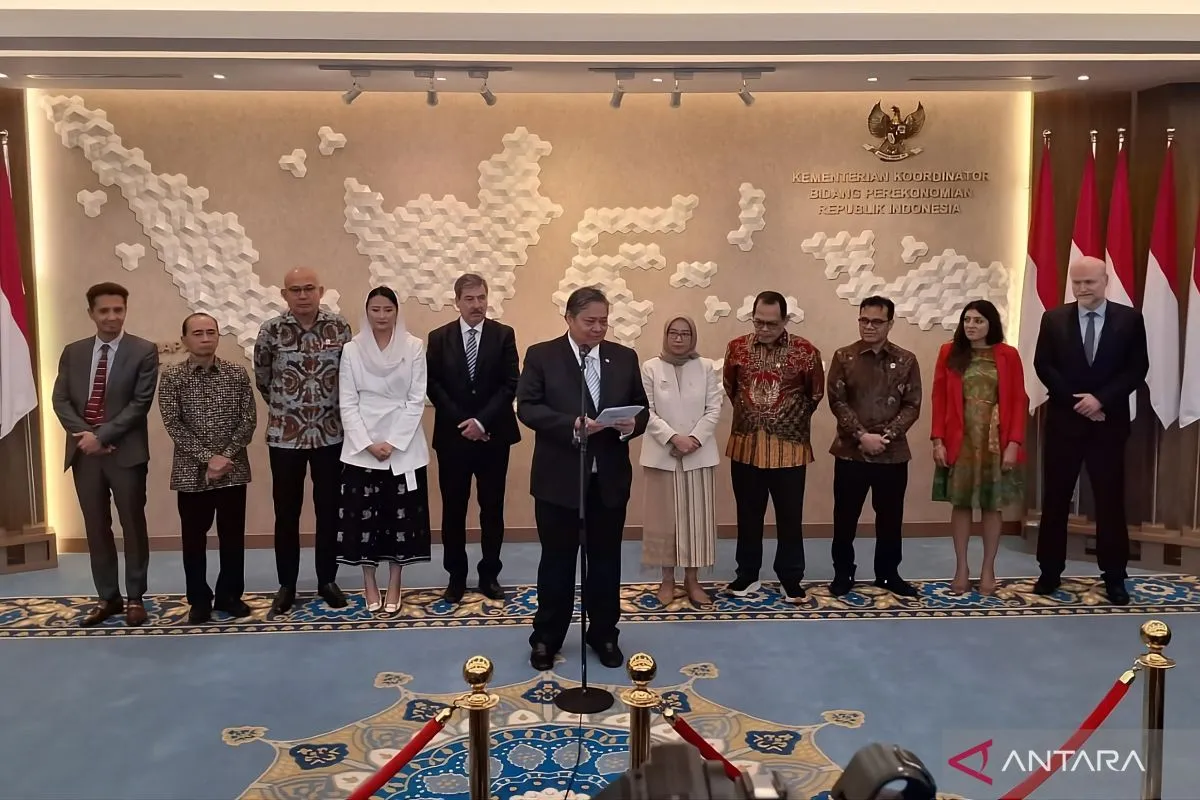
The latest progress was discussed during a meeting between Coordinating Minister for Economic Affairs Airlangga Hartarto and OECD Deputy Secretary General Amb. Frantisek Ruzicka, who reviewed the technical developments on site.
Airlangga said Indonesia has updated its technical review report, which currently prioritizes three main areas: environment, trade, and the digital economy.
He noted that these sectors are being reviewed first because of their high level of complexity and their strategic role in strengthening national resilience amid global challenges.
“This morning’s meeting focused on Indonesia’s update on the technical review, and at this stage, the main areas are environment, trade, and the digital economy. These sectors are being reviewed first due to their complexity and their important role in shaping national resilience to face today’s global challenges,” Airlangga said during a press conference in Jakarta on Thursday.
He explained that Indonesia’s target to join the OECD has been mandated in the 2025–2029 National Medium-Term Development Plan.
President Prabowo Subianto has also issued Presidential Decree Number 30 of 2025, which adjusts ministerial responsibilities related to the accession process.
To enhance coordination, the government has developed the INA OECD digital platform as a hub for interministerial collaboration and data integration.
“Indonesia has created a digital platform called INA OECD as a coordination and digital collaboration hub for the country. So, Indonesia is already using a digital platform for this OECD accession,” Airlangga said.
Airlangga emphasized that the accession process is progressing well and aligns with OECD guidance. He added that OECD membership would help Indonesia navigate increasing global uncertainty.
“In the midst of global uncertainty, Indonesia’s membership in the OECD is expected to help navigate uncertainty or the current multipolar environment,” he said.
In the trade sector, Airlangga noted Indonesia’s growing recognition on the international stage despite ongoing trade tensions worldwide.
He said Indonesia’s participation in various international economic partnerships, including the Comprehensive Economic Partnership Agreement (CEPA), has been widely appreciated.
“Indonesia is truly seen as a very visible country globally. This global visibility is accompanied by economic reforms and transformations, following the President’s directives to reduce bureaucratic bottlenecks and accelerate transformation,” he said.
As an example of rapid reform, Airlangga highlighted the Free Nutritious Meal (MBG) program, which has reached nearly 44 million recipients within just one year. He said this demonstrates Indonesia’s strong policy execution capabilities.
“Indonesia’s accession is expected to create policies that can improve people’s quality of life because the goal is better policies for a more prosperous society,” Airlangga said.
Related news: Indonesia urged to bolster governance, anti-graft drive for OECD bid
Related news: Indonesia boosts oversight to meet OECD integrity standards
Related news: Indonesia seeks Australia's backing for OECD, CPTPP accession
Translator: Muhammad Heriyanto, Primayanti
Editor: Azis Kurmala
Copyright © ANTARA 2025