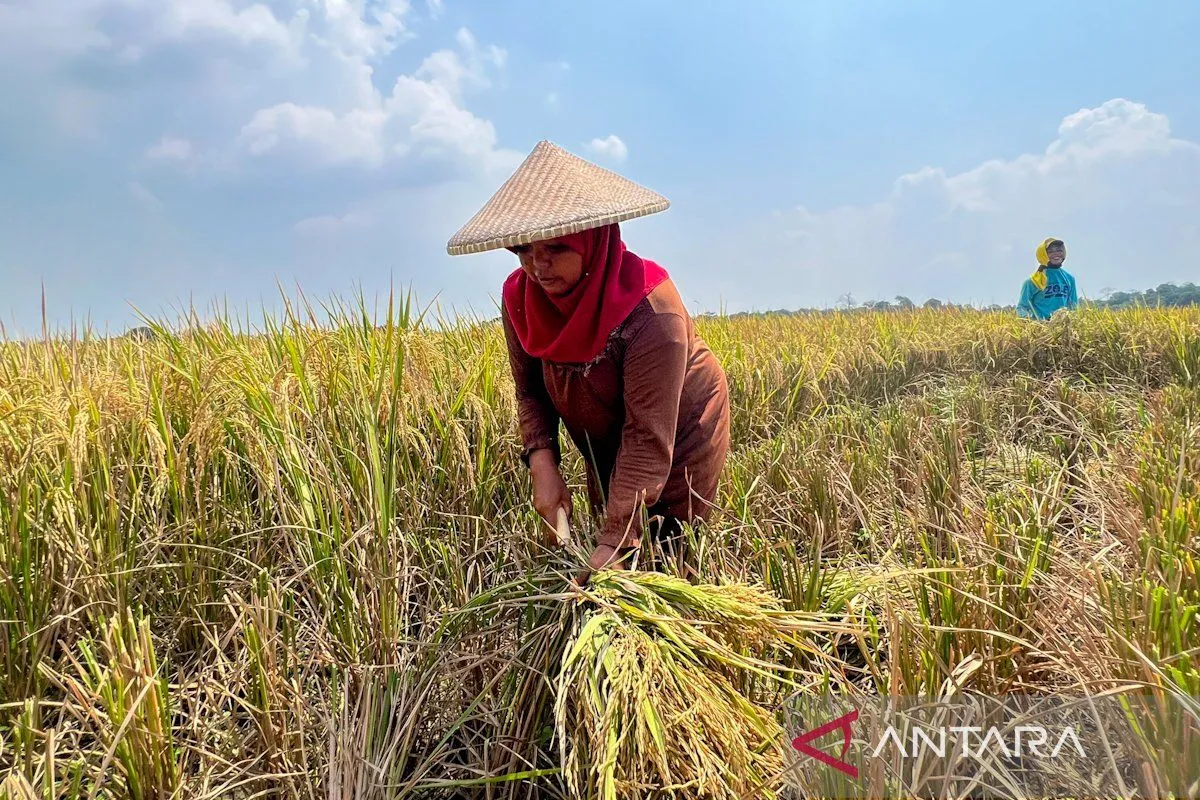
The year 2025 marked a significant milestone in Indonesia's national food security journey when the country finally stopped importing rice and corn.
Increased domestic production and promising state reserves were considered sufficient to sustainably fulfill domestic food requirements.
The warehouse of the state-owned logistic firm, Bulog, is now fully stocked with food reserves, a proof of the collective work of farmers and the state.
Rice stocks were reported to have reached 3.8 million tons as of early December 2025 and reached 4.2 million tons mid-year, the highest in Indonesian history.
These substantial reserves are not merely an administrative achievement, but a symbol of national confidence. For the first time, all the rice stocks stored at Bulog's warehouses came from domestic production, with no dependence on imported rice.
The government's rice reserves (CBP) have proven reliable, capable of supplying up to three times the needs of flood and landslide victims in three provinces simultaneously: Aceh, West Sumatra, and North Sumatra, which occurred in the fourth week of November 2025.
The Ministry of Agriculture also noted that international rice prices dropped from US$650 per ton to US$340 per ton due to Indonesia's import cessation. This prompted many countries to lobby for Indonesia to resume purchasing their rice.
In 2024, Indonesia still imported up to 4.5 million tons of rice. The policy of halting rice imports in 2025 affirms the new direction of national food sovereignty under the leadership of President Prabowo Subianto and Vice President Gibran Rakabuming Raka.
Agriculture Minister Andi Amran Sulaiman said the sufficient rice stock is also linked to the rice absorption policy that benefits farmers.
The government purchase price (HPP) for harvested dry grain (GKP) has increased from Rp6,000 (US$0.35) to Rp6,500 (US$0.38) per kilogram and applies to all grain qualities. This policy took effect on January 15, 2025.
Both Bulog and private millers are required to purchase GKP at the government price, while military personnel are involved in assisting farmers to ensure the HPP regulation is truly enforced.
This policy maintains farmers' purchasing power amid fluctuating production costs. The government is committed to ensuring that farmers' hard work is fairly rewarded while also encouraging sustainable production.
National rice production this year has shown a significant increase. Based on data from the Sample Area Framework (KSA) from Statistics Indonesia (BPS), rice production from January to December 2025 is projected to reach 34.77 million tons, a 13.54 percent increase compared to the previous year with a production of around 30 million tons.
Increased production is driven by a correction in the upstream and downstream sectors through irrigation improvements, agricultural mechanization, and access to targeted subsidized fertilizers, complemented by assistance with agricultural machinery to increase national harvest productivity and efficiency.
The government is also actively engaging millennial farmers through the use of modern agriculture, such as the use of drones for planting, fertilizing, and crop monitoring to improve efficiency and productivity.
Furthermore, efforts to create new rice fields are being intensified, including in Kalimantan, through the development of hundreds of thousands of hectares and the strengthening of agricultural land protection to ensure the sustainability and resilience of national food production.
Food transformation is considered a key foundation of current agricultural policy. The focus is not merely on increasing production but also on the welfare of farmers as an important element in the national food system.
The impact is shown in macro-indicators of agriculture. The agricultural sector's contribution to gross domestic product in 2025 reached 14.35 percent, the highest in the last six years, with the Farmer Exchange Rate (NTP) hovering around 124.
Agricultural exports also grew significantly to Rp507.78 trillion (US$29.5 billion) and provide employment for nearly 39 million people, reaffirming agriculture as a pillar of the people's economy and a stabilizing force for the nation.
On the other hand, corn self-sufficiency goes hand in hand with the strengthening of rice production. National corn production is able to meet food and animal feed needs, strengthening the egg and chicken sectors.
Deputy Chief of the Indonesian National Police, Commissioner General Dedi Prasetyo, informed that the realization of the National Police's corn planting program has reached 883,000 hectares out of the 1.3 million hectares target by the end of 2025.
The National Police, as a state institution mandated by President Prabowo for corn production, continues to achieve this target and support overall food self-sufficiency.
The corn harvest until the fourth quarter is estimated to reach 2.8 million tons, based on data from the National Police Food Security Task Force, which oversees production from various regions.
Through cross-sectoral support, including the National Police's involvement in expanding corn planting, corn production in 2025 is expected to continue to increase towards the national target of 4 million tons.
Coordinating Minister for Food Zulkifli Hasan stated that rice and corn self-sufficiency will be officially announced by the end of 2025, marking an increasingly solid foundation for food security amidst global challenges.
Going forward, the focus of food policy will be expanded to other commodities. White sugar self-sufficiency is targeted for 2026 through modernization of the sugarcane industry, land intensification, and investment in downstream processing.
The Ministry of Agriculture will also prioritize boosting domestic output of key food commodities that remain highly reliant on imports, such as soybeans, wheat, and others.
Food self-sufficiency goes beyond production targets, serving as a foundation of socioeconomic stability by balancing productivity, environmental sustainability, and farmer welfare.
As the 2025 calendar year draws to a close, Indonesia is entering a new era in food security, marked by increasingly sufficient stocks and stronger domestic production, while also bolstering efforts to reclaim its status as one of Asia's prominent forces.
Related news: Dy minister stresses vocational high schools' role in food security
Related news: Indonesia plans 100,000 ha land clearing for Papua rice program
Related news: Minister asks SMKs to harness regional agricultural potential
Translator: Muhammad Harianto, Resinta Sulistiyandari
Editor: Azis Kurmala
Copyright © ANTARA 2025


