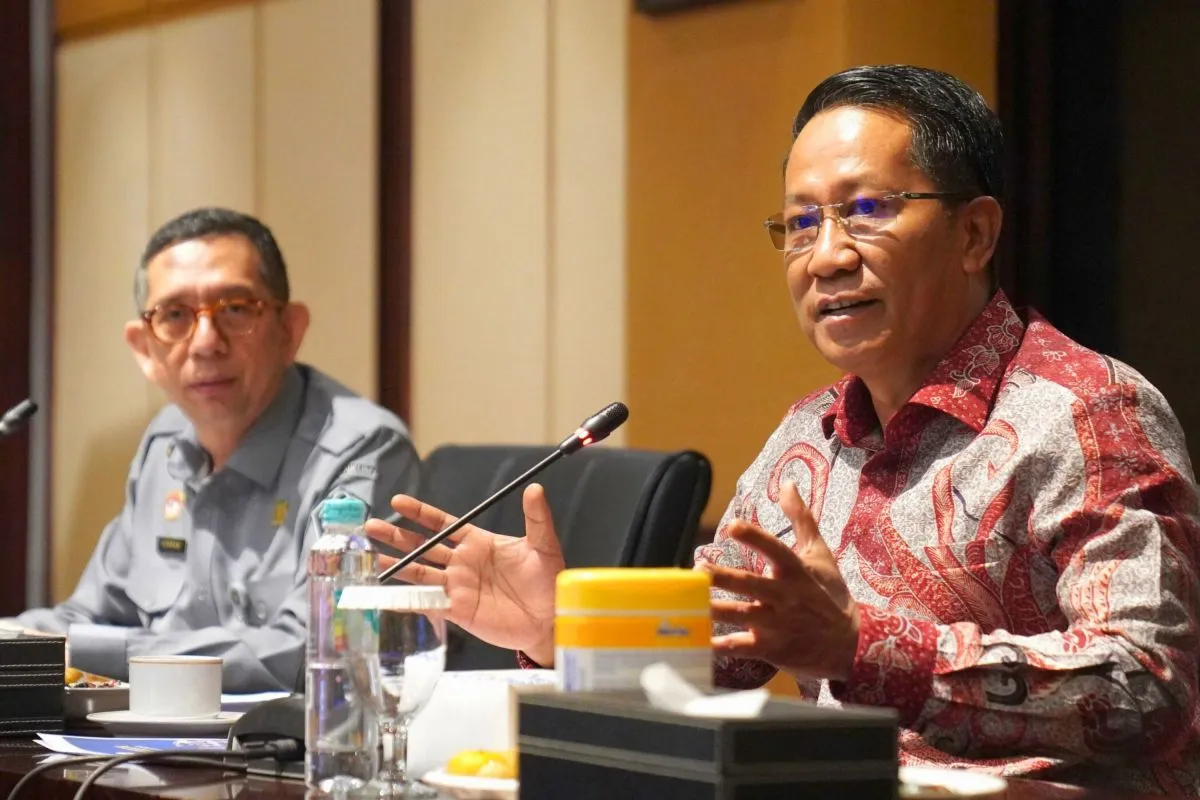
Speaking at a cross-ministry focus group discussion on Monday, Agtas said intellectual property, or IP, should no longer be viewed solely as a legal matter but also as a strategic economic asset that can be leveraged to support growth and productivity.
“At the World Intellectual Property Organization General Assembly, I observed that countries implementing IP-based financing are advanced economies,” Agtas said in a statement released on Tuesday.
He said 14 countries currently apply IP-based financing schemes and added that Indonesia could become the 15th if implementation proceeds smoothly and meets regulatory and financial standards.
The discussion brought together multiple ministries and agencies to assess Indonesia’s readiness to implement IP-based financing under the government’s smallholder business credit programme, known as Kredit Usaha Rakyat (KUR).
Key issues examined included IP protection, legal certainty, valuation of intangible assets, financing mechanisms and ways to mitigate credit risk, officials said.
The forum also aimed to align policy approaches across institutions to ensure consistent, measurable and accountable implementation once the scheme is launched.
Related news: Govt pushes cultural heritage IP regulation to boost economy
Regulatory support was another focus of the talks. Indonesia’s Financial Services Authority (OJK) has opened the door for intellectual property to be used as additional collateral, while technical coordination among ministries is ongoing to ensure the KUR scheme is applied prudently.
Officials stressed that careful design is needed to ensure the financing model remains sustainable and does not undermine the stability of the financial system.
Director General of Intellectual Property Hermansyah Siregar said IP protection and registration would be the foundation of any IP-based financing programme.
He said his office was working to ensure strong legal certainty so that registered IP assets could be reliably valued and trusted by banks and other financial institutions.
All stakeholders agreed the IP-based KUR scheme must adhere to prudential principles to balance innovation support with risk management.
If implemented successfully, the scheme is expected to widen access to financing for small businesses and creative economy players whose main assets are legally registered and protected intellectual property, helping turn ideas into economic value.
Related news: Indonesia eyes China support for stronger global copyright rules
Translator: Agatha, Kenzu
Editor: Rahmad Nasution
Copyright © ANTARA 2025


