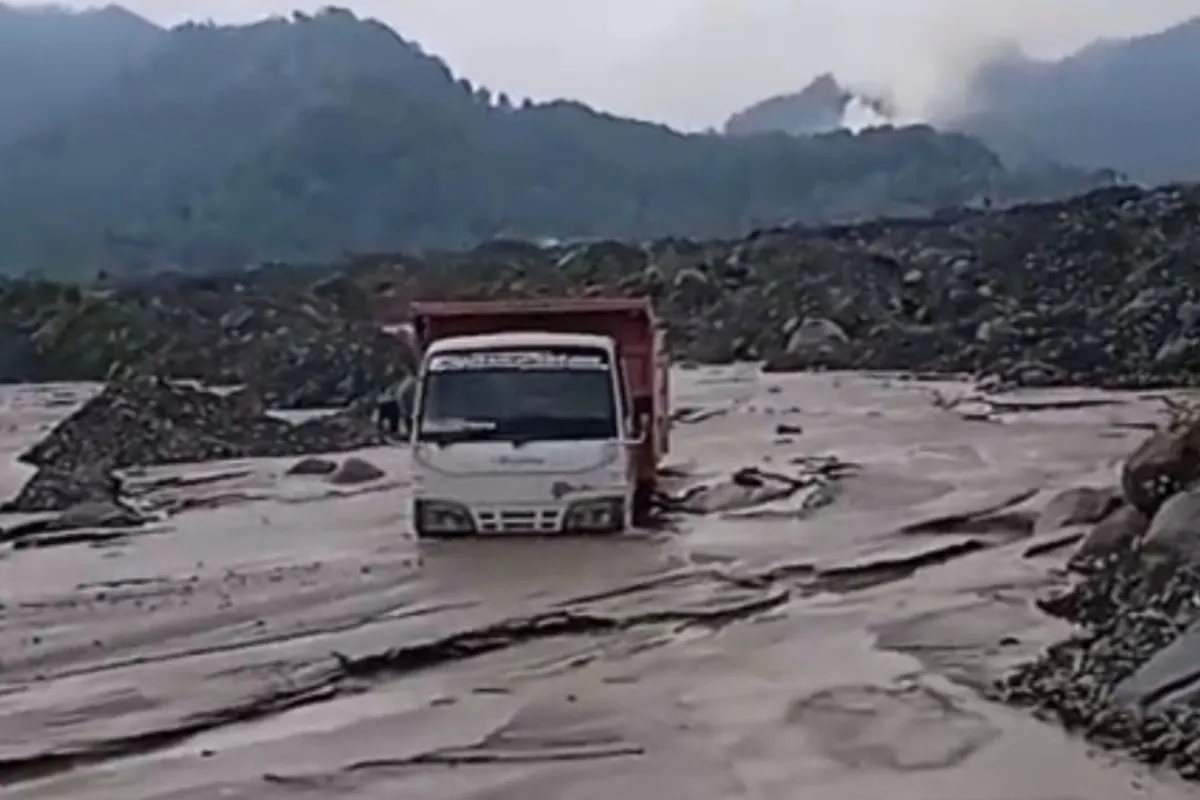
"During seismic observations over the past six hours, from 12:00 p.m. to 6:00 p.m., one flood tremor earthquake was recorded with an amplitude of 45 mm and a duration of 12,000 seconds," an officer at the Mount Semeru Observation Post, Liswanto, informed in a report on Sunday.
According to him, Mount Semeru also experienced 30 eruption earthquakes with amplitudes of 12-22 mm and durations of 91-114 seconds, three avalanche earthquakes with amplitudes of 5-7 mm and durations of 47-56 seconds, and one harmonic earthquake with an amplitude of 11 mm and a duration of 69 seconds.
"From visual observations, Mount Semeru is covered in Level 0-III haze. No crater smoke was observed. The weather is clear to cloudy, with light winds to the south and southwest," he continued.
Meanwhile, the Head of the Lumajang Regional Disaster Mitigation Agency (BPBD), Isnugroho, stated that the heavy rain on the summit of Semeru caused a volcanic mudflow, but it has so far not affected residential areas.
"Due to the strong water discharge, officers urged miners to avoid watersheds originating from Mount Semeru,” he said.
So far, there have been no reports of damage caused by the volcanic mud flood in Lumajang.
Mount Semeru remains at Alert Status, or Level IV, with a recommendation from the Center for Volcanology and Geological Hazard Mitigation (PVMBG) for the public to avoid any activities in the southeastern sector along Besuk Kobokan, 13 km from the summit (the eruption center).
Beyond that distance, the public is prohibited from engaging in activities within 500 meters of the riverbank along Besuk Kobokan due to the potential for expansion of pyroclastic flows and lava flows up to 17 km from the summit.
"We also urge the public to refrain from activities within a five-kilometer radius of the crater of Mount Semeru Volcano due to the risk of ejected (incandescent) rocks," Isnugroho conveyed.
He also reminded the public to be aware of the potential for pyroclastic flows, lava flows, and volcanic mud floods along rivers and valleys that originate at the summit of Mount Semeru, especially along Besuk Kobokan, Besuk Bang, Besuk Kembar, and Besuk Sat, as well as the potential for volcanic mud floods in small rivers that are tributaries of Besuk Kobokan.
Related news: Mount Semeru continues years of activity with six Sunday eruptions
Related news: Mount Semeru eruption injures three, displacing over 500 residents
Related news: BNPB suggests centralized Semeru evacuation centers modeled on Merapi
Translator: Zumrotun Solichah, Resinta Sulistiyandari
Editor: Azis Kurmala
Copyright © ANTARA 2025


