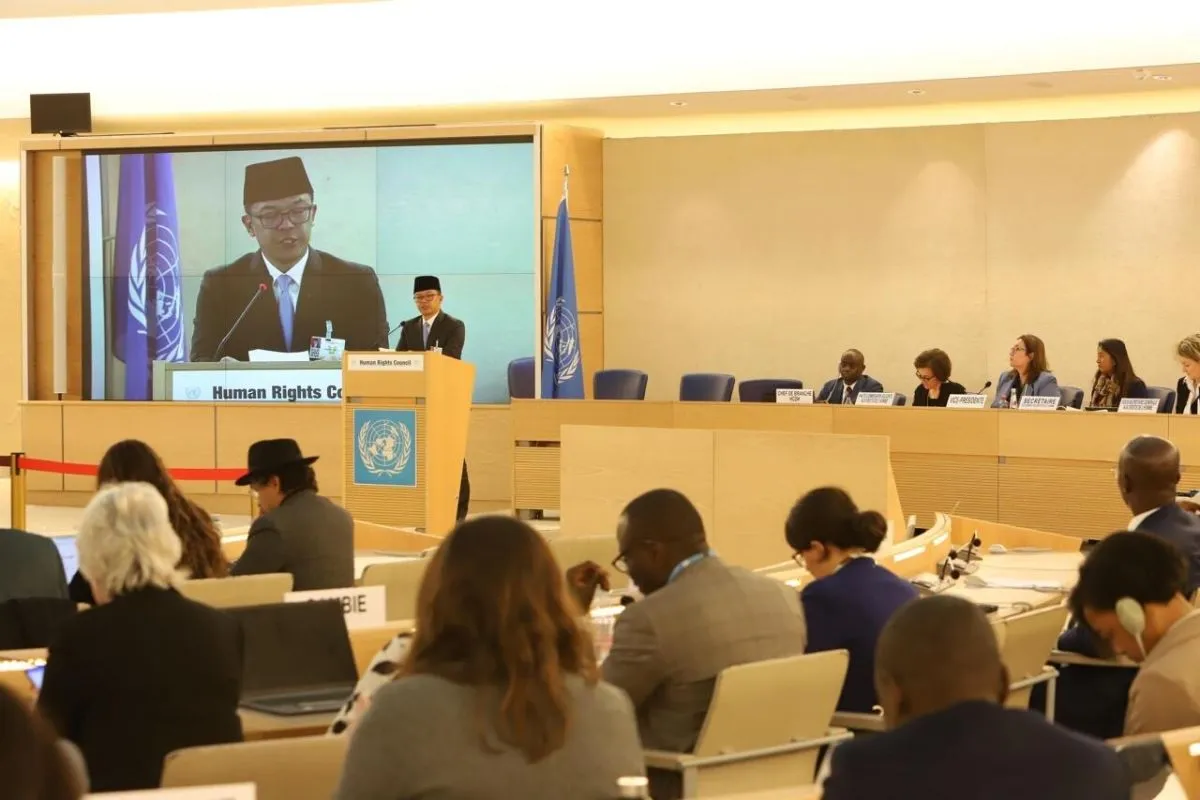
Ambassador Sidharto R. Suryodipuro, Permanent Representative of Indonesia to the UN Office and other international organizations in Geneva, will preside over the Council after his nomination as the sole candidate of the Asia-Pacific group—which includes China, Japan, and South Korea.
Suryodipuro's election as president marks two decades since the Council was founded in 2006.
The establishment of the Council was an important guide for its member states to fulfill their promise to promote universal respect for the protection of all human rights, he noted during a meeting in Geneva.
“We believe that the Council must remain faithful to the core principles of universality, objectivity, and non-selectivity in the consideration of human rights issues, treating all human rights, including the right to development in a fair and equal manner,” Suryodipuro told delegates.
Indonesia’s decision to step forward as president of the Council, according to him, was rooted in the 1945 Constitution, which aligns with the purposes and principles of the UN Charter.
The Constitution, he continued, mandates Indonesia to contribute to world peace based on independence, peace, and social justice.
Based on the constitutional mandate, he added, Indonesia must also continue to defend the multilateral order that affirms the rights of all humanity to global peace, prosperity, and progress.
Prior to being elected president, Indonesia had been elected to the UN Human Rights Council six times, including receiving the highest number of votes in 2023 with 186 votes.
In 2024, Indonesia, represented by Ambassador Febrian Ruddyard, served as one of the vice presidents of the Council, which has 47 member states.
Leading role
Taking over from last year’s president, Jurg Lauber from Switzerland, Suryodipuro will now wield the gavel at the Council’s three scheduled sessions beginning in late February, June, and September.
He will also be overseeing reviews of the human rights record of the Council’s members—a procedure known as the Universal Periodic Review.
As President of the Human Rights Council, Indonesia is committed to working closely with all member states, observer states, non-member states, UN specialized agencies, national human rights institutions, civil society organizations and regional organizations—recognizing their vital role in the global human rights architecture.
Suryodipuro further expressed Indonesia's determination to continue the various initiatives that have been pioneered by his predecessor, including efforts to rationalize and improve the efficiency of the Council's work.
"I will strive to create a respectful and inclusive space for all stakeholders, ensuring accessibility, preventing discrimination, promoting gender equality and the participation of least developed countries and Pacific island countries," he vowed.
In addition to ongoing issues like racism, the environment as well as economic and social rights, the UN Human Rights Council also held sessions focusing on country situations, such as in South Sudan and Palestine.
As a long-standing supporter of Palestinian independence, Indonesia has consistently voiced its support for ending Israel's illegal occupation, which clearly violates the human rights of the Palestinian people.
Indonesia reiterated its commitment to protecting Palestinian rights and upholding international law at the Council's session last September.
Meanwhile, regarding the Venezuelan political crisis, Indonesia stated its focus on the human rights situation, promotion and internal protection in the South American country—rather than directly responding to the abduction of Venezuelan President Nicolas Maduro by the US military.
"This latest dynamic is outside the mechanisms agreed upon by the Human Rights Council,” said Indah Nuria Savitri, Director of Human Rights and Migration at the Foreign Affairs Ministry.
Indah added that if further discussion is needed, the Council has provided a mechanism for an urgent debate or special session.
To date, there has been no official request regarding the issue of Maduro's arrest, so the Council will continue with its previously agreed agenda, she concluded.
Fostering dialogue
Columnist and alumnus of the Department of International Relations at Padjajaran University, Djoko Subinarto, highlighted the moral leadership that Indonesia could implement as president of the UN Human Rights Council.
According to him, the leadership most needed today is one capable of fostering dialogue, so change can grow slowly, not be forced.
"Indonesia ascended to the presidency of the UN Human Rights Council not as a superpower. Nor does it carry the image of a perfect human rights exemplar. It is precisely from this imperfect position that Indonesia has the potential to speak in a more honest tone. It does not judge, but it also does not evade," he wrote.
One of Indonesia's cultural assets is deliberation and consensus, where no party truly wins.
Everyone is asked to give in a little. Everyone is asked to listen more. The results may not be ideal, but they are fair enough to be accepted by all.
Meanwhile, the UN Human Rights Council has often become an arena for mutual accusations. Countries come with resolutions as weapons. The forum has become a platform for political legitimacy, while human rights are often used as a tool, not a purpose.
This is where Indonesia can play a different role. Not as a defender of human rights violations or a global moral prosecutor, but as a guardian of the process to prevent the conversation from immediately degenerating into conflict.
Subinarto emphasized the importance of universal standards for human rights, but the way to discuss violations, how to reprimand countries and how to encourage improvements cannot be standardized. This is where dialogue becomes crucial.
Indonesia can encourage a shift in the Council's working methods, he said. From the practice of open criticism that often dominates public attention, to a process that emphasizes listening to explanations, opening up space for substantive questions and answers as well as offering gradual paths to improvement.
"From an approach of naming and shaming to listening and engaging. From symbolic pressure to a conversation that enables real, sustainable change," he said.
This approach does not mean permissiveness toward human rights violations, nor does it imply inaction. On the contrary, it aims to ensure that human rights mechanisms remain necessary and are not abandoned by countries that feel cornered.
Related news: Indonesia reaffirms commitment to UN Human Rights diplomacy
Related news: Indonesia launches One Data system to transform human rights policy
Editor: Yuni Arisandy Sinaga
Copyright © ANTARA 2026