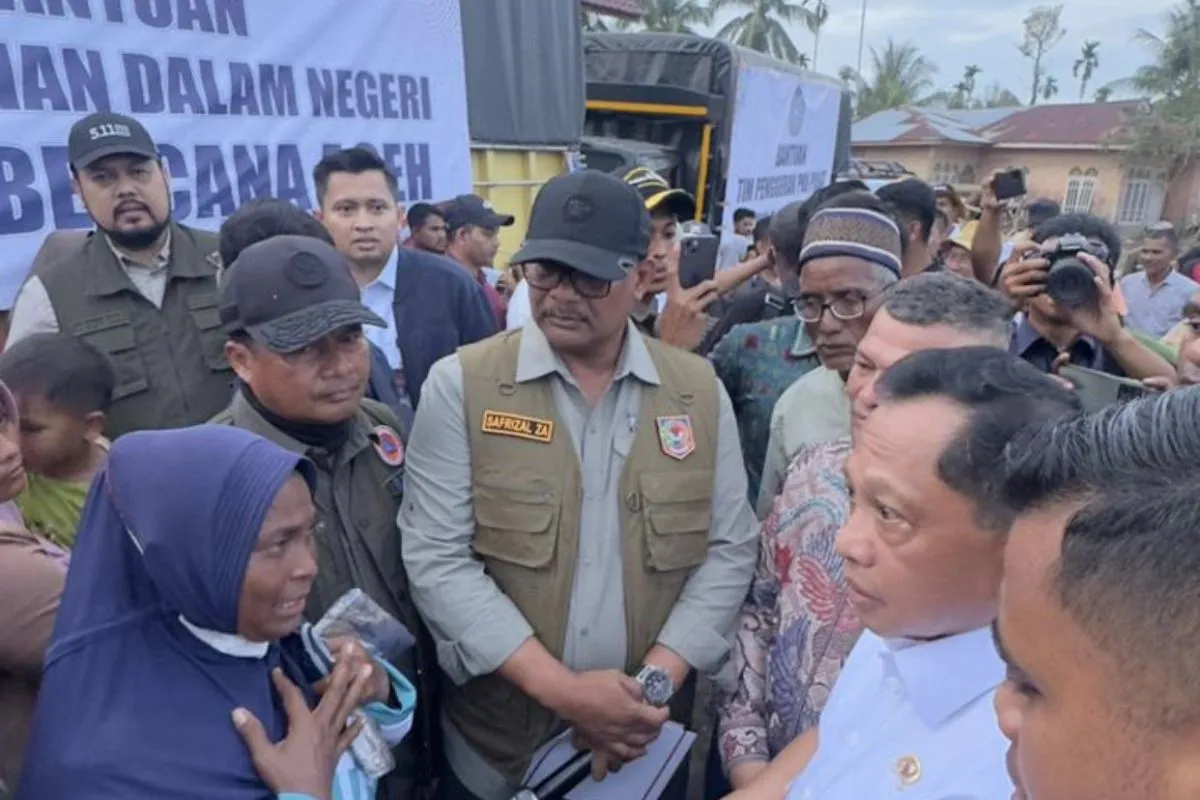
Selecting Aceh as the site of the command post is not merely because of its status as the hardest-hit province, but also because Aceh has a long history of facing crises, from conflict to disasters, such as the 2004 Indian Ocean earthquake and tsunami.
There is also a symbolic and strategic message behind it: that post-disaster recovery is no longer seen as just a series of scattered, sector-specific projects. Instead, it is understood as a unified national orchestration that requires strong leadership, cross-sector coordination, and a tangible state presence on the ground.
President Prabowo Subianto's direct order to form the National Task Force for Post-Disaster Rehabilitation and Reconstruction Acceleration and appoint Home Affairs Minister Tito Karnavian as its chair demonstrates an awareness of the high-level regional and administrative complexity involved in the disasters that hit Aceh and two other provinces of Sumatra–North Sumatra and West Sumatra–in late November 2025.
With the impact spreading across three provinces, coordination between local governments has become vital. Structurally, the Minister of Home Affairs sits at the vital intersection of central and regional relations.
However, this decision should also be examined further. The effectiveness of the task force's leadership will be determined not just by formal authority, but by the ability to resolve overlapping regulations, accelerate decision-making, and cut through the red tape that has historically slowed down post-disaster rehabilitation and reconstruction efforts.
The task force's first meeting, which involved various other ministries and agencies, including the Coordinating Ministry for Human Development and Culture, has reflected the seriousness of building a cross-sectoral coordination.
However, the real challenge lies in what happens after these initial meetings are held. Past experience shows that the emergency response phase often proceeds much faster and more responsively than the long, complex, and politically sensitive rehabilitation and reconstruction phase.
The central command post in Banda Aceh must be more than just a place to record needs and reports; it must have the operational authority to ensure that decisions are made and executed consistently.
Standby Force
The statement from the Ministry of Home Affairs' Director General of Regional Administrative Development, Safrizal ZA, regarding a standby force and intensive assistance from the very start of the emergency phase, is commendable.
A strong state presence during the initial stage of a crisis indeed determines the direction of the recovery. However, effective assistance needs more than just physical presence but also an accurate, integrated data system covering the number of victims, the extent of the damage, housing needs, and the socio-economic conditions of the affected communities.
Without a solid and open database, acceleration efforts could potentially cause new disparities where some residents receive quick handling while others are left behind.
The government's decision to focus on accelerating housing development for residents staying in shelters is the right step.
The compensation schemes for houses with light and moderate damage also reflect a more flexible approach, allowing residents to rebuild in a way that fits the local context.
However, this policy must be supported by strict and participatory oversight mechanisms to ensure it does not turn into a mere distribution of funds, which is prone to misappropriation.
This is where the central command post becomes vital as a hub for public communication.
The commitment that the post will serve as the primary channel for government progress reports, involving national and local media as well as social media optimization, opens a new door for more transparent disaster management.
Public communication must not be viewed as a mere ceremonial reporting. Instead, it must be a space for two-way dialogue, where the voices of affected residents, volunteers, and local governments can be heard and responded to swiftly.
Transparency regarding progress, obstacles, and plan changes will ultimately strengthen public trust, rather than weaken it.
Laboratory of policies
Going forward, the central command post in Aceh must serve as more than just a temporary command facility but as a laboratory of policies for more adaptive post-disaster recovery efforts.
This experience can be a foundation to create a new national protocol in cross-provincial rehabilitation and reconstruction, including standards for coordination, funding, and public communication.
By doing so, major disasters will no longer be responded to with an ad hoc approach, but rather with a framework that has been tested and continuously enhanced.
Another aspect that is often overlooked is medium-term and long-term socio-economic recovery. Building homes is crucial, but without restoring livelihoods, the risk of structural poverty will increase in the affected areas.
The national task force must integrate local economic recovery programs from the very beginning, and this includes support for small businesses, fishers, farmers, and those working in the informal sector, which are the backbone of the regional economy.
This approach will ensure that reconstruction does not stop at physical infrastructure, but continues toward the revival of people's lives.
At the end of the day, the establishment of the central command post in Banda Aceh is a test for the state's ability to learn from experiences and innovate in crisis management.
If the command post can operate quickly, transparently, and inclusively, it could become a new model for post-disaster management in Indonesia. However, if it falls into the trap of bureaucratic routine and one-way communication, this golden opportunity will be missed.
Ultimately, all eyes are on the state, hoping that it is present not just to rebuild what has fallen, but to initiate a new way that is fairer, more resilient, and future-oriented for communities rising from the impact of disasters.
Related news: Indonesia backs livestock investment for Aceh's post-flood recovery
Related news: Manggala agni deployed for post-flood response in Sumatra
Editor: Rahmad Nasution
Copyright © ANTARA 2026


