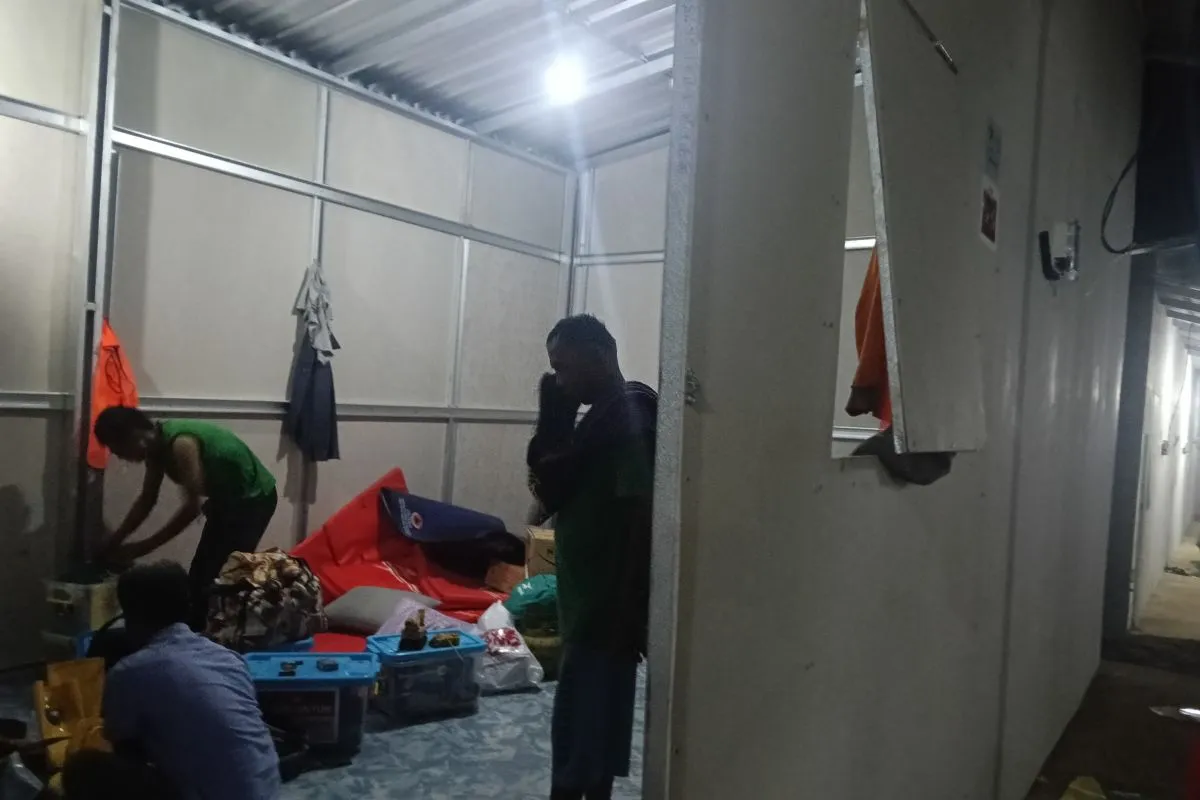
Suharmes, 45, a victim of flash floods and landslides in Salareh Aia, Palembayan Sub-district, Agam District, West Sumatra, greeted ANTARA warmly on Saturday (January 24) evening.
“Please come in, sir,” he said warmly, approaching and shaking hands with ANTARA near the temporary shelter that had just been inaugurated by the government.
That Saturday evening, most disaster survivors in Salareh Aia Village began occupying the temporary shelters built by the National Disaster Mitigation Agency (BNPB).
Under the soft glow of lights, Suharmes’ face reflected happiness, a gentle smile as if the burden of losing his home had eased.
The devastation of having his house washed away and livelihood destroyed weighed heavily, but the joy of occupying the new shelter eased his grief.
“Today is our first day staying in the temporary shelter. We have been in the evacuation site for almost two months,” said the father of three, beginning the conversation.
Suharmes felt grateful to be able to occupy the temporary shelter located at the public elementary school SDN 05 Kayu Pasak football field, Salareh Aia Village.
“Perhaps there is wisdom and a purpose from God behind this incident. We just live through it and must remain grateful. The most important thing now is that we have a new roof,” he added.
The man, who sold daily necessities by running a small shop at home before the disaster, had to accept what had happened.
He said the government had worked hard to help disaster victims. Various aid continued to flow even now.
Aid from central and provincial governments, local authorities, and volunteers has been “countless,” he said, allowing him to start over, reopen his business, and support his family.
The concern from the central and provincial governments, and local authorities, and the solidarity of volunteers moved them and made them very grateful.
“The aid that has come is countless. Today we have occupied the temporary shelter,” he said.
With this shelter, he said he will start over, reopening his business to support his wife and three children.
He did not deny feeling sad facing the reality of the disaster, but he believes he and other survivors must rise. Now is the time to recover and rebuild, starting from the facilities of this temporary shelter.
Other survivors also seemed happy to occupy the completed temporary shelters.
Saturday night, many survivors were still busy moving belongings, clothes, and daily necessities from the evacuation site in the SDN 05 Kayu Pasak classrooms to the temporary shelters.
Meanwhile, children of the disaster survivors played happily in the yard, their faces full of joy. Some played with toy cars, ran around, and laughed with children their own age.
Elsewhere, a couple, Sawaludin (51) and Yusmarni (45), busily arranged their household items inside their newly occupied room.
For the time being, they must live in the temporary shelter while waiting for permanent housing to be built by the government.
The couple felt grateful to occupy the temporary shelter as since the disaster, Yusmarni, along with her husband and children, had constantly moved, relying on relatives’ homes for shelter.
Besides living on aid, she could only use a small portion of her savings to survive. Their rice fields, which had previously generated income, were devastated by the flash floods.
The couple, who have two children, certainly hope that the government can help restore their farmland so it can produce again to meet daily needs and fund their daughters’ schooling.
The occupation of temporary shelters marks the beginning of post-disaster recovery in Palembayan, Agam. Families can now live more normally while waiting for permanent housing.
Related news: Temporary housing crucial to prevent prolonged stays in shelters
Beginning of recovery
In other words, survivors' occupation of the temporary shelters is a real step in the post-disaster recovery in Palembayan, Agam.
In the temporary shelters, they no longer sleep cramped together with other families.
Family activities can now be conducted more normally, while waiting for permanent housing to be rebuilt.
Coordinating Minister for Human Development and Culture Pratikno said that, according to President Prabowo Subianto’s instructions, disaster rehabilitation must be accelerated.
All sectors of recovery, rehabilitation, and reconstruction must proceed quickly.
Construction begins with infrastructure, as many roads and bridges need repair, including the restoration of electricity, fuel, damaged agricultural land, micro, small and medium enterprises (MSMEs), markets, temporary shelters, and permanent housing.
Equally important, Pratikno, who is also Chair of the Post-Disaster Rehabilitation and Reconstruction Task Force in Sumatra, emphasized the need to restore the productivity of disaster survivors in West Sumatra.
Currently, aside from accelerating infrastructure development, strengthening institutions for disaster prevention and mitigation is also important for the future.
The government also sees that the recovery of agricultural lands must be sped up.
Meanwhile, Minister of Home Affairs Tito Karnavian, who attended the inauguration of the temporary shelters in Kayu Pasak, Palembayan, Agam, said that with the inauguration, disaster survivors can now occupy them.
It is expected that with the temporary shelters, affected residents can quickly recover and rebuild their lives.
In Agam District, 117 temporary shelters are ready for survivors to occupy, who previously had to shelter in the classrooms of SDN 05 Kayu Pasak.
“Thanks to the central and provincial governments, police, military, volunteers, community organizations, and all parties who have helped the disaster recovery in Agam, especially in building these temporary shelters,” said Agam District Head Benni Warlis.
Related news: Indonesia ensures 9,145 temporary homes for Sumatra disaster victims
Editor: M Razi Rahman
Copyright © ANTARA 2026


