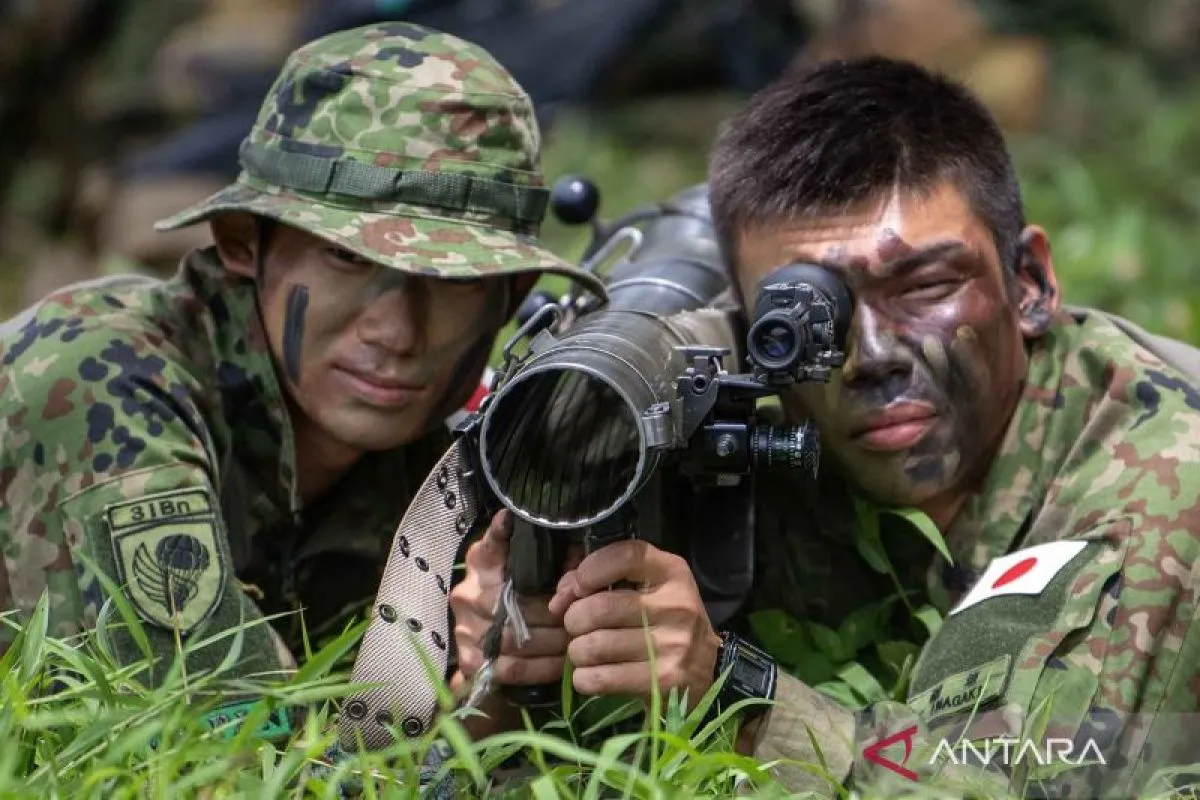
Yet this development is only one part of Indonesia’s broader regional engagement to deepen defense and security cooperation. Japan, in particular, has emerged as an increasingly important partner, as both countries navigate a regional environment shaped by China’s rise and intensifying strategic competition between Beijing and Washington.
Despite expanding cooperation, Jakarta and Tokyo do not approach regional security from identical perspectives. Their defense relationship is therefore best understood not as a convergence of threat perceptions, but as a pragmatic alignment of interests. Examining how each side views regional security challenges helps clarify both the potential and the limits of Indonesia-Japan defense cooperation.
Japan’s contemporary defense and security calculations are dominated by the rise of China. Over the past decade, Beijing has significantly expanded its military footprint in the South China Sea, deploying missiles, fighter aircraft, surveillance systems, and naval assets to artificial islands and outposts.
These deployments have been accompanied by increasingly assertive behavior, including large-scale exercises involving H-6 bombers, dangerous intercepts of US and Australian surveillance aircraft, and persistent challenges to freedom of navigation and overflight operations.
For Tokyo, these developments carry serious implications. The South China Sea constitutes a critical maritime corridor for Japan’s economy, particularly for energy imports from the Middle East. Japanese policymakers are therefore acutely sensitive to the possibility of Chinese coercion or a naval blockade.
These concerns are reinforced by China’s past willingness to employ economic pressure, most notably its restriction of rare-earth exports following the 2010 Senkaku Islands incident, as well as Chinese discussions of a potential blockade of Taiwan as a means of enforcing reunification.
Japan’s apprehension is further intensified by its own unresolved disputes with China. These include competing claims over the Senkaku Islands, frequent incursions into Japan’s exclusive economic zone, and intensified Chinese military activity near Japanese air and maritime space.
Collectively, these actions are viewed in Tokyo as part of a broader effort to undermine a rules-based regional order through coercion and unilateral changes to the status quo.
Proactive Contribution to Peace
In response, Japan has pursued a more assertive security posture under its policy of “Proactive Contribution to Peace,” first articulated in the 2013 National Security Strategy. Central to this approach is the vision of a Free and Open Indo-Pacific (FOIP), which emphasizes adherence to international law, particularly UNCLOS; freedom of navigation and overflight; opposition to unilateral use of force; and regional prosperity through open sea lanes and free trade.
To advance FOIP, Japan has expanded defense outreach to Southeast Asia through regular military exercises, defense dialogues, and capacity-building initiatives.
A key innovation has been the launch of the Official Security Assistance (OSA) program in 2023, which allows Japan to provide defense-related equipment to partner countries, marking a significant departure from its earlier self-imposed restrictions.
Under these frameworks, Japan has supplied coast guard vessels, patrol ships, radar systems, and maritime surveillance assets to countries such as the Philippines, Malaysia, and Indonesia.
The underlying logic is that enhancing regional maritime capacity contributes to deterrence, reduces the space for coercion, and reinforces regional stability without overtly militarizing partnerships.
Japan and Indonesia share a defense relationship grounded in common support for a rules-based maritime order free from unilateral attempts to change the status quo through use of force or gray-zone tactics, ASEAN centrality, and the ASEAN Outlook on the Indo-Pacific (AOIP).
The two countries conduct regular bilateral and multilateral exercises, maintain extensive defense dialogues across all service branches, and in 2025 agreed to establish an “Integrated Defense Dialogue” to further institutionalize cooperation.
Japan views Indonesia as a Comprehensive and Strategic Partner and uniquely holds a 2+2 Foreign and Defense Ministers’ Meeting with Jakarta among Southeast Asian states, aside from the Philippines. This reflects Indonesia’s strategic weight as Southeast Asia’s largest country and a de facto regional anchor.
At the same time, Japan’s gradual relaxation of arms export restrictions, driven by both strategic considerations and the desire to revitalize its defense industry, has opened new avenues for cooperation.
A 2021 agreement on defense equipment and technology transfer provides the legal basis for potential major arms sales, including Indonesia’s expressed interest in Japanese submarines and Mogami-class frigates.
Jakarta and Tokyo's perception of China
Despite these shared interests, Jakarta’s perception of China as a military threat differs significantly from Tokyo’s. Unlike Japan, Indonesia has not experienced sustained high-intensity military coercion from China, such as direct airspace challenges near its main islands.
As a result, Indonesia’s threat perception must be understood through the lens of its long-standing non-aligned foreign policy and its defense posture, which prioritizes sovereignty and territorial integrity rather than alliance-based deterrence.
Indonesia assesses China’s military potential primarily in terms of whether Beijing’s capabilities and behavior directly endanger Indonesian territory. This concern is most evident in the North Natuna Sea, where China’s nine-dash line claim overlaps with Indonesia’s exclusive economic zone.
Incidents involving Chinese Coast Guard intrusions, most notably in 2020, have prompted firm responses from Jakarta, including military deployments and diplomatic protests.
However, these maritime frictions coexist with broadly stable political and economic relations. Under President Prabowo Subianto, Indonesia has continued to maintain warm ties with Beijing, illustrated by Prabowo’s attendance at China’s 2025 Victory Day Parade and reported Indonesian interest in acquiring Chinese military platforms. This reflects Jakarta’s preference for strategic autonomy and hedging, rather than overt balancing.
While Indonesian military and security officials do recognize China as a potential threat, the relatively low intensity of Chinese intrusions, typically persistent but limited coast guard patrols, has meant that Jakarta does not see an urgent need to align itself with efforts to militarily contain China.
The contrast between Japan and Indonesia is evident in their respective approaches to deterrence toward China. Japan has supported multilateral efforts such as US-Japan-Philippines/US-Japan-Philippines-Australia Defense Ministers’ Meetings and joint exercises in the South China Sea.
Japan has expressed concerns over incidents involving Filipino vessels. For now, Indonesia avoids joining these collective efforts and expressing concerns over incidents involving China and third Southeast Asian countries for fear of being seen as participating in an antagonistic arrangement toward China.
The contrast between Indonesian and Japanese threat perceptions becomes even clearer when considering attitudes toward the United States.
As a formal US ally, Japan views Washington as the cornerstone of regional security and the primary guarantor of stability. From Tokyo’s perspective, closer alignment with the United States and like-minded partners is essential to countering China’s growing power.
More ambivalent
Indonesia’s view is more ambivalent. While Jakarta regards the United States as an important security partner, evidenced by frequent bilateral and multilateral exercises and the use of US-made defense equipment, it also considers Washington a potential source of insecurity. This was highlighted in 2023 when then - TNI Commander Admiral Yudo Margono told parliament that the United States was the most frequent violator of Indonesian airspace during the first half of that year.
Differences in interpretations of international maritime and airspace law further complicate relations. US freedom of navigation and overflight operations, conducted under its interpretation of international law, are often perceived in Jakarta as infringements on sovereignty. Consequently, from Indonesia’s perspective, both Beijing and Washington can pose challenges to national security.
Despite these divergent threat perceptions, sustained defense engagement demonstrates that Indonesia and Japan possess substantial common ground.
Japanese maritime security assistance, particularly in capacity building and coast guard support, aligns well with Indonesia’s emphasis on law enforcement and sovereignty protection rather than power projection.
Joint participation in exercises such as Super Garuda Shield, including the involvement of the Japan Self-Defense Force, enhances interoperability and mutual familiarity.
Such cooperation is particularly valuable for non-combat contingencies, including disaster relief and humanitarian assistance, where both countries are likely to operate together.
Arms cooperation also remains a promising area. Japan’s relaxed export rules and the 2021 defense transfer agreement create pathways for major systems sales.
Japan’s efforts to market Mogami-class frigates and submarines align with Indonesia’s defense modernization under the Optimum Essential Force program, which prioritizes naval and maritime capabilities.
Indonesia and Japan approach the Indo-Pacific security environment from different strategic starting points. Japan, facing sustained coercion and anchored within the US-led security architecture, views China as the primary disruptor of regional order. Indonesia, guided by non-alignment and a focus on territorial defense, adopts a more hedging-oriented posture.
These differences place limits on how far bilateral defense cooperation can go, particularly regarding overt balancing against China. Nevertheless, years of engagement demonstrate that substantial space remains for pragmatic cooperation.
By focusing on maritime security, capacity building, defense modernization, and non-traditional security missions, Jakarta and Tokyo can continue to deepen their defense relationship, despite their differing perspectives on regional order.
*)Daiki Tsuboi (u7565068@alumni.anu.edu.au) is a graduate of Master of Strategic Studies at the Australian National University.
*) Muhammad Teguh Ariffaiz Nasution (MuhammadTeguh.Nasution@alumni.anu.edu.au) is a defense and security researcher at The Horizon Indonesia. He graduated with a Master of Strategic Studies from The Australian National University.
The views and opinions expressed on this page are those of the authors and do not necessarily reflect the official policy or position of ANTARA News Agency.
Copyright © ANTARA 2026


