On February 2, 2026, President Prabowo Subianto highlighted the waste problem in Bali, emphasizing the need for more massive and aggressive efforts to address the issue during his speech at the National Coordination Meeting of the Central and Regional Governments in Sentul, West Java.
His remark was immediately responded to the following day by several parties in Bali, who conducted waste cleanups, including at the Kuta Beach tourist attraction in Badung District.
Thousands of people from the Indonesian military, the police, local government agencies, environmental communities, and students were involved in cleaning up the scattered waste, including plastic waste littering the shoreline.
Bali Governor Wayan Koster also responded by immediately establishing a beach cleanup task force.
The waste problem is not only found along coastal areas but also in residential neighborhoods, both urban and rural, which have yet to be addressed optimally.
Furthermore, the Suwung Landfill Site (TPA) in Denpasar is currently experiencing problems due to its capacity being exceeded.
According to data from the Bali Provincial Forestry and Environment Agency (DKLH), the average daily waste volume in the region is estimated at 3,436 tons. Denpasar City contributes the most, producing an average daily waste volume of 1,005 tons.
Active community involvement is crucial in addressing the complex waste problem, including plastic waste.
Behind all this, some breakthroughs can be implemented through controlling plastic waste at the source, namely the innovation of processing plastic into fuel oil (BBM).
Fuel from Plastic
Although most people still think plastic waste has no value, this mindset needs refreshment as it represents a breakthrough that has not been fully recognized by the public.
This is what the Get Plastic Indonesia Foundation, headquartered in Sibang Kaja, Badung District, Bali, is doing. They are turning innovation into an opportunity by transforming plastic waste into fuel.
The Chairman of the Get Plastic Indonesia Foundation, Dimas Bagus Wijanarko, explained that the idea of converting plastic waste into energy stems from the unresolved waste problem, particularly plastic.
To that end, since 2013, his foundation has focused on research into producing fuel using globally developed technology, pyrolysis.
Pyrolysis is a technology utilizing the heat of certain materials, including plastic, to high temperatures, above 350 degrees Celsius.
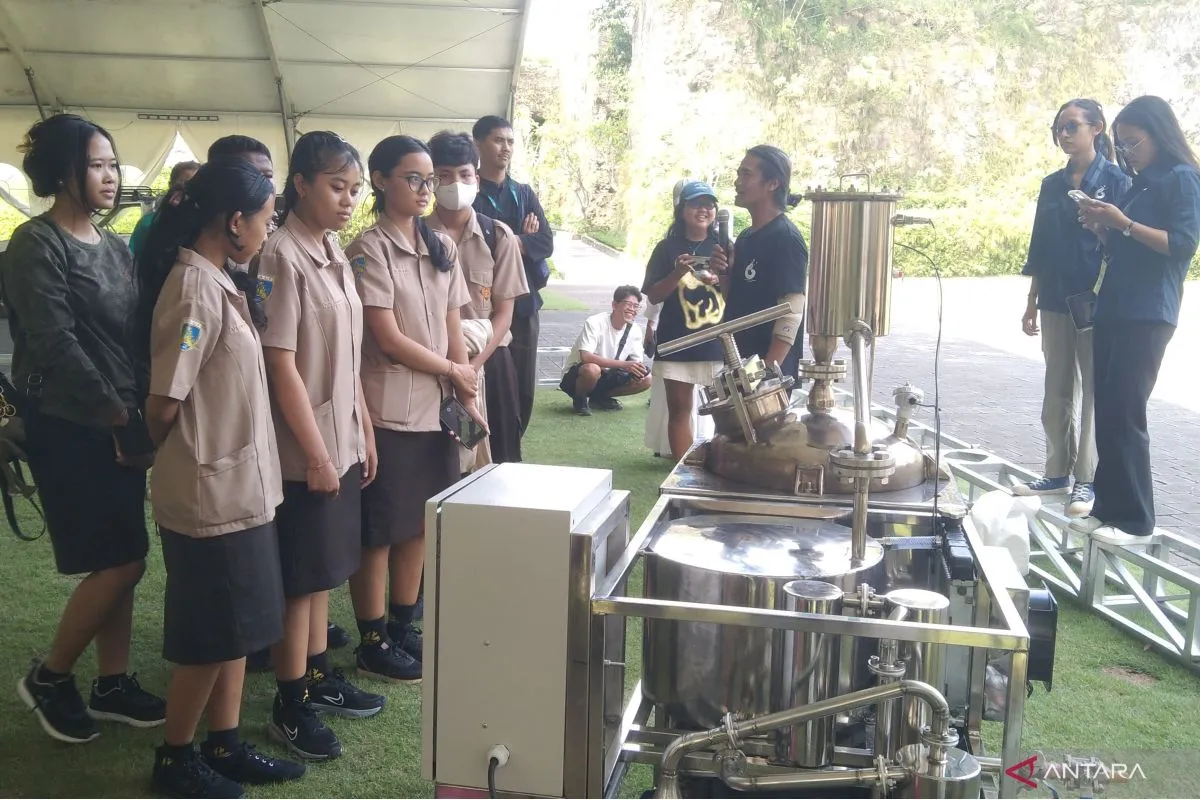
A team of 10 people in Bali has self-taught themselves by building a machine that processes plastic waste into fuel.
They currently own three machines, which have undergone a series of tests to ensure the fuel production.
Each machine has a processing capacity of five, 10, and 20 kilograms of plastic waste.
The 10-kilogram plastic waste processing machine is measuring 125 cm x 56 cm x 160 cm, and is portable due to its four-sided wheels.
The machine is equipped with a condenser tube, two reactor units, a water reservoir, and a tap for dispensing the fuel.
The machine does not yet have Indonesian National Standards (SNI) certification since it is not yet manufactured in Indonesia.
However, Dimas said that all components in the processing machine have been SNI certified.
Operational Method
The plastic waste collected from the community also serves as a means of environmental campaigning to ensure optimal waste management.
Once collected, the plastic waste is produced into fuel, a seemingly simple process utilizing pyrolysis technology. This technology uses a distillation method, which involves heating the plastic waste to a dry state.
The dry plastic waste is fed into a cylinder in the machine with a capacity of 10 kilograms for all types of plastic, from plastic bottles and plastic bags to straws and other plastics.
There must be no vacuum inside the cylinder, meaning the cylinder must be full of dry plastic waste. Dry and free of empty spaces, this ensures an oxygen-free environment.
"This is not a combustion process because it does not require oxygen. Combustion requires oxygen to ignite the flame," Dimas informed.
Once the cylinder is full, the machine starts heating the plastic to temperatures of up to 350 degrees Celsius, and turning it into gas.
This gas is then captured by mechanical rotation and transferred to a condenser to form steam.
When the steam meets the coolant, it turns into a liquid and then being converted into gasoline, diesel, or kerosene.
The liquid is then diffracted, or separated by density or mass in a second reactor.
"If the mass is light, like gasoline, it will separate itself. If the mass is heavy, it remains in the reactor to become diesel," he continued.
After about three hours of processing, the tap is ready to flow fuel.
With a capacity of 10 kilograms of plastic waste, approximately 10 liters of diesel can be produced, which is currently the focus of production.
Dimas estimates that the average fuel production from plastic waste has reached around 5,000 liters per year.
The distillation process also produces residue in the form of approximately 0.5 kilograms of carbon powder from 10 kilograms of plastic waste. This residue powder can be processed into souvenirs, such as ashtrays, paving blocks, and briquettes.
Regarding the measurements, the foundation has conducted laboratory tests at the relevant institutions, with the results of the quality of gasoline fuel tested at Pertamina having a cetane number of 92.3 and diesel containing 63 percent of the cetane number tested by two government institutions.
Opportunities for Plastic Fuel
Meanwhile, fuel consumption, including diesel fuel made from plastic waste, is still limited to the foundation's operational vehicles. The tour buses frequently used for the foundation's eco-friendly campaigns also utilize plastic waste fuel.
Furthermore, the fuel is donated to farmers near the foundation in Gerih, to power tractors. It is then used by shuttle buses in Yogyakarta and by partner companies in several cities across the country.
Tests conducted by a local government agency in Yogyakarta recorded relatively low emissions, at 2.7 percent.
Dimas envisions mass production of plastic waste fuel, thereby reducing the problem of waste polluting the environment.
Regarding this innovation, Ahad Rahedi, Manager of Communications, Relations, and Social and Environmental Responsibility (TJSL/CSR) for Pertamina Patra Niaga for East Java, Bali, and Nusa Tenggara, expressed his appreciation for the foundation's breakthrough.
He considers this innovation is potential for synergize with the state-owned oil and gas company's CSR program for sustainable development.
Ahad believes that synergy, collaboration, and the potential for replication of fuel from plastic waste in potential areas could be a form of support.
The current challenge lies in scaling up community-based innovations, particularly in the management of plastic waste. Producing alternative fuel from plastic waste requires strong commitment, courage, and substantial investment.
For the environment and the nation's future, this innovation can be considered as a pathway to energy independence while also helping reduce waste production.
Related news: Waste sorting vital to fuel power plants: VP
Related news: Jakarta governor committed to solve Rorotan RDF odor problem
Editor: Rahmad Nasution
Copyright © ANTARA 2026


