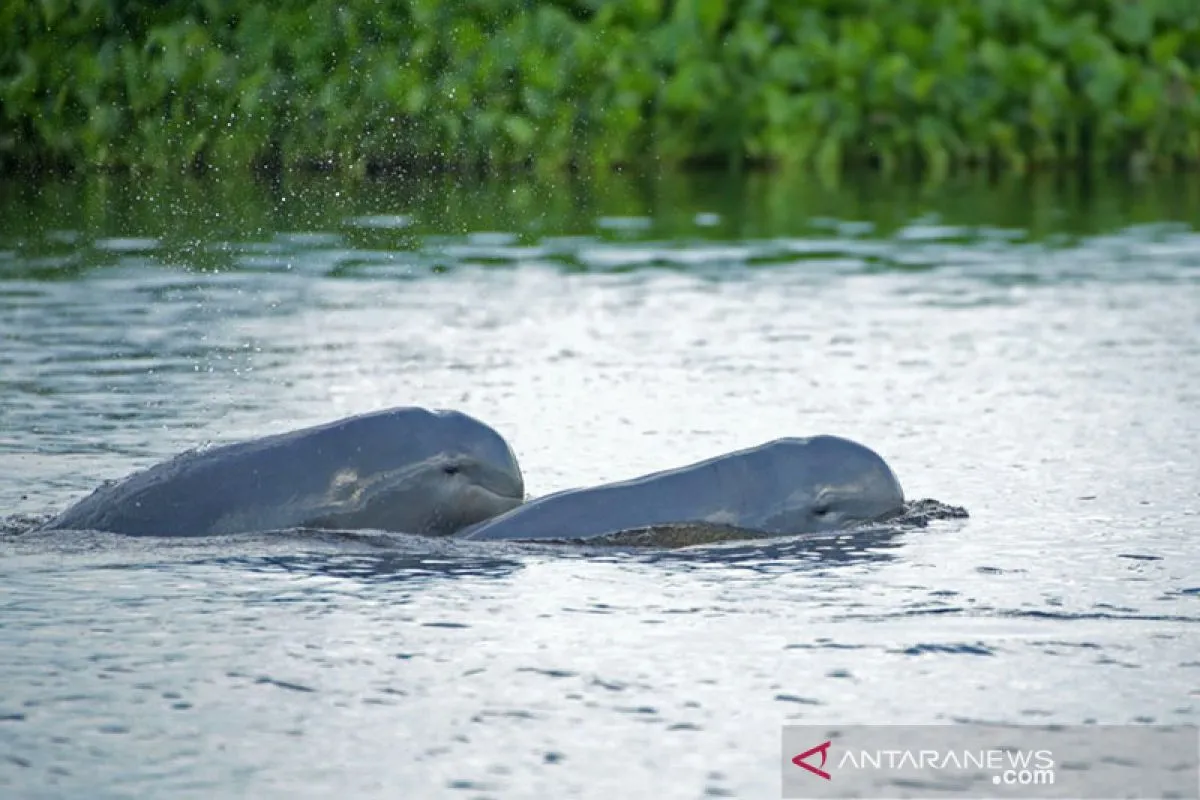
The International Union for Conservation of Nature (IUCN) categorizes the species as a critically endangered species due to its projected population decline of more than 80 percent over the past decade.
In Indonesia, according to monitoring by the Ministry of Environment, the Mahakam dolphin population has decreased from 66 in 2025 to 62 as of February 2026.
Biologically, the Mahakam dolphin, which eats fish and shrimp, breathes using its lungs and is classified as a freshwater mammal. Its body is gray to dark blue in color.
This endemic species, locally known as “pesut,” lives in groups and has unique physical characteristics that distinguish individuals from one another—similar to human fingerprints. Variations can be seen in their fins and the shape of the nape.
According to WWF Indonesia, the Mahakam dolphin plays a crucial role as a bioindicator of water quality. Sections of the Mahakam River where dolphins are still found, as well as indicators of the presence of fish and shrimp that are still abundant.
Therefore, it is important to protect this species from the threat of extinction due to a decrease in habitat quality caused by human activities and reduced food availability.
The Ministry of Environment has identified key threats to the Mahakam dolphin, including land conversion and clearing in upstream areas, coal mining activities that impact water quality as well as illegal practices such as the use of electrofishing and fish bombs.
In addition, heavy river traffic—particularly coal barges—is also suspected of disrupting the dolphins' navigation and critical habitats.
Related news: Most whale, dolphin habitats off Sumatra outside protected areas: BRIN
Emergency measures
In order to save the Mahakam dolphin population, the ministry is preparing emergency measures which include law enforcement against companies contributing to environmental damage that leads to the death of dolphins.
Recently, the Ministry of Environment suspended the operations of two companies suspected of polluting the Mahakam River, contributing to the decline in the dolphin population.
Environment Minister Hanif Faisol Nurofiq emphasized that environmental law enforcement and monitoring will continue to ensure that all activities in the river area—which is the natural habitat of the Mahakam dolphin—comply with established regulations.
To protect this mammal native to East Kalimantan, he continued, environmental law enforcement will be carried out fairly and equitably.
The ministry’s deputy for law enforcement had found PT GBE, which operates in the coal transportation and sales sector, to have violated the law by constructing a jetty without environmental approval.
Meanwhile, PT ML, which operates in the ship-to-ship sector, was found to have violated the law by not having a spatial use approval for the placement and mooring of the Coal Transhipment Barge (CTB).
The company also lacked environmental approval for the placement and mooring of CTB I and CTB II.
Both companies were immediately subject to strict action, with all operational activities suspended.
In addition to law enforcement, the government has designated two villages in Kutai Kartanegara Regency as conservation villages to intensify rescue efforts.
The newly designated villages—Muhuran in Kota Bangun Sub-district and Sabintulung in Muara Kaman Sub-district—join Pela Village, which had previously received conservation status.
The initiative highlights the ecological importance of the Mahakam River and Lake system, which supports diverse wildlife including proboscis monkeys, otters, herons, and numerous aquatic species, while also playing a strategic role in climate change mitigation and adaptation.
The ministry's Deputy for Pollution and Environmental Damage Control, Rasio Ridho Sani, stressed that all economic activities in the region—from fisheries and river transport to plantations, mining and tourism—must be managed responsibly to avoid harming the dolphin’s fragile habitat.
He also called for stronger waste and sewage management to reduce water pollution and protect biodiversity.
The ministry has opened channels for public reporting of environmental damage, ensuring follow-up through law enforcement.
Officials hope the Mahakam Dolphin Conservation Area will serve as a model of sustainable biodiversity management, delivering fair benefits for both nature and local communities, and demonstrating the power of cross-sector collaboration in environmental protection.
Related news: Indonesia investigates deaths of two endangered Mahakam dolphins
Cross-sectoral coordination
Collaborative efforts involving government, business, universities, NGOs and local communities are required to preserve the habitat of the Mahakam dolphin.
Head of the East Kalimantan Forestry Office, Joko Istanto, emphasized the necessity of cross-sectoral coordination to safeguard this rare freshwater species.
“They are assets not only of our province but also of the nation and the world. They must be preserved,” he noted.
Istanto highlighted that his agency's primary role is to prevent the silting of the Mahakam River, the dolphin's habitat, through effective management of upstream forests and the river's riparian zones.
He reminded stakeholders that compliance with environmental permits and operational criteria for companies near the river must be strictly enforced to protect the dolphin habitat.
“We also need to re-evaluate the distribution of responsibility for Environmental Impact Analysis among central, provincial and district authorities to ensure effective monitoring,” he remarked.
Ultimately, protecting the Mahakam dolphin population is not only important for maintaining the ecosystem and helping control fish populations for fishermen, but also for preserving the biodiversity of Indonesia—especially East Kalimantan.
Related news: E Kalimantan steps up efforts to protect Mahakam River dolphins
Related news: Indonesia outlines measures to protect endangered Mahakam dolphin
Related news: Indonesia to block coal ships in Mahakam to protect endangered dolphin
Editor: M Razi Rahman
Copyright © ANTARA 2026


