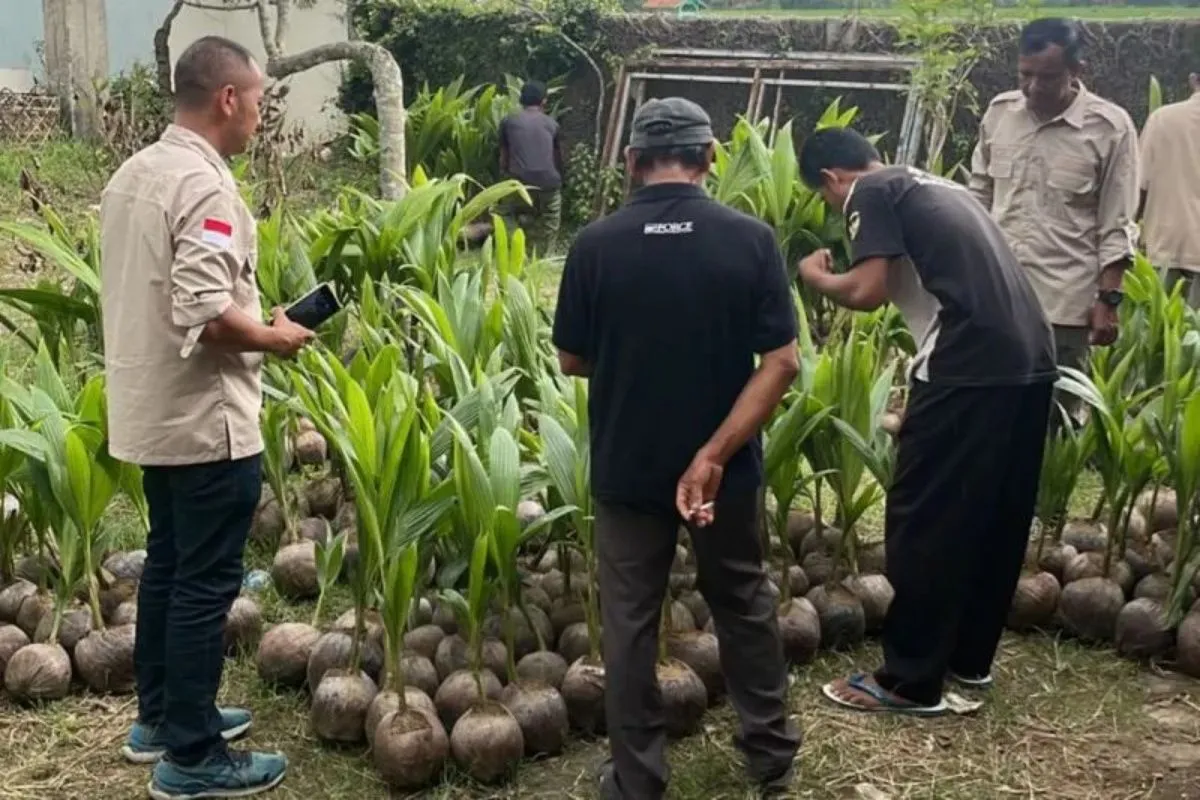
Recognized as the national powerhouse of coconut sugar for decades, Banyumas has now set its sights on a major transformation of its agricultural sector from upstream to downstream, betting primarily on initiatives to revitalize generic and dwarf coconuts, strengthen the industry, and improve the welfare and protection of palm tappers.
According to Banyumas District Head Sadewo Tri Lastiono, this ambition didn’t emerge overnight; it was conceived during his tenure as deputy district head from 2018 to 2023.
With Lastiono stepping into leadership, the initiative has gradually taken shape in a more structured fashion.
“The business demand for granulated coconut sugar is huge. In fact, Indonesia supplies about 90 percent of the world’s needs, with 80 percent coming from the Greater Banyumas region,” he said, referring to Banyumas, Cilacap, Purbalingga, and Banjarnegara.
Lastiono stressed that the trend is too valuable an opportunity for Banyumas to miss.
Beyond its extensive volume of coconut production, the district considers the dream technically viable thanks to its mature, well-established network of tappers, entrepreneurs, and exporters.
The district head expressed confidence that strengthening Banyumas’ position in the global coconut sugar supply chain would deliver significant economic benefits for locals, especially those in rural areas.
Still, he admitted there are pressing challenges between the district and its ambition, most notably the persistent high risks faced by palm tappers, who often put their lives on the line conventionally climbing coconut trees more than 15 meters high twice a day.
Alarmed by monthly reports of tapper accidents, some of them fatal, the Banyumas government is now promoting a transition from generic coconuts to the dwarf variety, whose trees typically grow only two to three meters high, allowing for both safer and faster harvests.
A government analysis indicates that with the same working rhythm, tappers can collect larger amounts of sap from dwarf coconut trees, as the shorter height enables them to work on up to 100 trees a day, compared with a maximum of 25 using the generic variety.
This approach promises a fourfold boost in productivity, despite each dwarf tree containing less sap—a negligible downside, as the quality remains on par with the generic variety. The transition is part of the government’s 13 Flagship Programs (Trilas), crafted by Lastiono and his deputy, Dwi Asih Lintarti.
Harnessing the district’s dwarf coconut potential reflects Trilas No. 4 on developing business centers and young farmers in all sub-districts, Trilas No. 6 on poverty alleviation, and Trilas No. 9, which focuses on achieving food self-sufficiency to enhance farmers’ welfare and aligns with President Prabowo Subianto’s broader national food security agenda.
Under this initiative, the district government aims to modernize the agricultural sector in pursuit of greater safety, productivity, and rural economic growth, while also setting the stage for young farmers.
To this end, the government has prepared at least 625 hectares of land, with each hectare designated for planting approximately 125 dwarf coconut seedlings.
Aware of the district’s limited fiscal capacity, Lastiono chose to avoid overburdening the official budget, instead pursuing partnerships with ministries in Jakarta and both domestic and foreign private companies.
Through this approach, the Banyumas leader secured support from an international partner that pledged to supply the district with tens of thousands of dwarf coconut seedlings under a corporate social responsibility framework.
The government’s aspiration for Banyumas has also been welcomed by domestic industrial players. Managing Director of PT Integral Mulia Cipta, Mario Ngensowidjaja, said his company’s 14 years of operation in Banyumas proves that the district lives up to its reputation as the national powerhouse of coconut sugar.
He expressed support for the transition to dwarf coconuts, citing concerns over the apparent lack of interest among young people in pursuing careers in the coconut industry, a challenge of regeneration he partly attributed to the high risks of climbing generic coconut trees.
Dominik Schwab, a project manager at Germany’s development agency Deutsche Gesellschaft für Internationale Zusammenarbeit (GIZ), stated that his team is ready to assist Banyumas in strengthening its coconut sugar supply chain while supporting environmental sustainability and farmers.
He noted that GIZ has devised a project that includes measures to advance the transition to dwarf coconuts, promote eco-friendly cultivation practices, develop agroforestry, and foster research collaboration with local and national universities in Indonesia.
Cushion for tappers
Beyond efforts to boost production and exports, the Banyumas government considers it equally crucial to enhance protection for palm tappers. District Head Lastiono has urged coconut sugar exporters to provide tappers with a safety net by registering them with state insurer BPJS Ketenagakerjaan, ensuring benefits in the event of work-related accidents.
This move reflects the government’s genuine care for the tappers, regarded as the district’s priceless assets.
Although official data show that Banyumas was home to nearly 22,000 palm tappers as of mid-2025, only 6,699 had been covered by BPJS Ketenagakerjaan. This gap has prompted the government to intensify efforts to protect them.
More than an economic agenda, the district government envisions the ongoing coconut sugar transformation program as a breakthrough opportunity to elevate the dignity and living standards of rural communities.
Banyumas has embarked on an arduous yet promising journey—driven by coconut revitalization, industrial development, international support, and social protection for tappers—toward maintaining its position as Indonesia’s coconut sugar backbone and emerging as a global hub for the valuable commodity.
Related news: Indonesia achieves self-sufficiency in 9 strategic food commodities
Related news: Indonesia pursues food industry downstreaming to boost added value
Editor: M Razi Rahman
Copyright © ANTARA 2026


