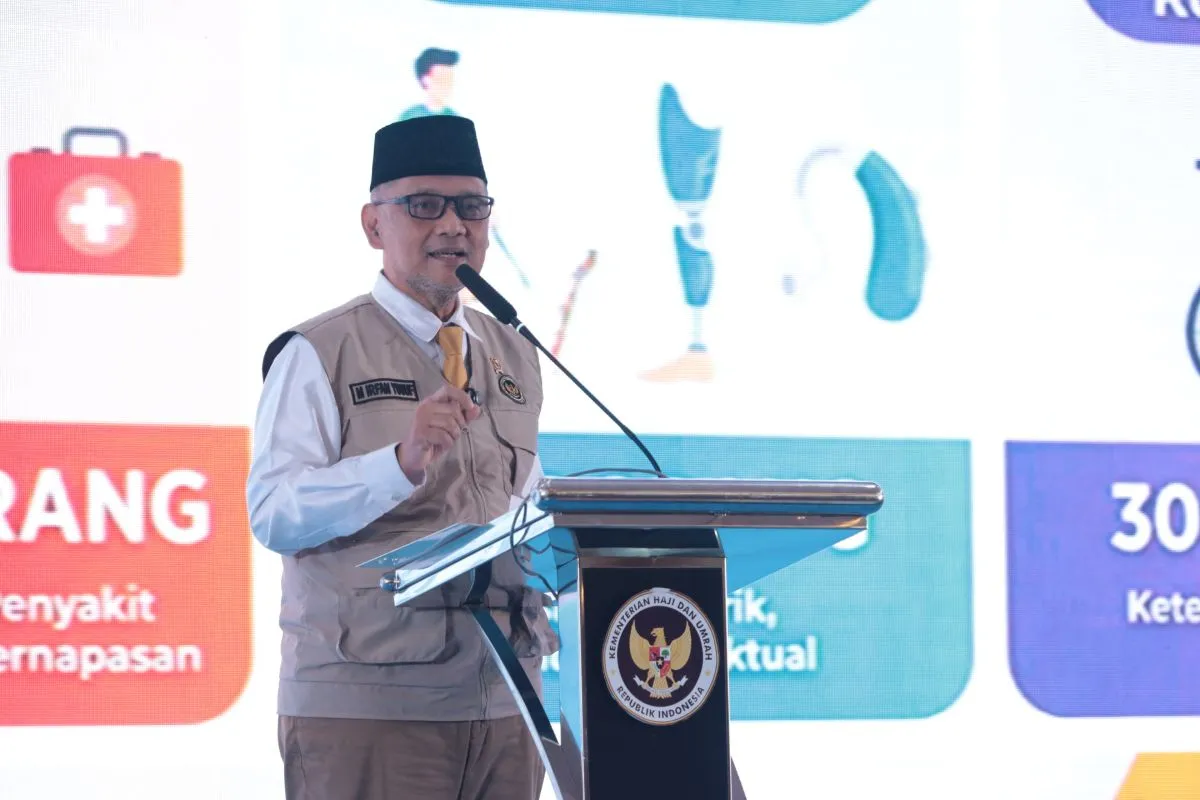
“The main principle in preparing these scenarios is to ensure the safety and security of Indonesian pilgrims as the highest priority,” Minister of Hajj and Umrah Mochamad Irfan Yusuf said during a working meeting with Commission VIII of the House of Representatives (DPR RI) in Jakarta on Wednesday.
In formulating policies for the Hajj during a crisis situation, the government is guided by several principles, including prioritizing the safety of pilgrims, exercising caution in decision-making, and maintaining close coordination with the Saudi Arabian government, the Ministry of Foreign Affairs, airlines, and international authorities.
Other considerations include preparedness in mitigating transportation and security risks, as well as ensuring transparency of information to the public and prospective pilgrims.
Irfan, also known as Gus Irfan, said the directive aligns with President Prabowo Subianto’s message emphasizing the importance of ensuring the safety of Indonesian Hajj pilgrims.
The first scenario allows the Hajj pilgrimage to proceed despite the conflict by mitigating risks in air travel routes. This would involve rerouting flights to safer corridors and conducting diplomatic efforts to secure safe passage for Indonesian pilgrims as non-combatants.
Air routes potentially to be avoided include airspace over Iraq, Syria, Iran, Israel, the United Arab Emirates, and Qatar.
As an alternative, flights could be rerouted through southern paths via the Indian Ocean and enter East African airspace or other safe routes in coordination with Saudi aviation authorities.
However, such rerouting could increase flight duration. For aircraft with limited range, airlines may need to conduct technical landings in third countries for refueling.
“The consequence is that it would likely increase aviation costs,” Irfan said.
The second scenario assumes that Saudi Arabia continues to allow the Hajj pilgrimage to take place, but Indonesia decides to postpone the departure of its pilgrims due to heightened global security risks.
In this case, the government would need to conduct diplomatic negotiations with Saudi Arabia to ensure that payments already made for accommodation, meals, transportation, and services in the Masyair area are not forfeited and can instead be carried over to the following year’s Hajj without penalties.
The Masyair service is a comprehensive operational service package provided by the Saudi Arabian government for Hajj pilgrims during the peak pilgrimage period in Armuzna (Arafah, Muzdalifah, and Mina) from 8 to 13 Dhu al-Hijjah.
The government is also preparing financial mitigation options for pilgrims, such as refunding the paid portion of the Hajj travel cost (Bipih) without removing their right to depart the following year, or maintaining the funds with higher returns as compensation.
The third scenario would occur if the Saudi government decides to suspend the Hajj pilgrimage due to an uncontrollable security situation.
Under such circumstances, the government would focus on safeguarding service funds that have already been paid and halt all service procurement processes, including accommodation, meals, transportation, and other services.
The government would also prioritize departure in the following Hajj season for pilgrims who have already paid their Hajj fees and were scheduled to depart this year.
“The Ministry of Hajj and Umrah will act as a risk navigator to ensure every decision is based on security intelligence data and the principle of protecting Indonesian citizens,” he said.
Related news: Saudi ensures safe Umrah pilgrimage amid regional tensions: RI govt
Related news: RI prepares anticipatory scenarios for Hajj amid Mideast tensions
Translator: Asep, Azis Kurmala
Editor: Primayanti
Copyright © ANTARA 2026


