The value of crypto asset transactions was recorded at Rp24.33 trillion (US$1.43 billion) in February 2026, lower than the Rp29.28 trillion (US$1.72 billion) recorded in January.
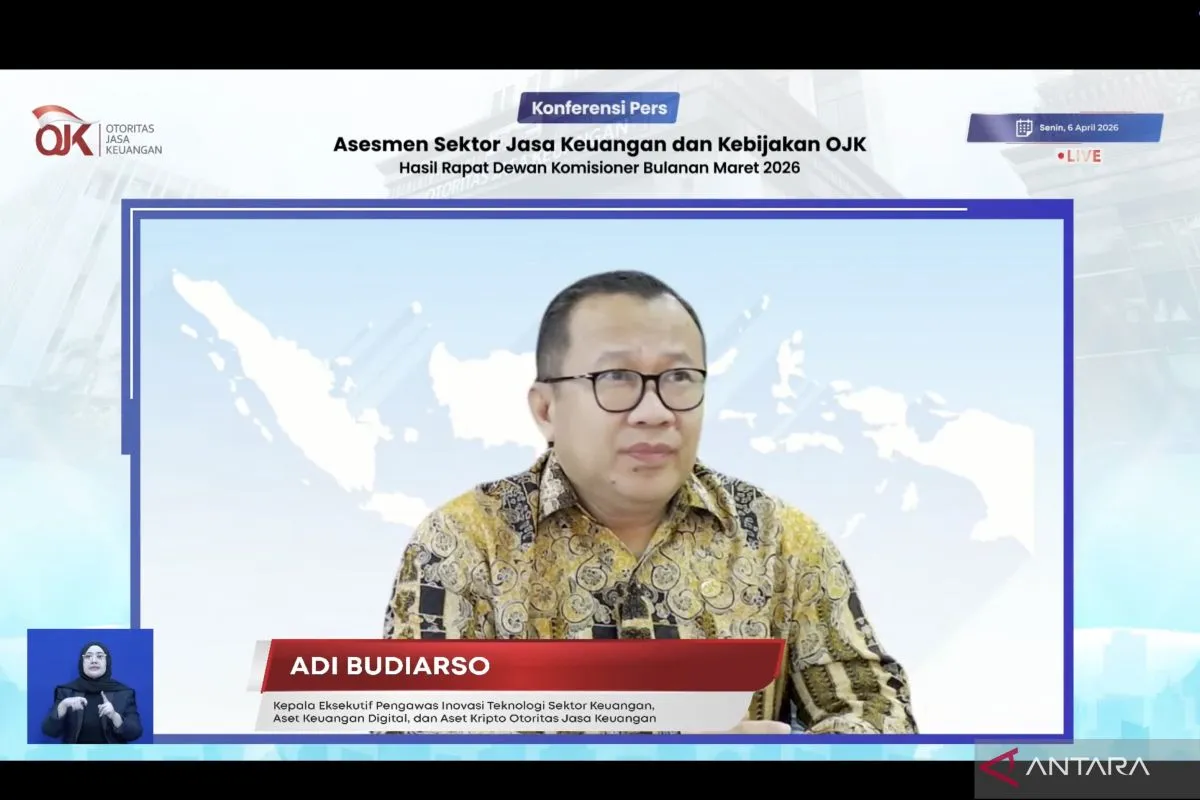
The slowdown was influenced particularly by the ongoing Middle East conflict, according to the authority’s chief executive for the supervision of financial sector technology innovation, digital financial assets, and crypto assets, Adi Budiarso.
"This is inseparable from global factors. Market cycles, where market sentiment is influenced by several events, particularly geopolitical turmoil, also impact decentralized financial platforms worldwide," he said here on Monday.
He explained that rising geopolitical tensions are driving risk-off sentiment in global financial markets. On the other hand, high-interest rate policies in the US also triggered large liquidations of leveraged positions in the crypto market, thus suppressing transaction volumes.
Furthermore, he stated that 2024 was a strong bull market phase. However, after reaching its peak, the crypto market entered a consolidation phase in 2025, marked by price corrections and declining transaction volumes.
Amidst these conditions, OJK will continue to strengthen the development of the crypto ecosystem through more structural measures, including the governance among exchanges, clearinghouses, custodians, as well as crypto asset traders to protect consumer interests.
Regulatory-wise, the OJK, along with the government, Bank Indonesia (BI), the Deposit Insurance Corporation (LPS), and relevant authorities, has also adopted the principle of "same activity, same risk, same regulation" to align with international practices.
To strengthen oversight, the OJK is reinforcing law enforcement against illegal practices, in collaboration with the Illegal Financial Activities Eradication Task Force (Satgas PASTI) and the Indonesia Anti-Scam Center.
In terms of policy, OJK issued a regulation and circular letter concerning the implementation of digital financial asset trading, including crypto assets.
This strengthening of governance includes the affirmation that providers must own, dominate, and control the systems used for trading and transaction storage.
The OJK is also considering drafting regulations related to primary market offering activities in the domestic crypto asset ecosystem. Currently, the OJK only regulates secondary market trading activities within the crypto asset ecosystem.
"Hopefully, with comprehensive regulations, it will encourage the emergence of domestic business actors operating in the crypto asset sector and increase interest and provide more diverse options to domestic investors, where currently traded crypto assets are dominated by global crypto assets," Budiarso explained.
For the record, the number of digital financial asset and crypto asset consumers in Indonesia reached 21.07 million as of February 2026, representing a 1.76 percent increase.
Meanwhile, the value of digital financial asset derivative transactions was recorded at Rp5.07 trillion (US$297.87 million), down from Rp8.01 trillion (US$470.6 million) in January.
Related news: Indonesia's crypto sector could create 1.2 million jobs - study
Related news: Preserving Indonesia's crypto edge amid global shocks
Translator: Imamatul Silfia, Yashinta Difa
Editor: Azis Kurmala
Copyright © ANTARA 2026


