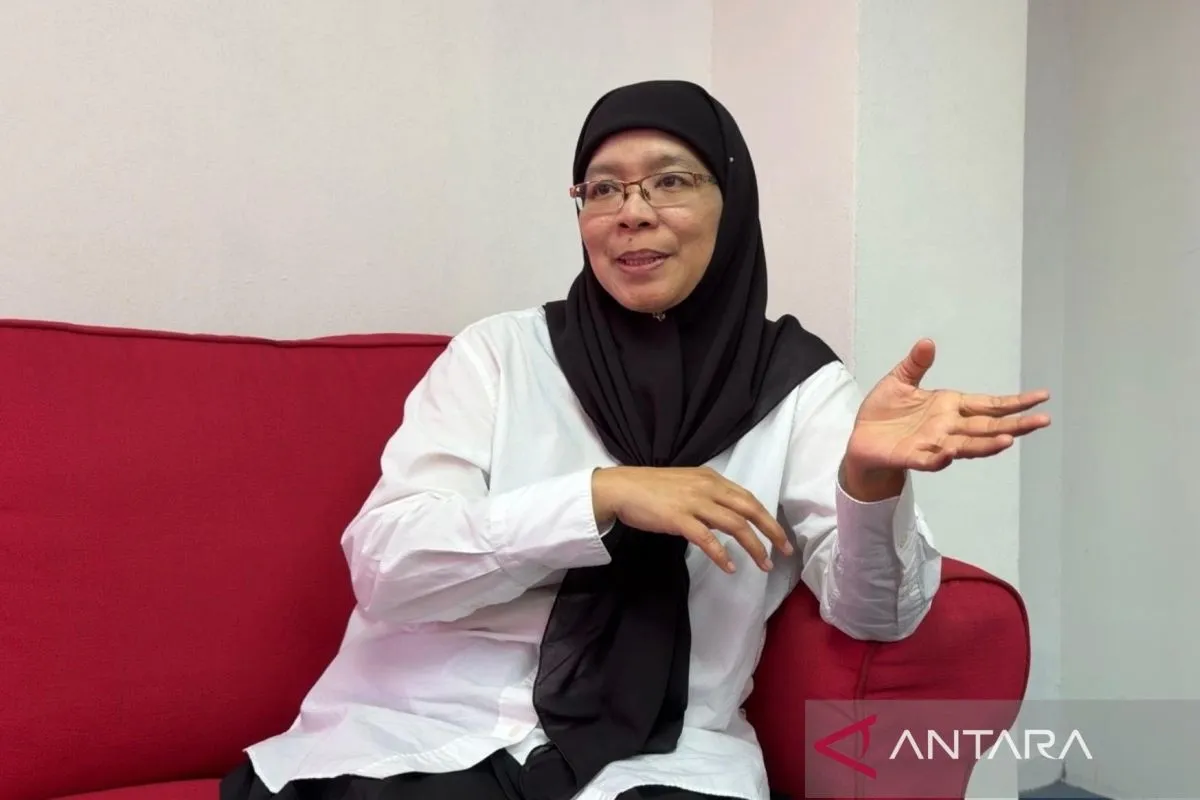
Kartika’s dedication to teaching diaspora children is reminiscent of national heroine Raden Ajeng Kartini, as reflected in the biographical analysis book on RA Kartini written by renowned author Pramoedya Ananta Toer, titled “Just Call Me Kartini”.
In his book, Toer portrays Kartini not merely as a symbol of emancipation but also as a fighter for the right to education.
Kartika, in her devotion as a “Kartini without a service medal title”, teaches Indonesian children abroad, facing various risks and limitations.
Kartika was born in Yogyakarta on September 25, 1971. The spirit of an educator runs strongly in her family. She is the eldest of four siblings, born to parents who were both teachers.
This environment shaped her from an early age. The world of education was deeply embedded in her daily life, and when she pursued higher education, she chose English language education at the Institute of Teacher Training and Education (IKIP) Yogyakarta.
During her college years, she was already active in teaching. Since her third semester, she ran English courses for children around her neighborhood, ranging from neighbors’ children to the children of pedicab drivers.
She recalled that some of her students could not afford to pay tuition fees. Instead, they gave her three pieces of fried bananas. A simple form of payment that deeply touched her heart.
In her seventh semester, she completed teaching practice at State Junior High School 2 and Berbudi Senior High School in Yogyakarta.
Becoming SIKL teacher
Several members of her family had already been working at SIKL. Her family contacted her, offering an opportunity to meet a Malaysian man of Indonesian descent, hoping it might lead to marriage.
“The marriage was arranged. Thinking about it, I felt like Kartini, whose (marriage) was also arranged,” she said with a giggle.
The marriage has now been blessed with four children, including twins.
Around the same time, another opportunity emerged: SIKL needed teachers. She applied through the Indonesian Embassy in Kuala Lumpur and was accepted as an English teacher.
“If I remember correctly, I graduated in August 1996, got married in October, and by November I was already working at SIKL,” she said.
It was at this early phase that her sensitivity and concern were truly tested.
She was suddenly faced with a new reality, the lives of diaspora children with all their complexities. The world she encountered was not always orderly but filled with administrative problems, family dynamics, and uncertain statuses.
For her, SIKL, established in 1969, was like a miniature Indonesia. Children from various ethnic groups and backgrounds gathered there, each carrying their own stories.
She saw firsthand how complicated her students’ conditions were. Some struggled with documentation issues, while others were affected by family problems. “Very complicated,” she said.
She also recalled an important phase, when the school, originally intended for children of diplomats and expatriates, gradually had to open its doors to migrant children without legal documents.
Before many community learning centers existed, education for these children was conducted through outreach, where teachers visited their homes.
“We had to search for undocumented children even in remote areas to provide lessons, Package A, B, and C education,” she recalled.
This effort was not without risk. If discovered by local authorities, she and fellow teachers could have been arrested for being seen as sheltering undocumented individuals.
However, that was in the past. She is grateful that today the Indonesian government, through its representative offices, has facilitated the education of Indonesian migrant workers’ children through Sanggar Bimbingan or community learning centers.
The goal is to facilitate their return to Indonesia through repatriation programs with affirmative secondary education scholarships.
In this regard, the Indonesian government seeks to break the cycle of illiteracy and reduce the number of undocumented Indonesians in Malaysia.
Breast cancer diagnosis
In September 2023, amid her busy teaching schedule, she received devastating news. She was diagnosed with breast cancer.
Previously, with family support, a lump she had long felt was finally examined at a hospital. The result showed breast cancer, close to stage three.
“At that time I was confused. The lump was 4 centimeters in diameter and almost stage 3,” she said.
She then requested permission from the school principal to undergo chemotherapy for several months. Each treatment often required her to be absent from teaching for about a week due to her weakened condition.
“After each chemotherapy session, I could not come to school for a week because I really could not get out of bed, but in the second week I forced myself to return, wearing a mask because I had to take care of my condition,” she explained.
For her, teaching became a form of “medicine” in itself.
Meeting her students made her feel alive again, far better than staying at home. At school, she also received full support from fellow teachers.
She recalled a moment when a Grade 11 student jokingly asked, “Ma’am, why do you always wear a mask? Do you have COVID?”
There were also moments when students always asked about her health: “Are you okay, Ma’am? Are you healthy?” and invited her to take selfies.
“Maybe they thought I wouldn’t live long, so they took photos with me, but I was happy. The students were caring and understood my illness,” she said.
For her, cancer may test the body, but it has not broken her spirit to continue working with fellow teachers at SIKL in fulfilling the right of Indonesian children in Kuala Lumpur to education.
“So I want to keep teaching, leaving behind good memories. I don’t want to just stay at home, lying in bed, doing nothing. I want to keep teaching,” she said.
Like Kartini, whose spirit lives on through her letters, Dewi Kartikaningrat continues to be a light through the knowledge she shares with love for Indonesian diaspora children.
Related news: Gov't urges collaboration to cut maternal death to pursue 2045 target
Related news: Women must speak out against violence: Puan on Kartini Day
Editor: Rahmad Nasution
Copyright © ANTARA 2026


