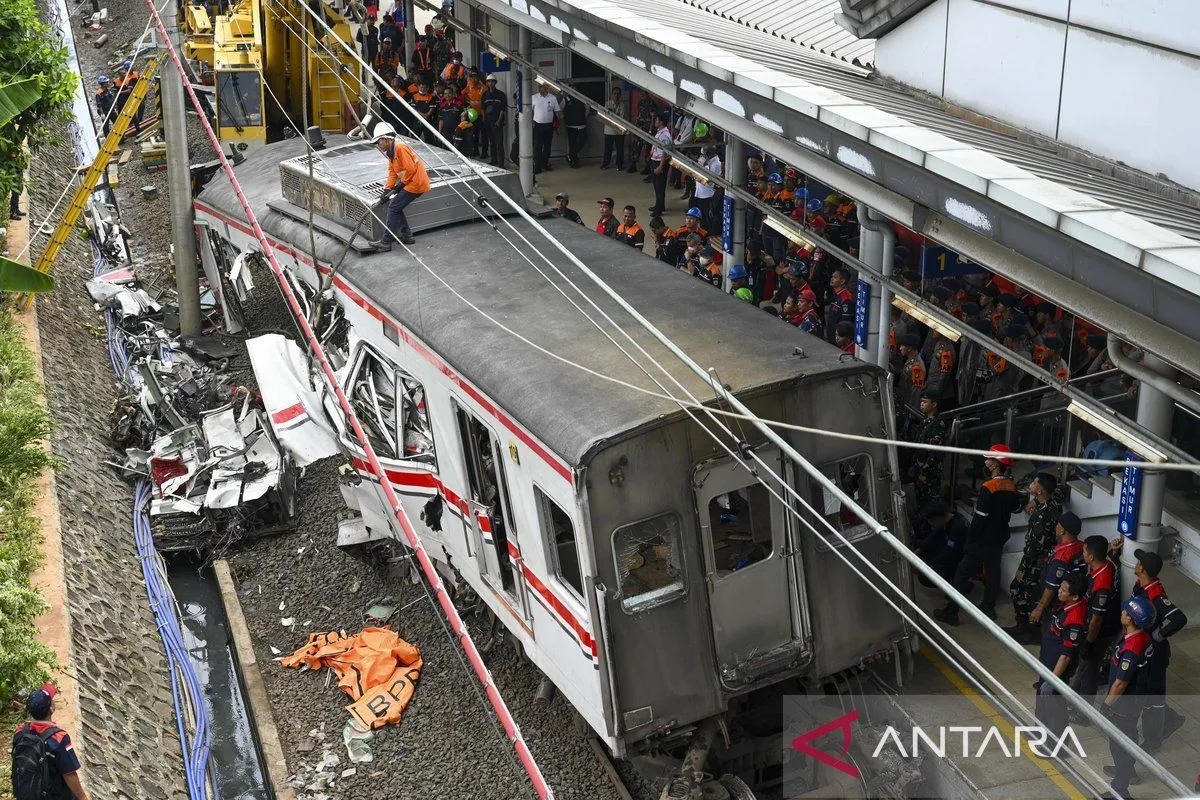
..we need to research how to neutralize these fields around tracks so they do not disrupt passing cars,Jakarta (ANTARA) - Indonesia's National Research and Innovation Agency (BRIN) is accelerating studies into composite rubber rail sleepers and magnetic interference to bolster railway safety, following a devastating train collision in Bekasi that claimed at least 14 lives.
The research initiative serves as a direct technical response to Monday’s tragic accident at East Bekasi Station, where an Argo Bromo Anggrek express train collided with a commuter line (KRL) carriage, BRIN Vice Head Amarulla Octavian said here on Tuesday.
Beyond the immediate human toll—which includes 84 injuries—the disaster has highlighted urgent infrastructure vulnerabilities.
Octavian confirmed that the agency is prioritizing "composite rubber-based rail sleepers to improve the safety and service life of railway infrastructure" while developing automated protection systems that integrate directly with train operations. A significant portion of the investigation focuses on the invisible forces at play during a crossing.
Octavian noted that the massive electrical systems within locomotives generate intense magnetic fields that may interfere with nearby traffic, particularly modern electric vehicles.
"The magnetic field is conducted along the train; we need to research how to neutralize these fields around tracks so they do not disrupt passing cars," he explained.
The collision on Monday evening has caused significant disruptions to the Jakarta metropolitan transit network.
State railway operator PT Kereta Api Indonesia (KAI) confirmed that while some tracks have reopened, services at Bekasi Timur remain limited.
Commuter services are currently terminating at Bekasi Station and bypassing the crash site, while emergency and information command posts have also been established to assist families in identifying victims.
KAI has pledged to cover all medical and funeral expenses for those affected as the National Transportation Safety Committee (KNKT) begins evaluating whether the incident stemmed from human error, technical failure, or signaling issues.
The Indonesian Ministry of Transportation earlier reported that the disaster began when a car stalled on a level crossing, forcing a commuter train (KRL) to stop for evacuation. This created a backlog, leaving a second commuter train stationary at East Bekasi Station, where it was subsequently struck from behind by the Jakarta-Surabaya Argo Bromo Anggrek express.
Related news: Indonesian parliament calls for probe into Bekasi train collision
Related news: Bekasi train crash: Death toll rises to 14 as rescue efforts continue
Related news: Minister pledges trauma recovery support for train collision victims
Translator: Lintang Budiyanti Prameswari, Aditya Eko Sigit Wic
Editor: M Razi Rahman
Copyright © ANTARA 2026


